Showing posts with label COL INQUIRY 2024. Show all posts

Wednesday, 14 August 2024

Reading strategies and frameworks with Marc Milford

Our literacy expert Marc Milford shared a literacy framework that he had researched as one that could potentially support our learners in their journey to become better readers.  Green Bay High School had been identified by the Ministry as a school that had effective practices that got kids ready for CAA and had supportive teacher practices that caused shifts in their practice (link here for the Green Bay High example).

They seemed really on to it and the Science of Learning and Reading has been embedded in their school like our RISE values are at our school.

One of the strategies that students have identified as helping them was called 'a literacy system' that has been embedded across the school.  Below is one of their posters and also a copy of Marc's notes that he has shared with staff.

NCEA Common Assessment Tasks 


Green Bay High School’s structured literacy approach


Key Points:

  • the Green Bay example is looking for teacher consistency in conveying reading skills.


  • Students ask, how do I approach a text, what do I do next.


  • Teachers asked, how can our strategies be inclusive of all students


  • how can our approach be informed by the science of learning and the science of 

reading

  • how can we engage in deliberate acts of reading instruction


What I want to do is use a few of the interventions as strategies to support my year 9 learners.


Saturday, 29 June 2024

COL Inquiry #6: Academic/professional reading and hypothesis

Find 3 Pieces of academic/professional reading. Explain how they and other sources helped you form hypotheses about aspects of teaching that might contribute to current patterns of learning.

Reading ONE: The Reading apprenticeship
The  Reading Practice Intensive (R.P.I) is a programme that was being run in terms 2 and 3 for those staff who were interested in the support to meet the demands and changes to new policy mandates, which they had built into the Year 7-10 RPI design.  The aims of the programme were to:
Building readiness for the reading and writing co-requisite unit standards and the common literacy assessment activities; dText set approaches to teaching reading strategies, skills and dispositions to support deep learning and ākonga literacy improvement;
A shared ‘pillars of reading’ framework that can be used to scale practices across teams and departments, in line with cross curricula (Te Mātaiaho), cross-subject and Common Practice Model approaches;
Draws on research based practices from Reading Apprenticeship in the secondary subject disciples and Secondary Literacy: A Teacher Handbook.
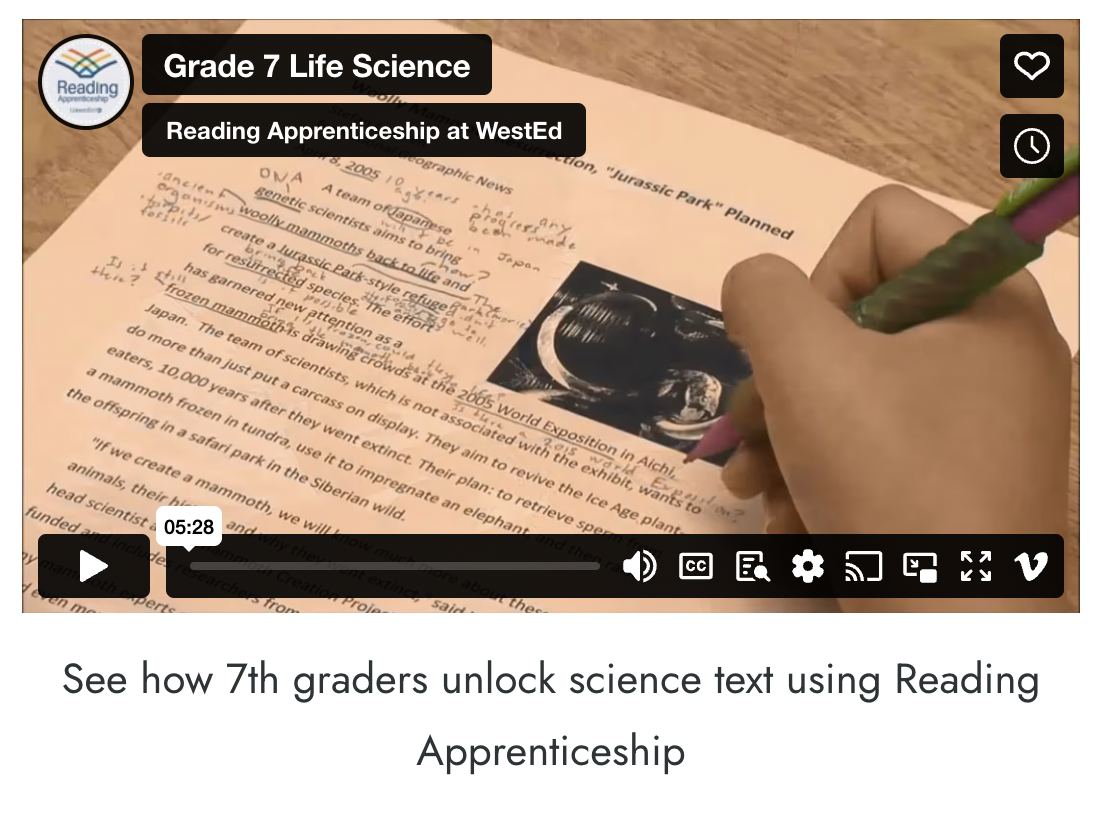
I clicked on Reading Apprenticeship and watched a video showing a Science teacher teaching and reading aloud supporting the students with a text.


Teacher modelling to the class:
I noticed that this is exactly what I do with my students but I see we could spend more time asking the questions.  One of the techniques was breaking down the title of the article.  The teacher models breaking down the title then asks the questions and writes it around the article.   Then she asked the students if there was anything they missed and to add to it.
Individual tasks:
Student then practiced on their own the same technique.
Group:  Then students got into groups and discussed the text together.
Class:  Students reported the questions/queries back to teacher as a whole class.  Teacher repeated the question back to the students and a shared understanding of the text was gathered.
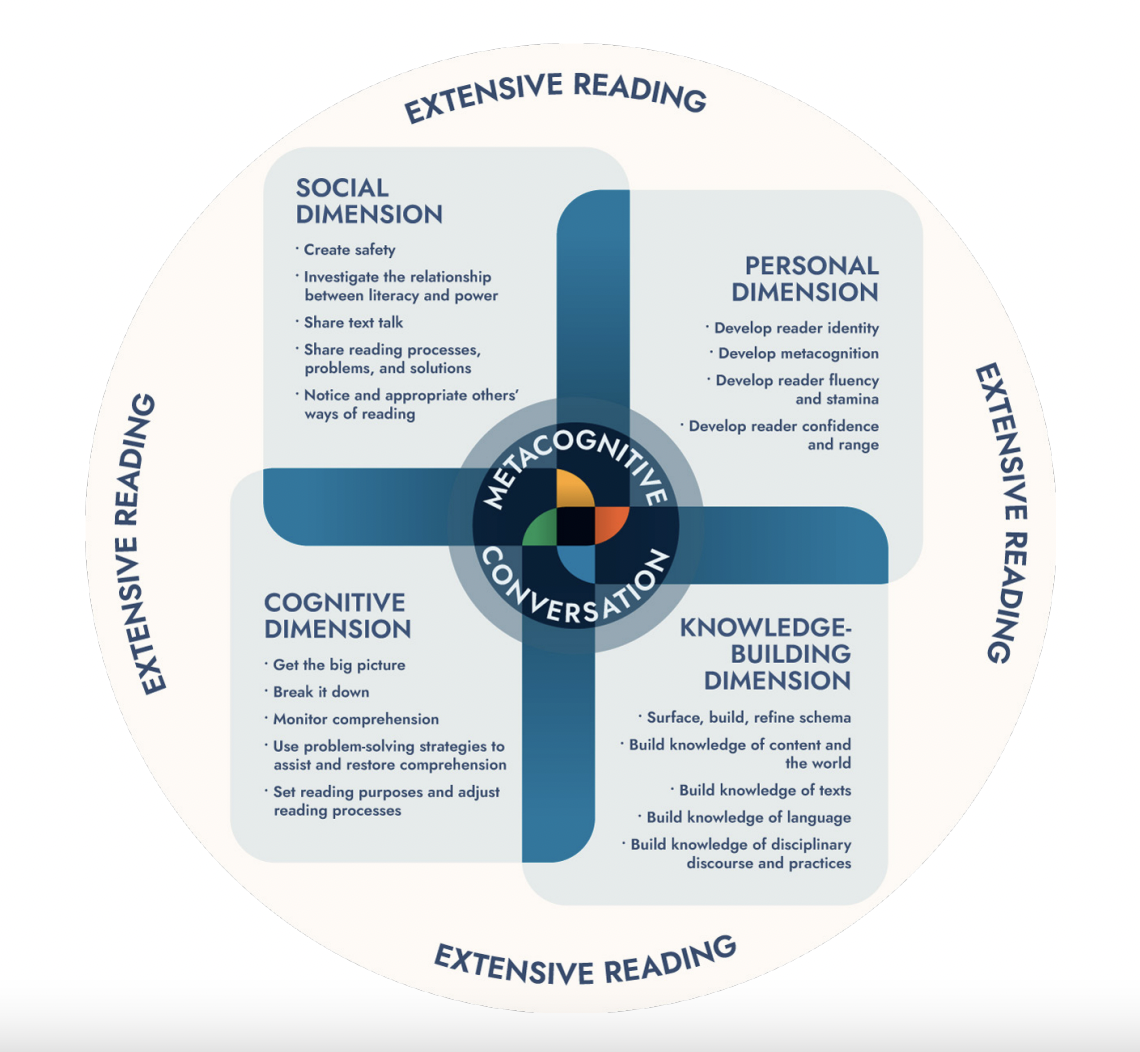
The approach looks at 4 key dimensions below:

What Does a Reading Apprenticeship Classroom Look Like?  This I read through this document outlining some basics.  Here are some (mainly Science) curriculum specific units and I liked the History one. 
I found heaps of good accessible resources on this site and I am interested in learning more about rubric’s like this one; Rubric-for-Student-Self-Assessment-of-Collaborative-Work.pdf

Reading TWO:  Nicola Wells CoL Teacher Report 2019 - Discussion Points, Conclusions and Suggestions
In 2019, Nicola Wells who was an across school COL teachers wrote a comprehensive report on her inquiry called 'Accelerated reading comprehension in students arriving at Tamaki College from Manaiakalani cluster Primary schools'.
Some of her key findings that I found interesting were:

Reading mileage - suggestion

To improve reading comprehension I propose that reading mileage - time spent actively reading a wide range of texts for a range of reasons, engaging in repeated reading of the same text, or engaging in supplementary comprehension strategies - should be increased. 

In the Secondary school additional reading mileage could be implemented during one of the single, 50-minute periods for many of the core subjects such as Science, Social Studies, Health and History, as it already is in English. Question generation and comprehension could be tailored to suit reading comprehension in each subject. For example, reading in History and Social Studies would suit the Questioning the Author package/routine while question generation targeting fact recognition and reliability would suit Science. 
Summarisation is supported as a reading comprehension strategy by multiple studies. Sencibaugh (2005) reported that some auditory/language-dependent strategies had a great impact on reading comprehension for students with reading disabilities, including ‘paragraph restatement’ and ‘summarisation.’

Reading THREE: Understanding the Science of Reading in the 'Reading League' (notes here)

How these readings helped me to form a hypothesis.

My hunch at the start of the year was that my learners were struggled to read because they were in the right learning environment and this has distracted them from their learning. Our students arrive at our school well below the national norm and this leads to a lack in engagement and motivation to engage in learning about reading.

From these readings, it is clear that the science of reading and structured literacy is an important approach to achieving success.  A key factor to succeed in Senior Social Sciences is the ability to critically think and comprehensively describe and understand key concepts and unpacking meaning of language is important.  Teacher modelling and reading mileage is another way to improve reading comprehension.

My biggest takeaway being the amount of time I need to spend focusing on modelling the understanding of key words through phonetic sounding out of words, something which I have done in the past, but can work if used in more frequency.  Developing and utilising a simple framework that would deepen their understanding of the text their reading is another area I want to explore further.


Sunday, 16 June 2024

COL Inquiry #5: Summarise your key findings

1. Summarise your key findings about the nature and extent of the student problem

After gathering data from PAT results, discussing how to identify struggling readers with a literacy expert and gathering student voice as well as my own observations, I have summarised some key findings to the nature and extent of the student problem.

  • Most students want to read but there are some barriers which push it to the background, like trying to get used to new classmates, new systems, new ways of teaching.
  • The Science of reading needs to be explored better through structured literacy so that kids who are feeling forced to read and don't understand the mechanics and the why of reading.
  • Boys would rather play sport then sit and read.
  • Regular reading needs to be a learnt habit.
  • Reading in short bursts works best because kids become distracted.
In summary, my hunch is that my year 9's are still transitioning and moving into specialist curriculum areas that all have different approaches to reading is a struggle.  They tell me that time constraints may not allow them time they want to process information, even though we had moved to one hour periods.  

I need the students to be critical thinkers which is an important social science skill to have and this needs to be built through understanding the why of reading better. Unfortunately, the reality for the majority of my year 9 kids right now is that they struggle to get one task completed during our class time.  This is leading to a lack of engagement by the less able students and a lack of motivation by the more able.  By making things like their PAT tests more transparent and understandable, students may be more likely to feel invested in their learning.

2. Explain how some of the data you have used to build a profile of the students’ learning will be used as baseline data at the end of the year.

The data I will look at will be PAT reading results to compare test 1 to test 2 as well as mid-term exams.


Thursday, 13 June 2024

COL Inquiry #4C: Discussions to identify our struggling readers with Marc Milford

One of the key ways to understand the challenge of reading for our juniors is to see how departments across our school are unpacking the problem to help solve it.  I sat with Marc to talk about one of the main challenges around reading in his many hours of trying to understand our learners needs.  Here are the notes I took from our meeting. 


Tuesday, 21 May 2024

COL Inquiry #4B: Collecting student voice and focus groups


Today I conducted a survey with my year 9's and asked them a few questions about reading.

The 1st question I asked was 'Do you like reading'.  Here are the results for the 18 students who completed the survey.


When asked why, the answers varied slightly so I categorised them into similar areas before graphing them

  • A: Enjoyment: Students find reading relaxing or enjoyable.
  • B: Learning/Improvement: Students talk about reading for learning, getting better at reading, or improving vocabulary.
  • C:  Interest in Topics: Students only like reading specific topics or subjects.
  • D:  Good for You/Important: Students think reading is beneficial or important.
  • E:  Mixed Feelings: Students show a mixed response (e.g., liking reading sometimes but not always)
  • F:  They Dislike reading: Students express a dislike for reading or mention negative aspects (e.g., reading is boring, gives them a headache).
The rest of the results are on this powerpoint.  It will help me design appropriate strategies to hopefully support my learners to be better readers.


Aside from collecting student voice data from the class, I also sat with a select group of students (2 boys and 2 girls) and to help elaborate further some of answers they provided.

The 3 main questions I asked were:
  • Do you like to read? If yes why, if no why not?
  • What are the positives and negatives of reading?
  • What are some things you did at your old school to help you read?
There response were what I'd expected and I will use what they have said when planning my hypothesis.

Friday, 10 May 2024

COL Inquiry #4A: Understanding PAT (T.M.A)

As part of our school and department goals, with a key focus on literacy and numeracy.  In our department we want to support a positive shift for students in their PAT and asttle tests linked to our school goal number 3.  


Earlier this year, our PAT expert Mele Suipi-Latu provided an in-depth all staff PLD around understanding PAT and how we can utilise the data to build effective programmes for our learners.

What was interesting to me were the text types Explanation and Persuasive and how in senior Social Studies, students had to understand different perspectives and points of view.  Students had to understand a persons/groups perspective through the words their spoke and the actions they took.


I will be looking at profiling my year 9 classes further to see what the learning needs are in the class.


Tuesday, 30 April 2024

COL Inquiry #4: Building an accurate profile of students' learning - Tools, Measures and Approaches (T.M.A)

COL Inquiry #4:  Building an accurate profile of students' learning - tools, measures and approaches.

Describe the tools/measures/approaches you plan to use to get a more detailed and accurate profile of students’ learning in relation to that challenge. Justify why you chose these approaches and tools.

My challenge is to create a learning environment that would encourage our students to be readers to feel comfortable to read and to approach reading with confidence.  I feel that by doing this it will help my learners to make shifts in their reading so that they will be able to engaged in their learning.  In our lessons students are have to read and respond to questions and this is an important skill to have if they want to succeed in Social Studies.  I know that students might not be interested in learning about the news but if I make it a cool thing, hopefully they will be able to appreciate the value of knowing what's going on around them better.


PAT and diagnostic test results in reading

I am using PAT data from year 9 year as utilising mid-term and end of term exam results in the Current Events skills section


Reading Frameworks and strategies

These diagrams show the overall ethnic breakdown of my year 9 class.


Expert Support

I will be using the help of our PAT guru Mele Suipi-Latu and our literacy expert Marc Milford to help identify key gaps in the learning for our students and key strategies in my teaching approach to support achievement.


Student voice

I will use student voice, both formally in the form of google forms as well as have in-depth discussions about reading.

Saturday, 16 March 2024

COL Inquiry #3: Schools profile and designed change in student learning

  1. From what you know already about your classes and your school’s profile and leadership goals for the year, share a possible inquiry focus.
  2. Frame your focus as a desired change in student learning NOT a change in teaching (as yet!)

From what I know about my level 9 class, they are a class of diverse needs and abilities.  We have a core group of students have scored well in their reading levels with the majority sitting at levels 2 and 3.  I can tell I would need to motivate the boys more, particularly one or two of my Maori boys and that would need an engaging programme that is essentially differentiated.   


Our school goal number 3 focuses on improving literacy for different groups of students so that would support my inquiry focus so I am hoping to look at improving reading skills and opportunities in my year 9 class as a focus as it will benefit them in their learning more.


A designed change I hope to see is a desire for my students to want to read widely and deeply texts are interesting and engaging in a hope that they will gain better results in their PAT tests at the end of the year.


Saturday, 9 March 2024

COL Inquiry #2: Collaborate with school leaders and colleagues

Collaborate with your school’s leadership team and colleagues to identify areas where your inquiry will make a powerful contribution to wider school and cluster goals.

Today we met with our Principal, Deputy Principal in charge of Curriculum and our other COL leaders to discuss what our inquiries may be based on this year. I shared my possible inquiry and talked extensively about the links to our school wide goal on raising achievement and cultural visibility for our Māori students. I shared the fact that working with the Level Up team and literacy experts would help not just my inquiry but should support staff who are find supporting their learners in read difficult. I also shared the need for us to delve into Dr Russell Bishops writing of 'Teaching to the North East' as a support guide for our staff.

My presentation was received well my our leaders who offered support and advice for my inquiry. They felt is was important to support the literacy needs of our students and could offer PLD for our staff.

Here is my presentation:


Saturday, 2 March 2024

COL Inquiry #1: Summarising, describe and explain the challenge of student learning

Question #1: Summarise the challenge of student learning you plan to focus on in this inquiry.

The challenge of student learning the I plan to focus on is around supporting my year 9 students to read.  I am thinking about my Māori students as a particular group to focus on.  A number of reasons for this are:
  • My focus has always been writing but I’ve learnt that kids can’t write if they can’t read
  • I have a new year 9 class with mixed abilities and ethnicities and I enjoy hearing their stories and where they’ve come from.
  • Reading is a key focus for our cluster.  
  • Our students arrive at our school well below the national norm.

Question #2: Describe how and why you have selected this challenge of student learning. Locate your inquiry in the context of patterns of student learning in Manaiakalani overall.

  • A key factor to succeed in Senior Social Sciences is the ability to critically think and comprehensively describe and understand key concepts.
  • In our recent cluster wide discussions, a number of groups are tracking well in reading but at our school, there is more work needed to be done with our juniors.

Question #3: Explain why you judge this to be the most important and catalytic issue of learning for this group of learners this year.

  • This year I teach two year 9 classes and have compared their term 1 PAT schools. One class has a number of students sitting at stanine 8 where as the other one has a number of students at below 3. I can see in the students' behaviour and engagement the impact of not have literacy (or numeracy) skills could impact on their learning. I believe it is important look at strategies which could support the wide spectrum of learners in each class as well as accelerate who are below the national norm.


Saturday, 27 January 2024

Level Up! A Tāmaki College literacy and numeracy initiative

As part of an initiative to drive Literacy and Numeracy at Tamaki College, a group of HOLA's (Heads of Learning) banded together to look at ways to address the challenges.  In year 10 we started by offering level 1 credits before they expired which helped to put our kids on the board.  It was a successful programme which led to 95 of the 120 students achieving at least10 credits in literacy and 103 achieving at least 10 in numeracy.

We wanted to continue that moment into 2024 so formed a committee.  Recently we presented at our staff teacher only day to share insights into the initiative, ways to support staff and future goals we have moving forward.  

A key focus for term 1 in the junior school is reading.  At our presentation we discussed two key aspects we wanted to address in term 1:  PAT data and how to understand it.  There are two people at Tamaki who have excellent insight into what the data tells us and how we can use it and they are Marc Milford our literacy expert and Mele Suipi Latu who has a masters degree focussed on literacy and currently works with our ESOL learners.  We enlisted the help of these experts to show support for our staff.  Here is the presentation that we led, along which has accessible links on the presentation.


Intervention COL inquiry #7A: Using the SQ3R Model

 In our learning, we used the SQ3R model to help guide students through their reading.  I have taught the specific model before and today I ...