Showing posts with label COL's inquiry. Show all posts

Monday, 10 May 2021

Inquiry Question #4: Collecting evidence and data

Begin to collect evidence and data and come to the next session ready to share your preliminary findings about the nature and extent of the student challenge i.e. using your baseline student data and evidence.


Most of my year 12’s have taken Social Studies again this year in year 13 so I used their student voice from the end of last year to identify what suggestions they had in how I as their teacher could help them better.


I have started to think about the staff resources we have in the school to help understand the issue better.


I have spoken to other staff members in my department who teach the same students what they believe the challenges are


I have used a tracking sheet to track progress in their attendance to class and task completion in their assessments. 

Sunday, 2 May 2021

Inquiry Question #3: Building an accurate student profile

 Inquiry task #3: 


My task is to describe the tools/measures/approaches I plan to use to get a more detailed and accurate profile of students’ learning in relation to that challenge.  I will also try to justify why I chose these approaches and tools.

My level 3 class is very mixed ability in the academic and cultural sense. The majority are of Pasifika descent and there is still a mix among these young people with regards to which how Pacific they are.  

Here is the link to my diagram showing what I will use (thanks to Karen Ferguson for the model)


Saturday, 14 March 2020

9AK #4: Studio ONE: A day to reconnect with student projects

On the 11th of March, our 9AK class spent the day working on the first of their planning and presenting days for the term.  We called this day 'Studio #ONE'.  The purpose of the day was as follows:
  • Reconnect as a whole to the purpose, direction and emergence of Akomanga Kaihanga 
  • Provide space for and support for teams to help them work well together
  • Review data and progress prototypes
  • Receive feedback and take prototypes to next stage from guests and community
  • Plan and set up the next sprint success
  • Teams leaved excited, resourced, motivated, and clear 
The space provided a good opportunity for students to work on their projects and to prepare to present to an audience after lunch.  Karl started the day with a reminder on where they were at and what they needed to do get to.  For an hour students had to plan for their presentations, figure out who was doing what job and practice standing at the front sharing their projects.


After morning tea, the boys had the chance to bond with each other by waking to the top of Mt Wellington whilst the girls visited a number of places around Panmure.  Although I really wanted to run to the top of Mt Wellington with the boys, I reluctantly stayed with the girls and the first place we visited was the Peace Experiment Montessori Education School across the road from the library.  We met with the principal Steven Arnold who kindly showed us around the school.  The girls were amazed with the freedom the students had, who could choose what they wanted to learn and when they wanted to learn it.

The next place we visited was the Maungakiekie-Tamaki Local Board office.  Here were we treated to a tour by the lovely receptionists and the girls enjoyed being in the boardroom and having a chance to debate Covid-19 (please see the video below for part of the debate).  

The boys rejoined the girls to meet at the Panmure Community Hall, where we were greeted by the Hall Manager Boaz Moala, who gave us an opportunity to explore the Hall and imagine redesigning the space.  We were lucky to have the chance to see the hall in it's entirety, even the small rooms that had been locked away for years. 
This is the just-before-lunch-I'm-hungry look.
After being treated to a delicious lunch supplied by Josie and her team, students went straight into the presentation part of the day.  Students had to present to invited guests who ranged from Mr Dunn our DP and staff (their P.E and Health teachers) to community activists and business people.  The guests went from group to group to hear their pitch and to provide constructive feedback.  Students who were not presenting were also given the chance to ask questions to each presenter, which meant the presenters needed to be thinking on their feet and ready to provide answers.  Overall the day was really good in providing students an insight into what the end of the project presentations would look like.  The skills and capabilities that students learnt on this day will definitely allow them to grow and enhance those skills moving forward. 

Saturday, 5 October 2019

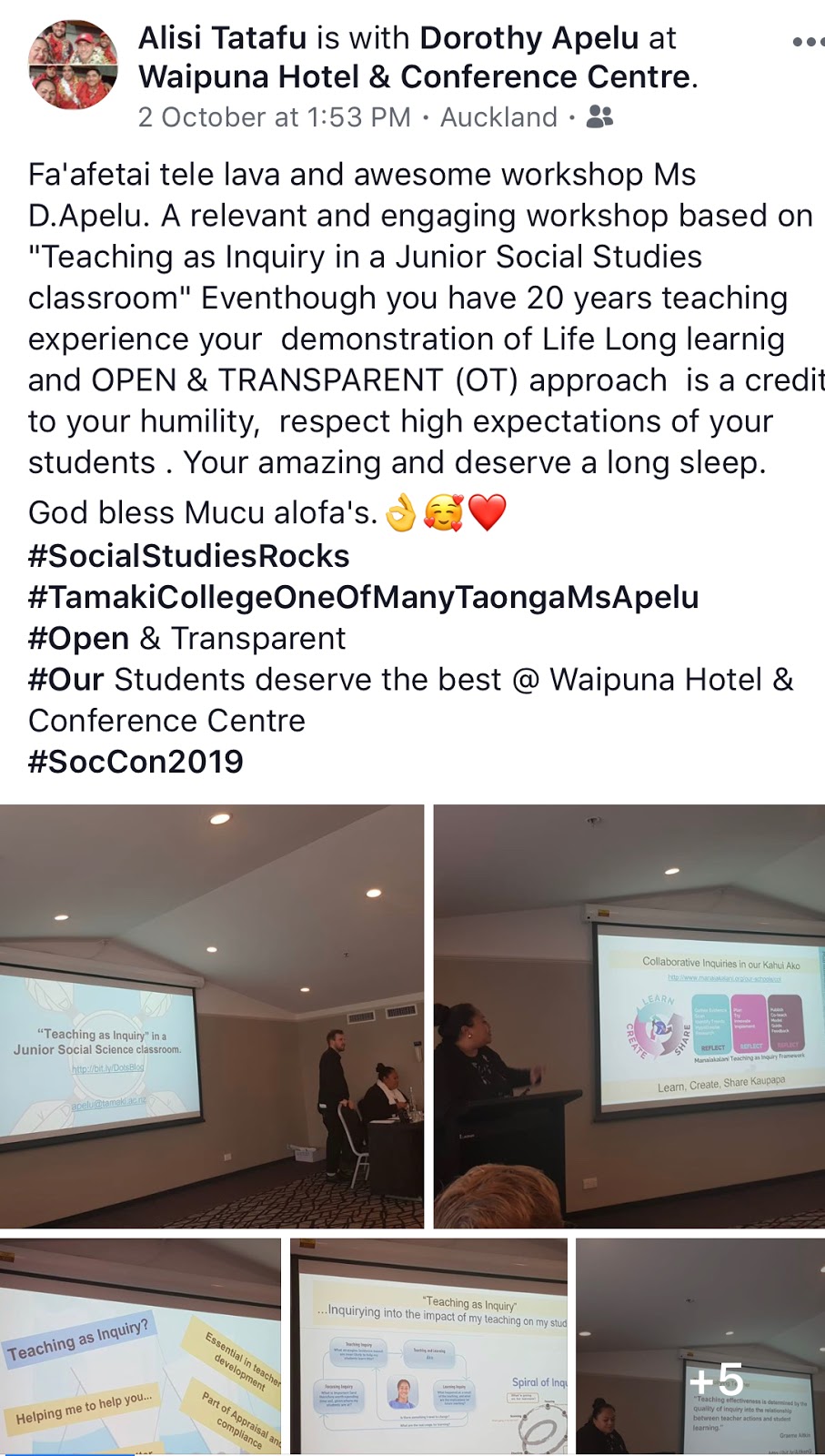
Presenting at the New Zealand Social Sciences Conference 2019

This week, I was invited to present at our annual Social Sciences Conference (SOCCON) which was held this year at the Waipuna Hotel and Conference Centre.  The theme of my presentation was 'Teaching as Inquiry in a Junior Social Science classroom' and it was a 30 minute brilliant burst.  I choose this theme because at conferences in the past, I have not seen or heard much about inquiry and this has been focus for me.  I wanted to share my journey in understanding the impact of my practice on my learners.
I was nervous because it is hard to gage why people are there so I first asked them to share in groups their understanding of inquiry and what it looked like to them.  I then defined my understanding so they could see where I was at, then proceeded to share some of my findings and reflections.


I explained the Manaiakalani kaupapa and how it had guided my inquiry to where I felt confident to describe my learnings as a teacher in the kahui ako.  I also explored the idea of being open and transparent as it supported others who may have the same challenges.  As the workshop progressed, I grew more and more at ease with the flow of the presentation and choose to have time at the end of the session for people to talk and ask questions.


At the end of the session, a number of people came up to thank me and one particular teacher, Sarah from Naenae College in Wellington said I was doing exactly what she was doing except her focus was on reading rather then writing!  She said she was so happy to find someone else who was doing something similar and we exchanged email addresses and said we would share resources.  Another colleague of mine from Mangere College tagged me in a facebook post which was really encouraging.  I enjoyed the chance to share my journey and look forward to doing it again.


Monday, 5 August 2019

Monitoring #2: A Colleagues observation of my teaching


In my on-going discussions with my department about my inquiry, I described to a colleague how well I thought my lesson went with my year 9’s, in learning the 7 concepts we need to know in our new Government unit.  I explained in my lesson, I had to focus on just getting the concepts learnt repeatedly and that this was a change in my teaching that taught me how to be more patient with my kids.  She wanted to see what this looked like so I offered to take one of her year 9 classes through the same lesson, for the first period in a double. 

My reflections:
The class was 9PDv and I taught exactly the same lesson that I’d taught the day before with 9PKr.  As it was just the first period of a double, their teacher continued to support their learning of the concepts during the next period.  I felt they are responded really well to the lesson because they seemed engaged and did not shy away too much from giving it a go.  I have not taught them before and it was refreshing to have different faces in front of me and different dynamics in a classroom.  


Staff feedback:
The feedback from my colleague was that she enjoyed seeing how I engaged the students in slowing the learning and forcing them to use their brains to learn.  She was surprised to see some of the loud boistrous boys standing up and giving the challenges a go.  She liked the way the kids stay focussed on the tasks and it gave her encouragement to try the model that I’d shown her.  She also shared it was one of the rare times that they’d been fully engaged.

A student teacher who’d also observed the lesson said ‘in both my practicuums, it was best teaching that had the kids so engaged that I’d seen so far, no offence’. (I was abit taken aback by this comment but felt humbled as well)

Student feedback through blogs:
Before the end of their double period, my colleague asked her class to blog about what they’d learnt during the lesson.  I enjoyed reading the blogposts below and felt positive and glad that they’d learnt what we’d set out to achieve.


Friday, 26 July 2019

Default vs Deliberate theories of action teaching #9

As a visual learner, I have designed a template to help guide my inquiry.


My 'Default' Theory of Action in teaching
When it comes to teaching, the old me would 'default' to my normal standard teaching practice as follow:
  • “Do Now, devices out, teacher talks for 10-15 mins to impart knowledge, students are shared tasks to do individually or in pairs, teacher checking work progress and understanding, complete a blog, students write a summary of the learning”.
I am pretty confident to deliver this standard teaching format and felt it worked because the kids appeared engaged and if they knew the routines, there would be less behavioural issues.  When it came to raising achievement in reading and writing, the mid to high ability students were doing well, but the gap seemed to be getting bigger for the lower ability.  On reflection, I need to be able to ask how my teaching actions have contributed to this gap and be prepared to challenge my thinking to enable better outcomes for my learners.  Albert Einsten said ''Insanity is doing the same thing over and over again and expecting different results".

Profiling and hypothesis generation
There are two areas for profiling and hypothesis generating - students and teachers.  For the students,  creating a comprehensive profile helps to inform strategies that align with raising achievement.  For teachers part, identifying my teaching theory and unpacking my hypothesis and causal chain support my design for deliberate teaching.

'My new deliberate Theory of Action'
The main hypothesis that I have is: If I slowed down the teaching and the learning of key concepts and have the students 'talk the learning', I theorise that the low-ability students will have the confidence and capabilities to build their language knowledge and this will could to an improvement in their reading and writing.

Intervention Design and Implementation:
I am consciously thinking about the planning around my implementation design and looking at the different aspects that support my hypothesis.  Rather then look at achieving the big picture straight away, I need to create little checkpoints along the way that will help me get to my valued learning outcomes.  I have identified a few ideas in my design and implementation, which will be detailed more in my other blog posts.

Monitoring
I have started to collect information to help me monitor the progress of the students and whether my teaching has had an impact in their learning and whether they can identify this.  I have listed a few formal and informal ways I will collect the information.  For the evaluation section, I will detail that further as my inquiry progresses.

Thursday, 25 July 2019

Restating my inquiry and my theory of action/change of events #8

Restate my inquiry question and theory of action/chain of events.

At our COL meeting today we were asked to restate our inquiry question and discuss our theories of action/chain of events.  Initially my valued learning outcomes were based around the ability for students to improve their summary writing skills through understanding what they are reading.  I've realised that the barrier starts with reading and even before reading, it is about having the capabilities and tools to grasp the thinking behind language.

After much thought and research, I have come to the conclusion that the valued learning outcomes that  I want to improve for my students in this inquiry are...based around understanding and articulating key concepts to improve reading and writing.

The changes I am making to my teaching to improve these outcomes are...focussing on the learning of language vocabulary by slowing down the teaching and having students talk the learning.

The reasons why I think these changes in my teaching will be effective for my learners are...that they will be able to conceptualise key words and show their understanding of their learning through relevant conversations and dialogue.

As quoted by Aaron:
"At the end of my inquiry, I want to be able to find out the changes that have happened for learners and to know why those changes happened.  I need lots of good information about the learners but also about my teaching.  

Last year, we saw evidence for shifts for learners but that evidence about what changes for teachers were was a bit weak - it was hard to know what the teachers had done differently that had caused those changes or if they were related.  

Theory of Action:  Learners have these improvements in their learners and it is because we think they made these changes in their teaching".

I want to be able to say 'This was how I was teaching before, and this is how I'm teaching now'.  I am thinking of developing a visual diagram of my inquiry so far, so that I could see how I am progressing and what I need to do next!


Wednesday, 22 August 2018

Encouraging the Talanoa - giving our kids the confidence to speak

When I ask my students to stand up and discuss or debate an issue that they care about or know a lot about,  there are a few kids who nail it. They are often the confident ones who enjoy the attention but in my level 2 class, most lack the confidence or the skill to stand in front of their peers and share their opinion for a number of different reasons.  

At our Power-up homework centre recently, DJ Tuaru, who runs the sessions, took the students who attended through the power of 'Talanoa', which looked at encouraging students to voice their informed opinions on an issue that interests them.  We discussed the meaning of 'Talanoa' and I found it empowering to be reminded that our Pasifika people were an oral people and that generations of our elders passed on their knowledge through song, music and storytelling. I asked DJ to come to my level 2 class, to share his presentation and help run a debate around what my kids had been learning about.  I wanted to see how the students would respond with the lesson.

Orators from around the Pacific
My students had just learnt about 2 different perspectives from the same religion in Israel who wanted different outcomes - the Israeli Defence Force and the Orthodox Jews.  We wanted to see if they could argue the perspectives from those viewpoints and respond to each other.  My recording of the lesson is below.   
(Please note: When debating, the students perspectives where in role play).


Reflection:  On reflection, I could see how hard it was for the majority of the class to speak up.  I wonder if it was the environment or their lack of knowledge of the context or other reasons.  I will have a follow up discussion this week and feedback from the class to see how they felt about it.  My next steps will be to organise smaller conversational groups, to support those who would not speak or were less confident and to allow them practice to hold conversations through different prompts and to mind map their responses.  I will also look at other strategies to encourage our students with the 'Talanoa' and ask Dr Jannie about ways to support our kids with conversations.


Acknowledgements:  Thank you Mr Tuaru for your inspiring lesson.

Tuesday, 14 August 2018

'Growing our children as conversationalists' - Dr Jannie Van Hees

At our recent School Leaders PLG, Dr Jannie Van Hees introduced the idea of growing our kids as conversationalists.  To define it, we think of 'talk of any kind between two, three or more people' as well as 'people in discussion - taking turns to share their ideas by speaking with each other'.  When I think about my students and whether I hear them having learning conversations, I admit that these conversations are very few and far between.


The idea of Chain Linking and the way students respond to each other has been something that I had never really noticed but I am really interested in finding out more about. Here are some of the notes from that PLG:
  • When kids talk to each other, they should take turns and share ideas
  • Talking WITH someone makes you focus on what is being said.
  • Take turns and share ideas.
  • Practice having conversations with 2, 3 or more people.
  • Link to a new idea or change the topic
  • Return to the point that has already been said.
  • Break down any conversations
  • Challenge what is being said and give your opinion
To and Fro talking
Chain linking - what you say to each other is thought about
Learners - brain has to work hard to respond to conversations

Talking WITH Someone
You can’t practice what you’re going to say, or your response
Learning to be conversationalists
A conversation is between 2 or more people, it’s about taking turns
Co-learn because we bother to share what’s in ourselves
Challenge what is being said

Some key questions to ponder:

What holds students back from conversing?
What can I add?
How do I add value?
Social appropriateness

Discussion:
  • Students are too sensitive, can be held back by giving responses or to challenge. Everyone’s contribution needs to be valued. Social appropriateness is important skill. Value and accept conversation in the classroom. 
  • Use drama to provoke conversations. 

My next steps:  
I am super interested in how to use 'conversations' in my lessons related to the context we are learning about in my year 12 Social Studies class.  I am thinking about how our Maori and Pasifika cultures are an oral people and I almost feel we need to do more to encourage our kids to speak and respond to each other.  


Monday, 25 June 2018

My Iste 2018 Experience - Part ONE: Keynote speakers

One of the most inspirational keynote speakers I have heard for a long time presented at the opening of the Iste Chicago conference for 2018.  Her name was Patricia Brown and she is a Technology Specialist at Ladue School District in St Louis, Missouri.

One of the key points she made was that digital media can change how people interact in the world.  She has 5 sons, and as parents of African American males, the conversation she has with her boys is that they have to work twice as hard and be twice as good who have the same opportunities as others who don't look like them.  Always take the high road and make good choices.  

Her community was in turmoil because of the a number of issues that were going on and she could not ignore it.  She wanted to teach kids to be socially aware and saw the impact of what was happening on her kids.   As a teacher of influence, her kids questioned what was happening and she gave them the tools to use their voices as a way of raising awareness. 


"Activism is my rent for living on this planet", a quote of Alice Walker makes sense to me, especially when I think about how lucky I am in the community and society that I live in to have access to the resources I do and the people I know to support my kids to make change for the good.
Patricia also encouraged us to 'find our tribe' and to begin the conversation and find people who were willing to speak up.   "Digital media can amplify the voices of marginalised individuals.  It can foster dialogue that is uncomfortable but absolutely critical".  We need to speak a safe and hopeful future for our children today.

Tuesday, 8 May 2018

Sharing blog comments across the cluster

In year 9, our students are learning about Globalisation and the importance of staying connected.  Recently, I have been collaborating with a colleague, Elfrida at Glenbrae primary, who wanted to start a 'commenting club' between students from our schools.  Whilst our years 9 and 10 write posts every week about their learning, it would be good to see more comments from different audiences that could support our learners.

I've decided to focus on two year 9 classes and their blog connections with a few classes at years 7 and 8.  I want to track their progress and see if they can utilise comments to support their learning and their writing.

One of the year 9 classes I had the chance to catch up with today is a lovely group of students who were comfortable with posting and commenting.  A really good document that Elfrida shared with me showed how to write good quality blog posts and provided scaffolded examples of comments.    I let the class know that I will be sharing their class site with their learning blogs to the students at Glenbrae so that they could share what learning they've been up to.


Many of the students read the blogs that were shared and just before the end of the class, I asked students how they'd found reading other students blog posts and most replied that it reminded them of when they were primary school and they'd enjoyed reading them.  I relayed the fact that Globalisation involved staying connected with people and students outside of our school and that sharing our learning with the world helps support them more in their learning.  The next step could be to collaborate on a common task or event and possibly invite other primary schools in our cluster to join our 'commenting club'.


Thursday, 3 May 2018

How to spot effective teaching even when you're not looking!

Today I stopped in to see my colleague and we got to talking about what she was doing with her year 10 class.  The kids were starting a new topic on 'Significant places' and learning about the reasons why a place is significant and to who it is significant to. I was interested in how she engaged them in their learning.

In our discussion, I asked what tasks the kids were doing.  She shared how kids were thinking about a significant place and used examples they'd learnt earlier in the year like Waitangi and Gallopoli.   She shared with the class her own example, then got them to do a brainstorm DLO using a Lucid chart instead of the normal class brainstorm.  After instructing the class on what to do, she went around to each student and checked on what they were doing.

I asked how it went, and she showed me some kids work and shared how happy she was that most of the boys had completed their charts.  She found that when she checked on individual students, one or two found the brainstorms useful to help them refocus on their writing.  I asked if she could share this lesson and the success she'd had with the rest of our department through a blog, and she froze.   The look of fear on her face stopped me in my tracks.  I got a sense that asking this was a step too far.

It was then that I got out a whiteboard marker and we started to put together the pieces of the lesson to help get her thoughts out in a structure like form.  This is what we came up with:


 I asked her to think about why she was using these strategies, and what was the challenge or the issue that she'd found with the boys in your class, to make her use these strategies.  She identified the overall problem as being, in the past, a lack of engagement.  I showed her the structure and compared it to a Big Mac burger.  I said she had the juicy parts that were the filling and I just helped to put the top and bottom burger buns on. 

Then I asked her to think of the reasons for why she used each strategy and she was able to articulate the deeper thinking behind the why.  I then asked her to identify some of the positive outcomes from using all of these strategies and she shared how engaged the boys were and the lack of behavioural issues that she'd had to deal with.  We then thought about a few next steps.  

The one thing that I said could support this structure further, would be the 'how do you know this' eg the evidence, data or research behind her actions, but I shared that we could add that later as this was an on the spot thing.

She was surprised that our short conversation could be valuable in helping her formulate a blog post, particularly when it came to her inquiry.  I said that the things she took for granted and had been doing all the time, are things that should be shared, because they work.  She was really thankful and said it helped her to see how effective it would be if people could learn from her.

When I reflect back to this 'accidental learning' discussion, I think I have been so busy trying to change the systems (and the world) that I hadn't stopped to see that the change is happening right in front of me, in the everyday classroom with a teacher who is just going about their business.  Sometimes the most effective change happens from the inside out, and I need to make sure I don't miss those golden opportunities again.


Tuesday, 17 April 2018

My GAFE Auckland Summit Ignite presentation 2018

Today I had the honour of presenting an IGNITE session at the GAFE summit.  I was a bit nervous but excited to be presenting in front of like minded educators and people from around the country and the world.


I shared my inquiry from 2017 and hoped that the audience learnt a bit about my journey.  I felt the opportunity to present allowed me to grow more confident in role as a COL teacher.


Friday, 16 March 2018

Reading about Language

I have been doing a bit of background reading from our COL's sessions to help me understand what 'Language in Abundance' could look like at our school and in my classroom and how we could value the theories shared by Dr Jannie van Hees on making 'language' a key focus for us.


In the 'Education Aotearoa', an article the Dr van Hees had written looked at 'Conversational Classrooms', the discussion looks at how when 5 year olds arrive at school, who have noticeable gaps in their language.  When thinking about my own classrooms, my year 12 and 13 students at this stage should be able to articulate and tell me what their thoughts are around their learning - but find it difficult.  When it comes to critical thinking or high order thinking, I am the one who is often discussing concepts and at times, they are present but not contributing. I wonder if it is because I assume they should know the language or are they're other reasons.


I am interested in finding strategies to address this. Dr van Hees describes difference making in two schools - an all girls Catholic secondary school and it's feeder primary school.  What she noticed was they shared an:
  • unswerving belief in the capabilities of students
  • high student expectations
  • fine tuned, scaffolded learning support
  • high calibre teaching staff and leaders
  • strong home-school partnerships
  • high levels of student self-belief
  • and a focus on ‘what really matters’ – the essence of enablement educationally.'
When I read this, I wonder which of these do we as a school have and how did these schools get to these stages?


The article goes on to say that the teacher dominated classrooms where the teacher asks questions and the kids put their hands up lacks the depth required to allow kids to think critically.


"Seldom occurring will be the dynamic cut and trust of ideas exchange – what we might hear in families where balanced sharing of ideas and thinking is the ‘bread and butter’ of meaning-making relationships and learning".  

When I am thinking about my seniors, I know it is about stepping away from dominating in front of the classroom and listening to the language of my learners better. In my classroom, I have control and can apply the strategies suggested by Dr van Hees but in my role as a COLs, I want to think about how I can approach and work with the culture of our school to develop the change that can help other learners achieve success.

Thursday, 15 March 2018

Catching up with my COL team

As a COL leader, I am privileged to work with lots of different teachers from different curriculum areas through our shared collaborative inquiries.  There aren't many chances to collaborate and hear from other colleagues in the school so I am grateful for this opportunity to hear different voices.


During our staff meeting, our COL leaders got together with their groups.  In my group, I have my department plus 6 other staff from different areas.  It was interesting hearing where everyone was at with their inquiries and blogs.  Some were well into their blogs and others were at the very start.  We shared what inquiries people were interested in doing, then used the framework from Hinerau's to use as part of their first blogs


After the meeting,  I caught up with two teachers who had been away and explained to them the purpose of our meeting.  From this, I decided to create a Google + community page as a way of keeping in touch with my team and sharing resources.  I'm looking forward to working with my team this year and hope their inquiries will be valuable to their growth as a teacher.


Thursday, 1 March 2018

Year 9 and 10 E-asttle testing for Term 1

This week, our year 9 and 10 students have been completing their easttle tests in reading, writing and maths.  We have found that in the past, our students have not taken their tests seriously which has seriously affected many of their results.  To try and address this, we have identified ways to manage the process better.

One of them is to ensure that students know the importance of these tests.  In year level assemblies, Mr Dunn, our Deputy Principal of Curriculum, has reminded them on the purpose of the tests and how they should try their hardest so that we can support them in their learning.  Their Deans reinforce this through encouraging students to use our schools R.I.S.E values when sitting the tests.  The purpose of doing this is so that students can see these tests are not separate from their teaching and learning in classroom, which in past has created a barrier for students.

The staff have also been reminded about the importance of preparing our students mentally, for the tests.  In our staff briefing, Mr Dunn has talked about making sure our teachers encourage our students to bring the right equipment to the test and have the right attitude.  The thinking was that the more our kids hear about the tests in the classroom, the more they can connect the fact that these tests influence how teachers the teach to their learning.


On testing day, the environment for which our students have been sitting the tests is mirrored on external examination conditions.  This has worked in our favour to ensure that students know the seriousness of these tests and can prepare themselves better for when they are in year 11 and doing NCEA exams.  Subject teachers are active monitors of students in the exam environment and have supported Marc, our easttle adminstrator, in ensuring that the students are settled and working to their best.


Once the tests have been marked and moderated, the next step in the process is, as a teacher, to understand what the results say and develop a plan collectively to support students in their learning.  As an across school COL teacher,  I want to support teachers in this process, because I see the need in valuing these tests, which on a whole, will speak to where our learners and at.  And it is up to us, to get them to where they need to be.

Monday, 19 February 2018

Language in Abundance - Take 2.

Today we have had the privilege of listening to Dr Jannie van Hees.  This is the second time in the last fortnight that I have heard Dr van Hees speak about 'Language in Abundance' and each time, I have heard something new that has resonated with me and challenge my thinking.

The issue that is facing many of our kids is that if they haven't got language, they can't carry concepts.

We want kids to 'Flourish' and part of it lies in understanding the brain (cognition) and concepts knowledge.  But a key component lies in the attitudes towards the learning.  When the learner loves language, this is difference making.  Self-esteem matters greatly.

Another key idea Dr Jannie shared was that if we as teachers are not paying attention to the learners paying attention, we can not recognise purposeful engagement.  Unless this is happening (photo) and we are optimising learning conditions, there is no learning happening.


Keep triggering the known to the new - all the times, different contexts (at least 3 times over to let it sit with the learners).  It has to all come together.

So what can we do help?  Help kids to scaffold themselves and the learner and amongst themselves and their peers - help them to be co-contributors to learning opportunities.  I have asked Dr Jannie if she could come to the college and help us build and implement strategies that can ensure our kids are getting 'language in abundance'.

Friday, 9 February 2018

My Inquiry for 2018

My Inquiry for 2018


For my inquiry, I have selected the following Manaiakalani CoL Achievement Challenge:


The focus of my inquiry are the boys in my level 2 Social Studies class. 

What and who:

Supporting my senior year 12 Social studies class through engaging contexts and effective writing strategies whilst ensuring they achieve success within the NCEA context and timeframe.

I will also share best practice evidence with my Social Studies department and support the implementation of writing strategies for the junior year 9 and 10 programmes.

How:

I will plan use researched and practiced evidence to understand how boys learn and develop a programme based around this evidence.

I will use engaging contexts to gage interest and motivation for writing.

I will use developed writing strategies such as SOLO taxonomy, our literacy resources at school, and visit other classroom contexts to design resources that will be tried in the classroom.

Measurable outcome:

The goal is to ensure that the boys in my level 2 class will gain 14+ credits at level 2 and at least 5 credits in level 2 literacy.

Thursday, 8 February 2018

Learning 'Language' at our first COL meeting


The kaupapa of our Manaiakalani COL team focuses on “Recognising and spreading sophisticated pedagogical practice across our community so that students learn in better and more powerful ways...”.

As an Across Schools COL teacher this year,  I have the opportunity to 'recognise' and 'spread' pedagogical practice not just within my own school, but across the cluster.  I am looking forward to the challenge and acknowledge that it is a big role to undertake.

At our first COL meeting, we discussed our big idea for the year 'Language in Abundance' and we were fortunate enough to hear from Dr Jannie van Hees.  Dr van Hees is an expert in 'Language' and has studied why talking matters related to 5 - 6 year olds at school.  We were given an example of how a child would feel, if they were told instructions on how to make a kite.  Through each of the stages, I thought a lot about assumptions and when I am teaching students, do they really understand the language and the words that I am using?  And how do I know this?

An example of this was earlier in the day with my year 12 class, and we were talking about different perspectives on Waitangi Day.  I found a short Mike Hosking clip and when I played it, it became clear to me that students didn't understand what he was saying.  When it was finished,  I asked the class 'do you think he is for or against Waitangi day', and straight away a student said 'Ms, he used some big flash words aye?  I feel dumb'.  I felt so disheartened and sad when I heard this because I assumed that our kids could gage his perspective from what he was saying.  This was not my kids fault, but definitely my lack of knowing the learner and assuming that in year 12, they would have 'language' to make meaning from what they'd heard.

Next time I use a clip by Mike, I need to lots of time to teach and expose kids to the 'flash words.'

One of the phrases that resonated with me, was Dr van Hees saying we needed to have 'an abundance of language that was drippingly available'.  She went on to describe significant ways to share language with our kids.  I remembered my visit to Panmure Bridge and seeing on every inch of their walls, language that flowed from every ebb - it definitely inspired me to want share this way of exposing our kids to language across our school - to be honest, at the moment my walls are bare.

What 'Language in Abundance' could look like - Panmure Bridge

Dr van Hees went on to describe that the contexts for sharing this language was right here on our doorstep, in our community and all around our kids.  I understand the value of this and saw it in action when our year 9's took on the integrated unit around 'Sustainability' in our community - our kids were so engaged and motivated because they could connect in some way to the theme.

Contexts are all around us.

I left the COL meeting feeling like I had learnt much about the value  of understanding how important language is for our kids to making meaning of their world.  It is clear that 'knowing language' is the key to whether our kids are able to achieve or not. One of my challenges as an across schools COL teacher is recognise how we currently use 'language' across our cluster, why we use it this way, and to develop collaborative and successful strategies to use the 'language in abundance' values so as to complement and support our teacher's practices and pedagogies.

COL Inquiry #6C: Academic Reading "Teaching to the North East"

From the Secondary Teacher Literacy Handbook page 33:  Bishop (2019) stated that to improve Māori achievement, teachers need to  create an e...