Showing posts with label Cultural Responsive. Show all posts

Monday, 23 September 2024

Celebrating 'Cultural Visibility' #1: Te Wiki O Te Reo Māori Language Week

This week our school celebrated Te Wiki O Te Reo Māori Language Week.  We have been entrenched in Haka Waiata preparations for our end of week assembly where will see each house compete for the Top House Award. I enjoyed helping a few of the different whanau groups behind the scenes to get ready.  I also had the honour of videoing the event below.


The fact that the Reo empowered our students to be part of something great is quite something to see.  I was so proud of some of my year 9 boys who were centre stage and I made sure that next time I had them for class, I elevated their involvement to the next level.


Saturday, 1 June 2024

Celebrating 'Cultural Visibility': Samoan Group performing at our Manaiakalani Teacher's only day

Today our small Samoan Group got to perform in front of our staff gathered from our Manaiakalani cluster.  It was important to acknowledge and celebrate the language week as Samoan is one of the three most widely spoken languages in New Zealand behind English and Te Reo Maori.  

Our group is a diverse group with a mix of Samoan, Tongans, Cook Islanders, Burmese and European and many of these students were excited to see some of the teachers that had once taught them in their primary school days.  

This year, their head tutor Alby Tuuga-Stevenson wanted them to be involved in as many school wide and community wide opportunities as they could.  He understood that being part of the group was not just about dancing but learning and nurturing the values like respect and service that come with the Samoan way of life or fa'a Samoa.  Some of these students are entrenched in their Samoan culture at home and in church, which is enhanced when they are part of the group but for many, being in our Samoan group is their only connections to understanding who they are and where are they from.  It is only right that we provide an avenue to make those connections and to connect them with their identities.  They may not know their language but their language knows them.

Fa'afetai Manaiakalani for allowing them the opportunity to perform.


Monday, 20 May 2024

Staff PLD Talanoa Ako: "When our languages thrive, our people thrive".

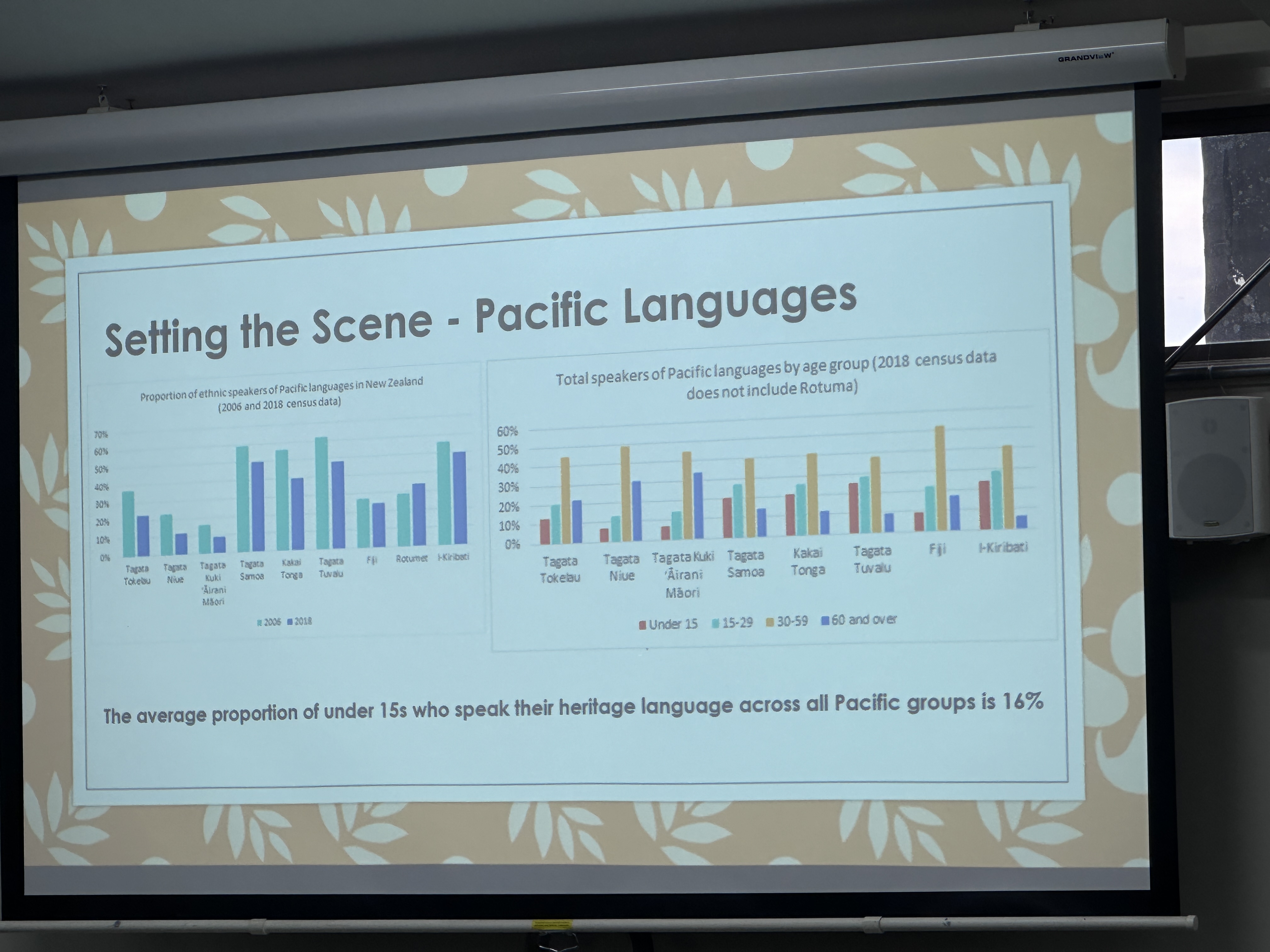
Today we had the honour of having Nafanuatele Lafitaga Mafaufau come speak to us as part of the Talanoa Ako PLD our staff has been learning about.  She shared some interesting and relevant information with regards to our Pasifika students and the risks of not teaching a Pacific language in the future. Below are some key points:

  • U.E Approved languages:  Samoan, Tongan and Cook Island and offers literacy credits/standards.
  • We Part of the Te Tiriti as Tagata Whenua 
  • Pacific Languages are not currently thriving.


When it's Polyfest season, why is attendance 100% the opportunity to engage with their language, culture and identity and it's values.  The Ministry of Pacific people's work with communities is far-reaching.

Auckland Girls had the highest achieving NCEA results because students were thriving in their language and culture.

It's that mindset, that a language is easy, just as vigorous as valuable as.  Introduction of Pacific Studies, History, Geo and Sociology, is going to be university approved 

What kinds of career pathways - careers have not even been created for our people with languages, academies, eg. Director of Languages implementation.

When our languages thrive, our people thrive.
Have to encourage the Ministry, keep pushing.  Correspondance school.  School Priority. Survey the community. One class.

Monday, 17 August 2020

Back to lockdown learning with 9KMe Akomanga Kaihanga class

This morning I had my first online lesson with my year 9KMe class and I had 10 students join me.  I was worried that not many kids would connect and I was pleasantly surprised when they did.

I did not want to create any new learning for my kids as I know from the first lockdown, many kids weren't able to get online.  Our main focus was to connect, check-in and tidy up any work we started last week.  We agreed that we only needed to catch-up for the first half of a double period.

We started with a karakia and for our do now, we moved into a fun socrative quiz where I played the 'Eye of the Tiger' to hype up the kids and expose them to some classic old school music (check out the short clip below).  Then we went into our lesson (I have purposefully recorded the lesson this way for those who didn't make it to class).


After the socrative, I sent out a check-in survey to my kids inviting to share their thoughts about the lockdown.  Here are the results.


From the results, there are a answers that I'd expected and others which surprised me.  In our next class, we may discuss the answers further.


Saturday, 20 June 2020

9AK #7: Evidence gathering: Connecting with whanau during lockdown

Did connecting with whanau support student learning during the lockdown?  

The lockdown was a chance to connect with whanau on a another level.  Before the lockdown, students were sent to school for their learning and that was that.  During lockdown, students pretty much brought their homes, lives and families to ‘school’ with them when they were forced to shared their learning spaces with their teachers.  I was interested in how our students handled this and I found an article that talks about the vā, the relative space between people and their relationships.

“The vā that binds: a Pasifika education story during Covid-19” describes the vā as a sacred space that online learning interrupted.  Teachers were invited into the sacred spaces of our kids in their homes.  In that space, the divide grew wider or got closer, depending on whether the kids trusted you or not.  At the start of the lockdown, my seniors were all for it turning up to online classes religiously.  But nearer the end, they were rarely there.  There would be a few reasons for this.  Much of the school work they were doing was individualised research which required basic checking in and quick discussions and they were off.  Another reason for a lack of attendance was that many students either worked, babysat or were expected to contribute to the household chores and rarely had time to login(see a recent blog post).  

The juniors on the other hand were there everyday, ready to learn.   In the 9AK project based class, I had at least 75% attendance on average from my year 9's and it was really enjoyable connecting with them in this way.  Most of the time, they had their screens off and mute buttons on. 

I'd like to highlight one student who regularly invited me into his whanau ’space' whenever our classes were on.  Below are the interactions we had from the lockdown (I have changed the boys name to Adam).

Week 1:  Adam introduced his little brother to the class and was feeding him whilst taking part in the lesson. 

Week 2:  Adam’s mum joined the class kahoot with us and beat Adam in a couple of the questions.

Week 3:  Mum helped Adam brainstorm capabilities when he was stuck (see video 11 mins - 11.45 secs).

The week before we went into level 1, Adam’s mum had described to me online her worries about sending her son to school.  I reassured her that she didn't need to send him to school until she was ready and he wouldn't miss anything as we were still online as well as in the classroom.   She seemed happy with my response.

Now that we are pretty back to normal teaching and learning in the classroom, I feel that I have a better relationship with Adam compared to before the lockdown.  If he gets distracted during the lesson, I just call out his name and give him the 'look' and he apologies and refocusses.  I feel there is an unspoken respect and trust that has been formed as a result of connecting with his mum during lockdown.  

The fact that these small connections occurred closes the gaps with the vā.  My wonderings are that if we can shorten the va’, how do we continue the momentum?  I am excited to learn more about developing better connections with our whanau to support our student learning.

Sunday, 31 May 2020

Online teaching and learning #8: Virtual Samoan Language Week

This week, we celebrated Samoan Language Week in a different way - online!  
We didn't want to miss the opportunity to share our culture with staff and students even in a lockdown.  The theme was: “Tapena sou ōso mo lau malaga - Prepare yourself a gift for your travels.  Below are some of the activities that we did.

Daily activities website:
We created a daily events page on the Social Sciences website for students to do during the week.  Tutor teachers went through the activities during tutor time. 

Staff briefing:
At each staff briefing, one of our Samoan students would share their understanding of the theme.  Here is a link to their speeches.

Student morning tea:
Last year we served hot koko alaisa (cocoa rice) and panikeke's (small donuts) to our students outside the wharekai.  It was our way of sharing our love of food with our kids.

Staff challenge video:
Students always love seeing their teachers giving something a go so I coerced some staff to create a staff challenge video which was fun to make and was shown to classes by their tutor teachers.

Staff morning tea: 
In previous years we usually have a huge lunch catered by our Pasifika staff.  This year, we did it takeaway styles and each staff member was treated to some yummy sweet treats that was delivered to them.  
Yummy mud cake for staff
'Pass the Siva' video challenge:
Our team discussed an idea of putting together a 'pass the siva' challenge video where students would perform a short dance and pretend to pass a move to another student.  We also wanted to connect our ex-students with our current through the video as the theme lent itself nicely to it.  Our Samoan tutor Alby put the word out for students to send in and near the end of the language week, I made a short video bringing all the video's together.  Unfortunately we were unable to perform in the polyfest this year, so it was lovely to see our students performing for the video and we enjoyed providing a different way of sharing our love of our Samoan culture. 

Cheehoooo!

Friday, 29 May 2020

TAI 2020 WFRC #5: Nature and Extent of the Student Challenge.

Share your findings about the nature and extent of the student challenge. Make sure it is clear what evidence from your inquiry supports each finding.
My inquiry is looking at whether project based collaborative ways of learning in a Talanoa environment will make the difference in the learning journey of my year 9 class.  I know I need to be more specific with regards to shifting achievement in literacy, so the challenge will be how to shift the capabilities and achievement of our lower achieving students above their entry level to high school.  This will be with regards to both reading and writing.

My initial focus was to develop a plan to observe and construct strategies to support students in teams during their groups collaboration process but because of the lockdown, part of my focus has changed to include how groups can do this in both the physical sense (in the classroom) and online.

I have taught level 2 and level 3 Social Studies for a number of years, and when it comes to students presenting their learning to their class (or even verbalising their learning to me their teacher) students find this really difficult.  Students refuse or why they know they have to present, they provide an ill-prepared speech or spending the time reading a powerpoint from the board.  This led me in 2018, to inquire into why my seniors struggled and to what extent was this lack of speaking to their learning, an impact on their achievement.  

A big part of my inquiry focussed on the ‘Talanoa’ and how I thought, that this strategy of having students speak their learning could encourage students inevitably lead my kids to write better.
I found that the actions around the Talanoa did support those students who were already confident speakers and those who weren’t, were able to slowly come out of their shells, with support from scaffolding templates and encouragement from  their fellow classmates.  Students’ were able to articulate their learning better than before, although I found there was still a disconnect from students who could speak their learning to having to write it.

One of my goals with my inquiry this year, is not to wait until year 12 and year 13 to find out that students could not talk their learning, but to create a culture of ‘Talanoa’ through the collaborative efforts in my year 9 classes project based learning, so that it would be the norm for them.

From my observations of my year 9’s at the start of the year, I could see that there had been some success with regards to students who were less confident before becoming more confident through a lesson we had on conversation skills (blogpost here).  However there were many students, particularly those of lower ability struggling with collaboration and speaking their learning.  During the lockdown, it was a challenge to run a physical collaboration and so my attention turned to whether students were able to collaborate in a google hangout (blogpost here).  What I noticed was that regardless of the platform (physically in class vs. google hangout), students still needed a lot of prompting and scaffolding to support their ‘Talanoa’.  Some students needed less whilst others would needed more.

The challenge for my learners this year is understand that the ‘Talanoa’ can work to support their literacy journey towards achievement and success.  I want my learners to engage in learning conversations that can be presented in a public forum and understand that the Talanoa is another way to show progress and learning. I want them to support each other in their groups and to use their strengths to build on their participation in the group.  This would mean that I need to make sure that I provide enough opportunities to engage in the Talanoa with well-developed resources and strategies that will cater to the varied learning needs of my class.

COL Inquiry #6C: Academic Reading "Teaching to the North East"

From the Secondary Teacher Literacy Handbook page 33:  Bishop (2019) stated that to improve Māori achievement, teachers need to  create an e...