Showing posts with label Inquiry 2018. Show all posts

Thursday, 27 September 2018

Encouraging the 'Talanoa': Using Cue Cards for reflections

My level 3 Sos kids have just completed their externals and to get my level 3 students back on track and completing reflections on their Social Actions, I wanted to use a different method to get them to remember what did they and how they did it.  Usually, I would expect students to reflect individually but in the past, students get bored and loss motivation.  Because I know the year 13's like to talk I got them into their groups, shared with them the lesson plan and gave them reflection cue cards to help them discuss their actions.  The main rule I gave was that everyone had to have a question and that every member had to respond with an answer (one at a time of course)

There were 4 groups in total and it was interesting to see how each group responded.  The boys in the front of the class found using them good to hear from the quieter less overt members of the group.  A small group of 3 used them to ensure that they could write in more detail because they were lacking this in their written reflections.  The biggest group of girls who had issues with their suppers (ie they ran out of food) were able to talk in honesty about how they felt when this happened.  The last group, who were my most able students, didn't find them as useful as I'd hoped, instead choosing to rush through the questions, so they could get to their writing.

The supper group discuss their social action.
A smaller group 'talanoa' about their action.
On reflection, a thing I would change next time is to ensure that these discussions are done with the groups separated in a different space/room because it was a bit noisy in the one classroom where some really good discussions were going on.  I also think that I would have students voice record their conversations and create a transcript that they could use in their assessment.  From this, I hope to look at more focus group types of discussion, where I could model to them how to 'link' their answers to each other and learn how to respond to each other.  Overall, I think the lesson went well and I hope to develop this strategy better.

Wednesday, 26 September 2018

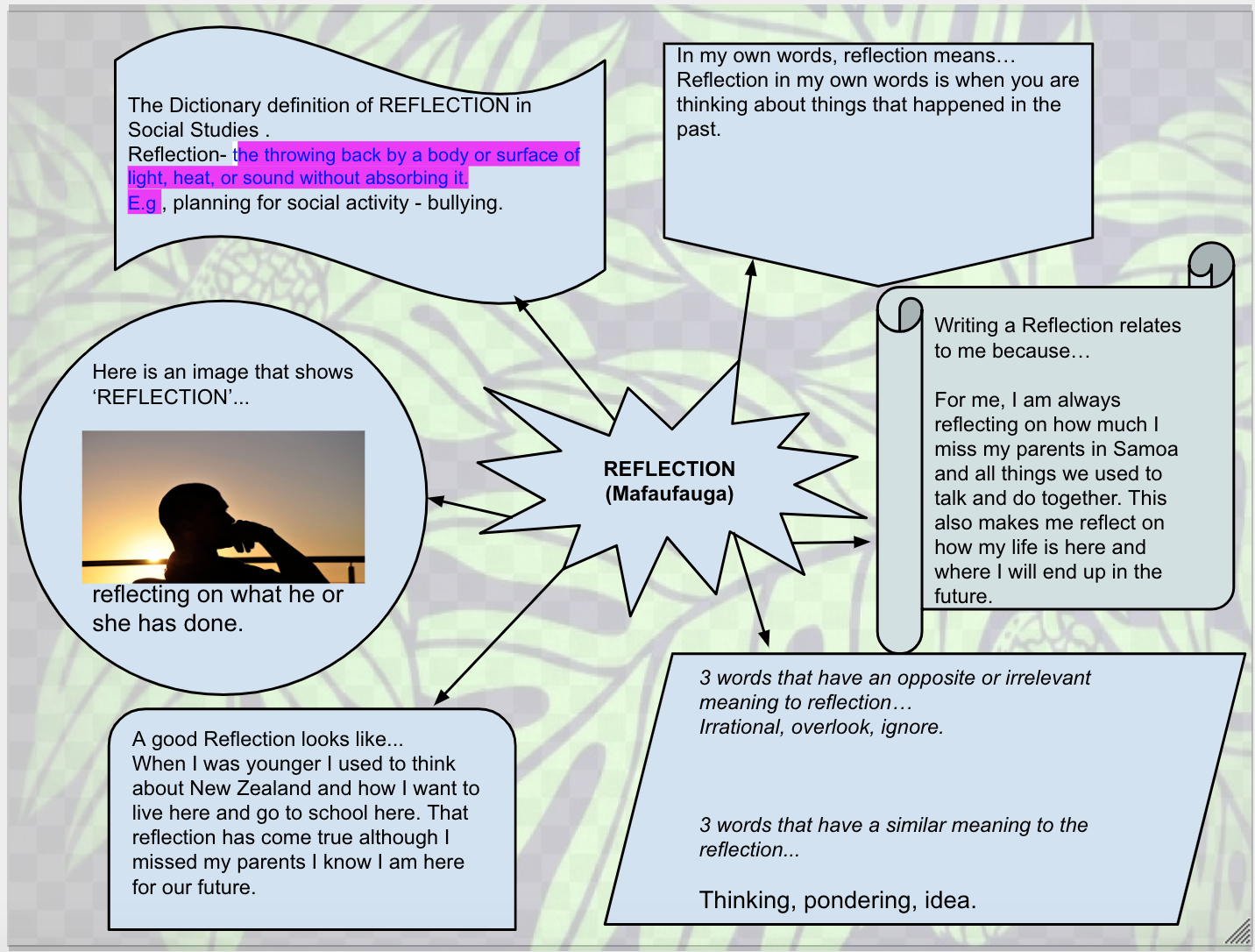
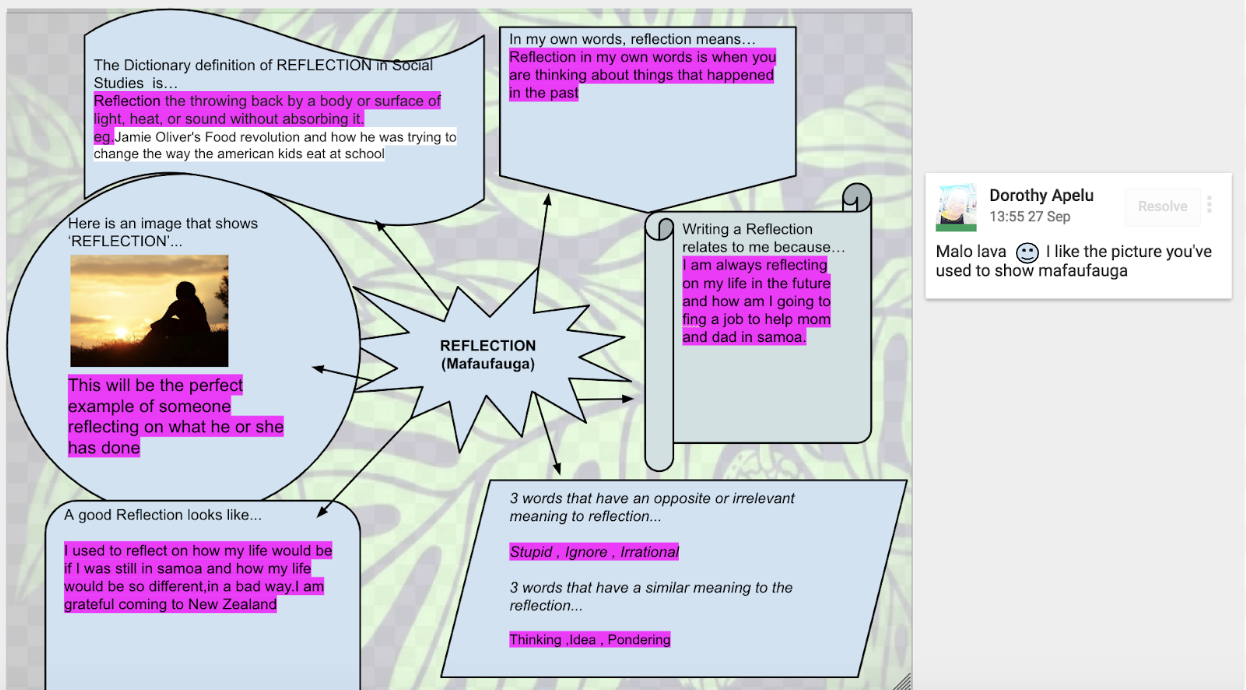
Concept Maps with my ESOL students

Lately I have been thinking about how to support my ESOL learners better in my level 3 Sos class.  In my last post, I wanted them to focus on understanding the deeper relevance of concepts that we were studying, rather then brush the surface.  I used a concept map with the word 'Reflection' in Samoan in the middle ('Mafaufauga') and with the support of a translator, they were encouraged to explore the concept more deeply.  (As an aside, although I am Samoan, I sadly can not speak it and this has been a challenge when trying to help my ESOL students fully). 


They were pretty enthusiastic about doing the task which didn't surprise me.  I knew that they would see a connection between the English and Samoan version of the words and it allowed them to see the concept as more then just a foreign word on the page. 

A completed concept map from Student 1
A completed concept map from Student 2
Once they had completed their concept maps, the next step was to use the concept to identify positives and negatives of their social actions.  I shared with them a document that asked them to apply 'mafaufauga' to the their actions.  I attempted to use Samoan words to emphasise the key ideas and I was encouraged by how well the students responded to this.  Although positive, I think they wanted to get the task completed rather then focus on detail. 

My next steps are to think of ways to develop more comprehensive deeper thinking on the issue and I'm thinking that they need to be exposed to this more often.  As Dr Van Hees has said, one of the ways that students can have better understanding of words is to expose them to 'language in abundance' and I think by getting them to see it in their world first could help them to be more receptive to new words and concepts.
Student 1's answers


Saturday, 22 September 2018

Reading Reflections: Supporting my ESOL students

My level 3 class has such a wide spread of learning needs and learning abilities, sometimes I find it difficult to ensure that each student and their groups have equitable share of my time.  I have students working at level 8 of the curriculum and achieving Excellences in NCEA, sitting next to students who had only recently migrated to New Zealand and are struggling to grasp basic English words and concepts. 

Although I have attempted to scaffold and break-down key elements of our learning and language, I know my ESOL students are not getting enough of my attention and support to ensure their success in my subject. 

Recently, I sat down with my 2 ESOL kids and discussed a realistic plan moving forward.  One of my students had chosen to return to year 13 having completed part of her course last year, so this is her second year in my class and she had returned to gain her level 3 over 2 years.  Last year, she managed to achieve one of the 4 credit internal standards in Senior Social Studies and also gained an achieved in one of her NCEA level 3 History exam papers which was awesome.  Her goal this year was to gain at least 10 more credits in my subject area as part of her career pathway.

My other student migrated to New Zealand at the beginning of last year and according to our English support teacher, was 'very low in her language comprehension and acquisition'.  Both students have a teacher aide sit with them for one of our double periods in class which has helped enormously with relaying ideas and learnings to them but the struggle has been the lack of opportunity to apply these learnings to a context that they could relate to.

I have been reading about how do this better and have found the TKI site 'Language enhancing the achievement of Pasifika' site useful.  Under 'Language and school', there are tools and strategies shared that I want to try out.

At the moment, my year 13's are being asked to write a 'Reflection' on the social actions that they'd completed earlier in the term.  I have provided different opportunities to reflect and now students are writing them.  I have realised that I have assumed that my students knew what the concept of reflection was and instead of allowing my ESOL students the time to process it, I have been trying to rush them to the next stage without them being ready.  One of the strategies that I want to use will be to extend their vocab by paying special attention to it.  Instead of trying to get them to write the reflection, I will get them to 'know the word' better so that they can apply it practically when necessary.  I will start with a checklist that can support them in their vocab learning.

A tool to support my ESOL learners
A common tool we use in Social Studies is a concept map that allows different ways to use a concept and allows student to become familiar with a concept at the start of a unit.  This will take a bit of time but it will be worth it for my ESOL learners to ensure that they come away with key vocab which will enrich their learning.

A concept map for 'Reflection'

Saturday, 15 September 2018

Reflecting on my year 12's exams

This term, my seniors have been busy preparing for practice exams.  We have looked at a complicated topic like Israel and Palestine and picked it apart in a hope that it makes sense to them and although I feel they know the context quite well now, the writing of it is something that I feel definitely needs more work.

Of the 17 students entered for the exam, 3 of them didn't sit it, and of the 14 who did, although they attempted it only 7 of them passed.  I was disappointed with the result and talked to my co-teacher CC, who helped teach and mark the exam, about it.  I could see in their writing that they still needed to structure their ideas better and that they lacked depth and insight.  CC said the students wrote like it was a 'brain dump', they just tried to get everything out on the page without double triple checking the questions or the exam paper. 

I talked to the kids and they generally felt like they were a bit lost and weren't sure what to do.  I also sent out a survey to follow this up and to help me understand what was needed to be done to support the kids better.

Here are some of the questions I asked my kids:


My next steps are to sit down with each student and talk about what they need to do to improve in their writing and to look at more effective strategies around essay structures to help them to feel more confident in their writing.


Friday, 31 August 2018

Encouraging the 'Talanoa' - Home group/Expert groups in Level 2 Social Studies

In my level 2 Social Studies, I have been looking at ways to engage students in their learning through encouraging the use of the 'Talanoa', or discussions about the context, as another means of knowledge building and understanding.  Dr Jannie Van Hees recently shared that we need to be 'developing conversationalists' and how students oral literacy skills would improve if they could 'chainlink' what they had to say to each other.  I wanted the kids to work in smaller groups to discuss and engage in conversations about perspectives that were relevant to their learning.  

The topic we have been studying is the conflict between Israel and Palestine and in a recent exercise (that I'd blogged about earlier) we split the class into two different groups with opposing perspectives, to allow for students to verbalise their learnings.  Although there were some good debates going on, realistically it was 2 or 3 students with the confidence to speak who did so.

To get more students to engage in a 'talanoa', my co-teacher CC and I, tried out a home group/expert group exercise.  We asked students to get into an expert group of their choice, making 5 groups in total.  A leader from each group came up and pulled out one of the perspectives from a box - Hamas, IDF, PLO, U.N and the Zionists.  Students were given a brief about what they needed to write and got to the task of researching their assigned perspectives.


Most of the groups worked well together, but I noticed one or two students who would not contribute or did not engage.  I had a quiet word with them to remind them that soon, they will need to split up and have to be able to tell others from outside their group, who they were and what they believed in.  This gave them a 'boost' with the expectation that others will need their input.

After about 30 minutes, we asked the expert groups to split up and move in to 'home' groups, where they shared the beliefs and perspectives of the group they had studied  Each group was then given a scenario, whereby they had to attempt to reach a resolution .  Near the end of the session, I put the final statement on the board 'Whose owns the land' and gave everyone the chance to go for it!

On reflection, I found this activity was really engaging for the students, even the ones who had little to say.  Some students spoke with confidence and encouraged each other, where as others listened, then gave input where they saw fit.  Although there were one or two stragglers, the others in the group pulled them in to the conversation.

When I asked the students what they thought about the exercise, one student said how she felt 'brainy' because she could say what she'd learnt and reply back to other people who had opposite beliefs.  One of the boys said he felt surprised that he could say what he did because he was usually shy but felt safe enough in the smaller group environment to speak up.

For next time, I would like students to write a reflection of the exercise to gage how successful (or not) it was in helping them in their learning.  I may also use conversation cue cards or question cards on each table once their in their home groups, to get more kids to share and get used to discussions in these smaller, more manageable groups.


Year 10 presentations

I have recently inherited a year 10 class for one period a week and although it is hard to gather momentum when you are teaching something, I've made it my goal to make sure that they are challenged and excited about learning in Social Studies.

For our lesson, the kids had been working in human rights groups, on a Universal Declaration of Human Right.  They had to present their work on a google presentation as a class with their other teacher, but didn't do this so I was eager to see how much work they'd put in.

When asking for volunteers, I got a varied response.  There were the super confident students like Leo, who jumped at the chance to present and then there were the shy, withdrawn students who refused to get up.  I didn't want to pressure or force every student to present and from what I could gage, the culture wasn't quite right or comfortable enough for each group to present.  In the end, 5 of the 7 groups in some form or other presented and I let the class know, that my goal was to support them in their confidence to get up and share their learnings with each other.

Leo is super confident to present

Jolise offered to share her learnings

Fana and Tevita started well but became shy


Friday, 24 August 2018

My Hui presentation

The Manaiakalani Hui is an opportunity for our CoL teachers to share our inquiries with lots of different people who are invested in some way or form in or Kahui Ako.  This year, we made one minute introductory videos to our inquiries, which provided a taster for anyone who wanted to find out more.   Once our videos were played, we held a round table session for 10 minutes which allowed us to discuss our inquiries further.   Below is my video:


At my round table sessions, I spent much of my time talking about what I had found with my inquiry and I there was a lady who was also a social science teacher who asked some really interesting questions and comments.  I shared that a group of us teachers have met to look at using and teaching sentence structures that was adopted from the 'Write that essay' programme and how much students learnt from the strategies.  One question was whether I saw the benefits of using the writing strategies in a 'Tuakana Teina' aspect, where the senior boys could support the junior boys in their writing.  I said that was an interesting way to use the skills they'd learnt and I would look into how they could work.  It was refreshing to share our inquiries with like minded people who cared about the learnings of the kids in our Kahui Ako.


Wednesday, 22 August 2018

Encouraging the Talanoa - giving our kids the confidence to speak

When I ask my students to stand up and discuss or debate an issue that they care about or know a lot about,  there are a few kids who nail it. They are often the confident ones who enjoy the attention but in my level 2 class, most lack the confidence or the skill to stand in front of their peers and share their opinion for a number of different reasons.  

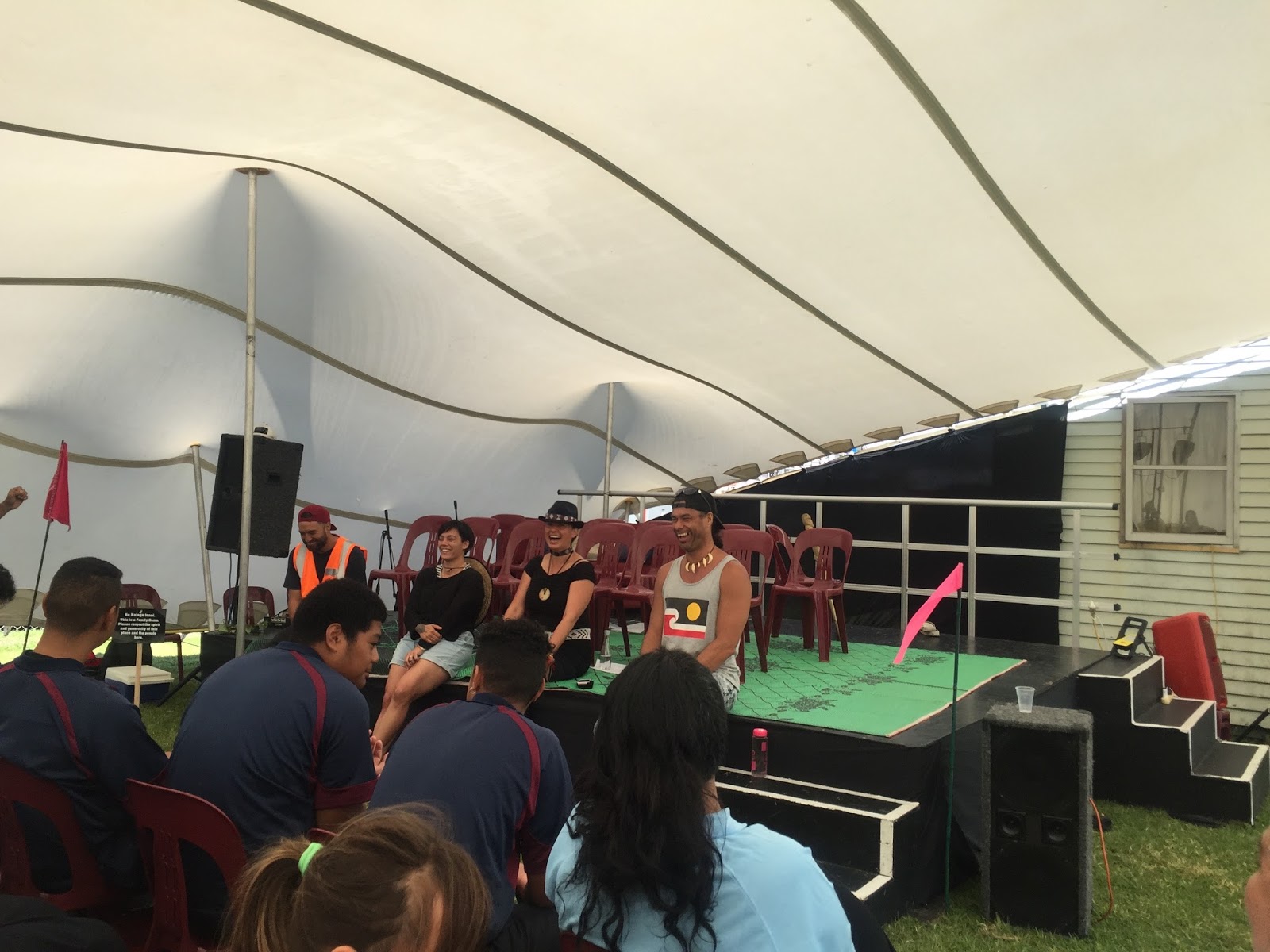
At our Power-up homework centre recently, DJ Tuaru, who runs the sessions, took the students who attended through the power of 'Talanoa', which looked at encouraging students to voice their informed opinions on an issue that interests them.  We discussed the meaning of 'Talanoa' and I found it empowering to be reminded that our Pasifika people were an oral people and that generations of our elders passed on their knowledge through song, music and storytelling. I asked DJ to come to my level 2 class, to share his presentation and help run a debate around what my kids had been learning about.  I wanted to see how the students would respond with the lesson.

Orators from around the Pacific
My students had just learnt about 2 different perspectives from the same religion in Israel who wanted different outcomes - the Israeli Defence Force and the Orthodox Jews.  We wanted to see if they could argue the perspectives from those viewpoints and respond to each other.  My recording of the lesson is below.   
(Please note: When debating, the students perspectives where in role play).


Reflection:  On reflection, I could see how hard it was for the majority of the class to speak up.  I wonder if it was the environment or their lack of knowledge of the context or other reasons.  I will have a follow up discussion this week and feedback from the class to see how they felt about it.  My next steps will be to organise smaller conversational groups, to support those who would not speak or were less confident and to allow them practice to hold conversations through different prompts and to mind map their responses.  I will also look at other strategies to encourage our students with the 'Talanoa' and ask Dr Jannie about ways to support our kids with conversations.


Acknowledgements:  Thank you Mr Tuaru for your inspiring lesson.

Saturday, 18 August 2018

Shared 'sentence' success - Level 2 Health and Social Studies

This term we have been focussing on teaching different types of sentences that can help formulate effective paragraphs in preparation for our external exam.  During our social studies lesson this week, one of my year 12 boys was struggling with how to write a power sentence.  He pulled out a little red notebook, that his health teacher, Whaea Kata had given him and looked carefully at his definition of what a power sentence was.   He tells me that they are doing the same thing in health and he just wanted to double check the meaning.


I have had discussions with Whaea Kata on how she is using sentences structures in her teaching and her brilliant idea of getting kids to write down in their own notebooks the definitions so that they can carry them around to refer to, is paying off.  As I introduced sentence structures at the beginning of the term, the health kids were like 'we're doing this in health too' and it will be interesting to see if the 10 students, who take both subjects,  show better outcomes with their writing then those students who don't.

Wednesday, 15 August 2018

Writing effective sentences using images and post its.

For my senior students to prepare for their exams, I have had to reteach and remind them to plan and structure their essays to support the writing process.  I have found in the past, that the boys especially, struggle to start a paragraph let alone write a whole essay, so my focus was to look at how to write a good effective starting sentence.

After 2 weeks of solid content on the conflict with Israel and Palestine, I went through the 'How to write effective essays in Social Studies' lesson again with the emphasis on 5 ways to start a sentence.  I printed off and laminated each slide and made the 5 sentence starter ones bigger.

"How to write an effective essay" on the wall

5 sentence types in A3

To provoke their thoughts around our context, I gave out photos with provoking images on them.  I asked them to choose an effective sentence type to create, based on what was happening in the photos. By giving them a different point of discussion to start with, I hoped it would help provide the class, especially the visual learners, a way to connect their writing to their learning.  I then encouraged them to write the sentences on post it notes, to stick to the A3 sheets on the wall.


I made mini cards with the meanings to give out if needed.

Reflections:
The skill of using different visual mediums as a source of writing is probably a skill that needs further development and use in my classroom.  Some of the students found value in the images where as others, it proved harder for them to summarise in a power sentence, what the image showed.  For the more capable students, they were able to transfer the knowledge of what was behind the image (which we had been learning about) and use that knowledge alongside the photo to provide some good power sentences.  The post it notes helped students to share their sentences and would allow them to refer to a variety for the future, if they struggled to start a paragraph.  The actual physical nature of moving and putting their post-its on the wall was something that the boys liked to do, whereas the girls needed prompting to get up-they were quite happy to show me their sentences at their seats.

Post it notes help students share their sentences

Next steps:  I can see that the students engaged in writing power sentences the most which was interesting.  Now I hope to support them in writing power paragraphs, which will be my next goal.


Monday, 13 August 2018

Essay writing in my Social Studies classroom

With the senior exams in week 8 of this term just around the corner, the pressure is on for my seniors to be ready.  The format for their exams is an essay for which the kids will be immersed in learning the context for this however, they still struggle to gage what the structure like in their minds and in the past, we haven't had great success in achieving in our exams because of this.

To breakdown ways to tackle the essay, in our department we are using T.E.X.A.S as our main paragraph writing structure.


Before getting into the context, I spent some time discussing how to structure the essays with the main point being that every essay is an argument.  Below is the power point I developed and I tried to use Marvel characters to make it stand it out.


Slide 16 - 20 are the 5 of the 12 definitions that our W.T.E.(Write that Essay) crew agreed we would share across our curriculum areas in teaching our kids.  I've decided I would print off the powerpoint and put it on the wall, then blow up slides 16 - 20 so that kids could use post it notes to share their different sentences dependant on the context of their lesson.  In my next post, I will share how the lessons went.

(Credits: Marvel images, Write that Essay)

Friday, 10 August 2018

Using SOLO hexagons and Power Sentences

Teaching Israel and Palestine in the past has been a bit of a challenge as some kids find it hard to relate to the context.   Add the fact that learning dates and key historical facts can sometimes put my kids to sleep, I needed to find a strategy that would involve them sharing their knowledge in a way that would help them map the links for writing and verbalise what they've learnt.  Here are the steps I took for the lesson.

Step ONE:  SOLO HEXAGONS.

Using the online SOLO hexagon generator, I put in all the key words, concepts, details etc that we had learnt in 2 weeks.  I wanted the kids to use SOLO hexagons to connect what they have learnt and to verbalise the connections first to the peers and then to me.

Observation:

When I pointed out to them that being able cluster and compare concepts and facts in groups shows that they are working at merit level and describing the impacts of different links on others was an excellence, students began to recognise the relevance of the exercise.


Tough guys like to hold flowers while they are completing their hexagons

Step TWO: POWER SENTENCES.

I focused on one of the sentence types that our W.T.E (Write that Essay) crew suggested we try out to help our kids start a sentence, the power sentence.  This is a sentence that has to have a punch with only 12 words or less.  I gave examples on the board and as a class we wrote one together first.  I then shared a document where by I wanted students to write 5 paragraphs and each one had to have a power sentence.   I wanted them to use the SOLO hexagon activity to guide what to write in the paragraphs.


Observation:

I realised the expectation was a bit much to get them to write 5 paragraphs and it wasn't enough to just share a doc.  I noticed the girls in the class happily opened the doc and got on with it, but the boys couldn't be bothered.  So I adjusted the lesson to get kids to share it on the whiteboard so that we as a class could judge the best one and I would award a prize to the best one.  It was then that the boys got fully involved and I took the opportunity to video it below.


Overall REFLECTION:

It was the first time that I had actually observed some of my kids handwriting something - I never knew we had so many left handers!.   In saying that, the boys were especially engaged in the competitiveness of the activity and weren't shy to put up their answers.  This was encouraging as I want the kids to feel they can challenge each other to show what they know without being shy about it.

Next time: 
I realised that the girls are quiet and I need to make sure they feel included and have a voice in the classroom.  I see that the boys have grown in confidence and are not shy to answer and verbalise by making meaning from what they've learnt but I do not want the girls to feel that they get all of the attention.  My next steps are to ensure that they are provided a platform to voice their ideas more, whether it be out in front of the class or more 1 on 1.  I will definitely be sharing this lesson with my department and will use it with my year 13's.

Wednesday, 1 August 2018

'Write that Essay' at T.C

Across our school, effective writing is one of the challenges that we are trying to address in our individual subject areas.   In my search for answers, I was excited to find a PLD being offered during the 2nd week of the holidays, around the 'Write that Essay' programme.  This is an academic writing programme that I had heard so many positive things about.  A group of staff from our school from a range of different curriculum areas, recently attended the professional development workshop and on their return, I organised a meeting to collect key takeouts and ideas moving forward. 

The W.T.E team sharing key takeouts

It was the first meeting for the group since the workshop and their discussions were positive and they had shared how they'd learnt so much from it.  They reflected on key takeouts and decided on a number of goal.  One of the goals was to focus on improving sentence structures with the help of a guide suggesting '12 ways to write a sentence', which the group has agreed, will be a good place to start.   These strategy's are ones that I had seen before and will adapt to use with my seniors.

A few of the strategies we will be trying out
In the discussion, the team agreed to try some of the strategies in their classrooms, reflect on them and come back together near the end of the term, to figure out how to share the strategies and reflections with the rest of the staff.  I've decided my job will be to support and monitor how they are going on the way, so that they can feel empowered in sharing the great things they are doing to support our learners with their writing.


Thursday, 26 July 2018

Learning about 'G.I Cheechee' at our COL's meeting

We had a really interesting session at our CoL meeting.  Here are some of my key takeouts from the session:


  • Resilient students are those who come from the bottom socio-economic quartile but who's ability to perform at or above level 3 goes up over 2 years... (PISA report).


Building Evaluate Capacity.

We need to evaluate through the success of the learner the effectiveness of my teaching and learning from what I did.  BUT it's not just enough for us to be the better teaching/learner, the kids need to say this. (figurative kids not cleaning their beds - we do it all for our kids).

We are the lighthouse inquirers in our schools for whom it rubs off on other people.  An influencer and my evaluation of my inquiry on the delivery of the children.  Its about kids being metacognitive.

In the past, teachers didn't evaluate themselves by the success of the children.  If it's not for the child, whose it's for?  It's about value-added.

Teaching IS an intervention - it's what we do everyday.  Alan Peachy said 'Great teachers make children learn'.  At the least we need to challenge them.

What do we need to do in term 3? 

We need to deliver the curriculum really well.  Make sure it's visible.  We won't be getting the crank up that we need.  If it's not visible it won't crank up as much as it should be.  We need high expectations.


We can make language exciting - don't need multiple themes, JUST a really good one.  It could last a week or more.  Language programs can be fun.

Our kids speak 'GI cheechee'- combo of broken English and broken P.I language.

Need to see my kids at least twice a week frequency.  Work out cycle rate because it matters (you won't get the acceleration).  In the instructional moments, we need to put in the language moments.

We need to think about speaking the language of success eg. "I go toilet"


We need to be aware of when they are speaking to us and each other to subtly address it.

Plan how we are going to grow/revisit/maintain the language & concepts.  Eg.  I need to remind kids of the language and need to say it back to the teacher.  We need to build it into our planning.

THOUGHT:  My next action is to encourage kids standing up and being confident presenters

  • Link the language and concepts to the known environment as the place to extend knowledge and understanding - the richness that we have (Home fires).
  • The Stop sign story - what's your legacy?
  • We need to provide the formula or the template - gifting them the shape of what you know of.  The origins of lots of formal language is formulaic.  Following the formula.


Teaching the kids when they greet a guest.  Ask people about themselves & you need 3 questions.

Spoken language is like a song - lyrical.

Goal:  Record a lesson of mine, listen to the conversations the kids have and listen to myself.

Publishing is one of the things that lifted performance.

Kids need to post twice a week to accelerate.

Friday, 11 May 2018

Learning from our mistakes - getting the boys back on track

The results of our first internal assessment are in and four of my nine boys passed.   Three of them started well but did not complete the assessment and the other two didn't even attempt it.  My hunch was that after 3 weeks of solid teaching about the context, introducing relevant guest speakers and a trip to a community exhibition, would mean that they were ready to write what was needed for their assessment.  I left them to it, expecting that they would be able to self-manage and ask for help when needed.  This was not the case and I realise that they lacked the motivation to stay focussed.  By me handing them the whole assessment, I didn't into account that maybe they would lose momentum.

Our new unit is around planning and participating in the 40 Hour Famine.  For this unit, I've decided to break down each task and do it as we go.  Students are in 4 groups and for each task, I've showed on the whiteboard each groups tasks, to motivate kids to complete them.


I have been doing this for a week and have found that the boys are responding really well to this method.  One of the boys has done more writing in the last two weeks then the whole of last term (that 10 weeks!).

I asked them why and they said it's because they could see that on the board, where their names are and if there was a gap, they didn't want to be left out or the only ones who have not done the work.  They also got ideas from each other and could see that they also had the same ideas.  I want to see how long this would work for before they got sick of it.

Wednesday, 9 May 2018

Supporting our learners by making the 'why' real.

My level 2 Social Studies class are busy preparing for the 40 Hour Famine this year, which is raising money for the refugee children from South Sudan who are in camps in Uganda.  We have been talking about human rights, and whose rights we are standing up for when we are doing the 40 Hour Famine.  I asked my kids 'what is your why for doing the famine' and the majority said was 'I'm doing it for the credits'.  I knew this would be the answer for most of them, because they struggled to relate to the context.  My hunch was that if I could make the learning real for them, they would care about the context and about their writing.

I contacted the Auckland Resettled Community Coalition and asked if there was someone who who would be willing to share their journey with our students.  Mr Gatluak Chuol who is a Community Outreach co-ordinator, contacted me and said he would be happy to come and speak to our year 12s.  In 2015, Mr Chuol arrived in New Zealand as a refugee from South Sudan.

Today we were fortunate to have Mr Chuol speak to our class about the religious conflict that had led to the civil unrest in his homeland and he described the atrocities that had happened to him and his family when his village was attacked. "One morning, bombs were dropped and we had to run. We ran to a bush. We didn't know where our parents were. We were scared of being killed and saw lots of death around us. We walked for miles with nothing". He shared the anguish of losing loved ones in front of him and how the trauma still exists with many refugees who are trying to settle in our country.

I know our kids are respectful when they have a guest speaker, but there was a strange vibe in the room as Mr Chuol spoke.  It sounded like empty silence, it looked like disbelief and felt like time had stood still.  Here was someone standing in front of our kids who'd survived the unimaginable and he choose to share his story with them, making it real.

As he wound down his talk, I invited him to wander around and have a chat with the kids who may have had a few questions but were too scared to ask.  I noticed two students at the back of the room and overheard them talking about how they'd heard about South Sudan and why we were doing the famine, but weren't really caring about it until they heard the reality from Mr Chuol.  "We complain about little things like not having money for what we want and then we hear how Sir had to see his relatives pass away around him and hide under them away from gunfire...what do we know about hardship?".   I asked them if they were o.k and they asked me if I had any tissues.  They quietly thanked Mr Chuol for being there and I could tell they were affected by his talk.

Mr Chuol with members of our Level 2 Sos class.

At the end of Mr Chuol's visit, our students thanked him for sharing his journey and a group of boys asked to walk him back to the office.  For the students that remained, I asked how they felt about his visit.  There were mixed reactions of sadness for Mr Chuol and thankfulness for what they'd had.  Later on in the day, I emailed the class to ask them to let me know their reflections about the visit.  One of the boys, who I've struggled to engage with in the past, replied.  I was surprised by his reaction and understood that he may well have found his 'why'.


Saturday, 24 March 2018

My theory of 'Action'

My theory of Action

At our recent COL teacher meeting we learnt about identifying our Theories of Action and we discussed a 'causal chain'.

A causal chain is when a cause leads to an effect and that effect becomes the cause of another effect

A leads to B. B leads to C. C leads to D.

Any intervention you design will (consciously or not) be based on a causal chain you have in mind - this is my theory of action.


Thursday, 22 March 2018

Stepping outside the classroom - real life learning in our wonderful Community.

Today our level 2 Sos class took part in the 'Home Fires' workshops as part of their assessment 'Conduct a reflective Social Inquiry 91280' into the TRC and the housing issues happening in our area.  One of the criteria requires our students to 'describe people’s points of view, values and perspectives and to consider the ways in which people make decisions and participate in social action related to the focus of the inquiry'.  The social actions that our kids have been studying in class and have happened in our community, have been wide and varied.  We watched numerous videos, read articles about protesting and listened to guest speakers (thank you DJ, Renee, Brenton and Phoenix Lemalu) about their perspectives on the issue.  But these types of learnings were still in the confines of my classroom and after a while, my kids were becoming disengaged and off-task because the context for their 'language of learning' was limited to my class.

Today they were challenged to step out of the classroom and see what the issue meant to another group of people it had affected.  Tamati Patuwai is part of a group called Madave who are a local community group and have shared their journey of the changes that are going on around them.  They invited our kids to a non-violent, artistic, peaceful expression of actions as they are a group of people whose houses are one of the few remaining on Fenchurch - the development is unbelievable!.  Every day the families in the little houses that remain, wake up at 6am to the sounds of drills, trucks moving concrete or generators buzzing furiously all the way til 10pm.  I can't imagine what that would be like!.

The group welcomed our kids onto their whenua (property) with a powhiri.  I sensed our kids feeling nervous and apprehensive for the day.  But those feelings soon disappeared as the day went on.  They were feeling like one of the whanau.  Our kids had a choice of one of 4 workshops:  Poetry, Graffiti, Dance and Photography.  Each group had the same question - what does a 'Home' mean to you?  Seeing the kids step out of their comfort zones and not be shy about sharing what they've learnt in such a short time, showed me the value in taking these 'last minute' opportunities when they come.
The respected Kaiako for the each group.

I was worried about taking these students out of their other classes to this field trip because I know how hard it was when half of your kids are taken out out of your class especially during an assessment.  Believe you me,  I know how frustrating it can be.  But as I look for ways to engage my kids better, if as a teacher you are willing to take the risk and in your hearts of hearts know that the value & learning in it is bigger then the walls of our classroom, sometimes you just gotta take that chance.

I saw our kids respectfully treat Tamati and his sister Ngaraiti's home like it was their own.  I saw how involved they became in their groups learning and engage in their learning like I've never seen before.  And I saw how they stood up proud of who they were and who they represented.  Three of them said they didn't want to leave, and when we got back to school, two of them told me that they would be going back for the evening session.

When I ask myself 'was it worth all the grief that comes with being last minute?' I say 'hell yeah - just ask the kids!'
Ms Gordon and the little fulla 


A beatiful Tui painted on the side of the house


The photography group is brainstorming

The poetry/haiku group getting their poems ready.

Photographers out and about

Teariki starts the graffiti groups story

Vei asked Ms Gordon if she could take a photo of her art work

The words become real.

Lawrence learning his dance poses


The completed graffiti 'wall'

The Graffiti group sharing what they have learnt

The photographers sharing what they have learnt

Go Tupou!

Lawrence and the dance team in action.


Chasity, Evelyn and Latisha being expressive in their dance

You were amazing dance team!

Our poets Kaho, Zeke and Neva sharing their poems.

Antonio has the last word.

COL Inquiry #6C: Academic Reading "Teaching to the North East"

From the Secondary Teacher Literacy Handbook page 33:  Bishop (2019) stated that to improve Māori achievement, teachers need to  create an e...