Showing posts with label SReflect. Show all posts

Saturday, 7 December 2019

Thinking about my Inquiry for 2019 #1: The Big Summary!


When I looked back at my teaching, my concern was that students were not completing the work that I’d set them.  I noticed this when the kids found it difficult to write a quality paragraph.  

My initial evidence of this was through reading their paragraphs and looking just at the ideas that they’d covered.  I knew this wasn't vigorous and it was impressionistic rather then analytical.  On reflection,  I needed to think about what was the causality here.  In the past I had used student learning strategies that worked for some but not for all of the students so I decided that if I look at the way I was delivering learning, I could I make a difference to their capability.

I needed to collect samples and Dr Jannie suggested I put an analytical lense on it.  What I was seeing was that students were able to talk about their learning at the time which was a strength, but I also saw a lot of gaps when it came to writing.  

I asked myself 'Have I given them the tools that they need in order to become more capable writers or are they just intrinsically not able to write’.  Ah No, light bulb, they are clever people - so therefore it's about the tools.

I did an extensive quantitive process of vocabulary measuring comparing times 1 to time 2 in their paragraph writing.  After doing the analysis, it became clear is that their lack of vocabulary and their inability to expand ideas was sitting inside their writing.  They also lacked organisational skills.  From this, I wondered if I am going to teach writing or is there something deeper then that.

When I unpacked my pedagogy, I realised that because of the pressures of time and the need to get through content,  I would basically scoot over learning and only really tapped the surface.  BUT if I did deep diving and we talked our learning more, we would foreground the language which would then inform their writing. 

I decided that if I was more intentional in noticing language, that that would increase their uptake and an increase in noticing (which is one of the optimised conditions for learning).  If we, both orally and in written, deliberately put out in our mind and our eyes on how the language is working and what the language means, then they are more likely to hold it in their head and make it their repertoire.  By doing that it I believed it would make a difference to their writing.  

During the interventions, it was important for me to monitor student progress as well as reflecting on my pedagogy when teaching during my inquiry.  As challenges arose, I tried to tweak small things to see if they could help address the challenges.  It was important for me share these tweaks because it helped justify why changes were made and I could revisit whether these tweaks worked or not. 

Although the evidence shows some shift for one of my students, there are still gaps in their writing that I hope to address in my future inquiries.  

Monday, 2 December 2019

Evidence #1: A Quantitive Analysis of Student Writing

To find evidence of whether my inquiry (interventions) has shifted student writing, I discussed ways to do this with Dr Jannie.  She suggested that I carefully analysed writing samples from the beginning of the year, pre intervention, and compared it to their most recent piece of writing.

This is an analysis of writing for 3 students in 9PKr: (M1, R1 and A1 are codes for the students names).  What I did was to select 3 students who were low, middle and upper in their asttle writing and PAT results to start off with.  I then gave collected two writing samples (Time 1 and Time 2).  I then compared the following:
  • How many Notions and Ideas the student had
  • Examples of complex word groups used
  • How well ideas were expanded and detailed under text development
  • If the student was able to write in an academic style
Using the vocab profiler called ‘Lextutor’, I put in the sample writings and calculated the number of simple, compound, complex and complex compound sentences in the sample.  The vocab profiler also calculated k1 (1-1000) and k2 (1001 - 2000), which counts the most frequent English words that people should know (eg k1 is the first 1000).  AWL stands for ‘Academic Word List’.  In the last column, I counted how many sentences/phrases were topic specific.  
Lextutor
I have linked the collated results here and taken screen shots of the evidence below:
Here are the links to each students of writing:
Summary:  After an extensive quantitive process of vocab measuring comparing times 1 to time 2 in my students' paragraph writing and looking at qualitative student voice feedback,  I found that the higher the stanine of the learner, the more stand out are areas of uplift.  A1 has made significant areas of uplift too, mainly a greater density of ideas and notions, and complex word groups.  R1 and M1 did not make as much gain as I’d liked.

After doing the analysis, it has became clear it is that their lack of vocabulary and their inability to expand ideas was sitting inside their writing.  This was evident even after the interventions I had applied in slowing down the learning.  Overall they also lacked organisational skills.  

My learnings from analysing data/writing academically is that I need to do this more to understand the needs of the students more purposefully and it definitely helps direct a clearer inquiry.  Quantitive data combined with a qualitative approach gives a more realistic picture of where our kids are at and how my teaching can be guided and informed when planning my inquiry.  In my next blog, I hope to provide an overview of my inquiry process.


    Thursday, 21 November 2019

    My 'Bursts and Bubbles' Presentation

    Today, I presented alongside my fellow COL'ers my Burst and Bubbles presentations.  We were given 3 minutes to present. Here is my one:)

    Will putting the focus on language by deep diving into text, enhance year 9 understanding and comprehension of text to improve achievement in writing? 

    Have you ever taught something then asked your students ‘so what did you learn’ and they look at you like you’re speaking another language?  I get that everyday and in an ideal world, I would spend hours revisiting my teaching but in reality, I would scoot through content and hope for the best.

    The catalytic aspect of student learning my inquiry focused on this year was …..getting kids to notice language by deep diving into text and slowing down my teaching through talking the learning.
    I noticed  ……that my year 9’s were not writing good quality paragraphs, so I needed to build a rich picture of my students’ learning by collecting writing samples, asttle and PAT results, student voice etc.  

    The main patterns I found were  …… that within their writing there was a clear lack of vocabulary and an inability to expand ideas.  So then I thought, am I going to teach writing or is there something deeper then that, that I needed to address. 

    I was good at…engaging the class in discussions around contexts But I realised that my students would likely make more progress if... I allowed them the time and opportunity to deep dive into text and talk the learning without time constraints.

    So a change I made in my teaching was to  …Have ‘Talanoa days’ where we just explored contents/context through talk and I couldn’t take it for granted that kids knew words.
    I read alot of literature and called on some experts but the key biggest support I have found was working closely with Dr Jannie Van Hees.

    The easiest things for me to change was... sounding out words with more purpose and intent which required lots of talking and I like talking alot.

    The hardest things for me to change was... letting go of time pressures and the thinking that kids needed to write something everyday to show me they’ve learnt something. 

    Some changes I made along the way were… to cut down on trying to teach too much content over a unit but to focus on quality and deep diving through talking the learning so that we could foreground the language.

    Overall I would rate the changes in student learning as… happening in small doses but not consistent enough to impact a shift in achievement and I know this because when I analysed their writing and vocab, students were expanding their ideas more, but still lacked the skills to write competently.  

    The most important learning I made about deep diving into text was that... kids need optimal conditions to uptake the language.  They need time to allow for deep diving and they needed an expert with the capabilities and tools to teach to the students needs.

    The most important learning I made about inquiry was… keeping your eyes on the prize is the key.  If I don’t blog, I fall behind.  Let the kids know that you are collecting evidence to become a better teacher is being open, transparent and patient. 

    Some learnings that would be relevant to other teachers are… 
    • Always back up your hunches with evidence that proves or disproves your theories.
    • It’s o.k to have stink days and share it because it saves other people having a stink day too. 
    Next steps would be to work collaboratively across departments to give kids optimal conditions to learn language.   Learn how to be a teacher of language eg. know what a complex compound sentence is.  Prepare our year 9 teachers for the year 8’s coming through by developing richer learning environments.  

    Friday, 16 August 2019

    Monitoring #5: Student feedback on our lesson on key concepts

    Today I sat down with a focus group of students who are in 9PKr to show them the lesson I taught on key government concepts and to ask for their feedback on their thoughts of the lesson.  I also wanted to know if there were any other ways that I could support them in their learning.
    I choose two boys and two girls from the class with mid to high levels of ability.  I did this because I thought they wouldn't be shy to share their ideas and because they seemed engaged during the lessons.  I have coded them as:  T2 and T3 = Male, M2 and A2 = Female.  Here is a snippet of our conversations.

    Did you enjoy the lesson? 

    M2:  Yes it was cool
    A2: That was one of the funnest days because we actually worked as a class and everyone participated.
    T3: We got to talk about words that we didn’t know and practice them heaps

    Is there anything I could do to help you talk about your learning more?

    T3: Make it a challenge and put us in groups. And whoever gets the answer right, gets a prize.  Us boys like challenges.
    M2: Give us more things where we can move around and have to talk to each other.
    A2: Yea like maybe do things where we don’t have to talk to the same people

    Should we mix up the groups?

    A2: Yes cause we’re always in the same groups

    Anything else?

    A2: Oh miss, can we try debating once in a while because we did it in Health and it was fun.  It we can hear from everyone even the quiet students.

    Tell me more about that?

    A2: We had boys against girls and it was fun.  We had to really about what to say because
    T3: Have us in groups of 4 or how we had the U shape like when Ms Jannie was here cause it made everyone on the same level and we all had to contribute.

    Reflections:  As they watched, I could see they were interested more in what they were doing during the lesson rather than what I was doing.   I think one of the things that I have learnt from showing them the lesson was that as they got to see what they were doing and how they were responding, they became a bit embarrased and they were surprised to see themselves behave the way they did.  From time to time a few of the kids called out, made comments that could be heard on the video or distracted others from their learning.  Although this was not how I intended to use the video, it was interesting for me to see their reactions and I feel that this could be a useful tool to do from time to time to keep students in check.

    Next steps:  I enjoyed listening to the students' feedback and found that by giving them a voice, I could hear how they wanted the lessons to go.  I want to use some of their ideas in our next lessons to support their learning more and find more opportunities to sit down with different students in class to ask for feedback as a focus group.

    Wednesday, 7 August 2019

    Monitoring #3: Choosing an area of focus in my teaching


    Quizzing the kids by slowing down my questioning
    This short video observation is one I am examining more closely to monitor my questioning of my students.  It comes after 1 hour of learning the concepts and their meanings and thorough discussions around examples of them.  I’ve chosen to highlight this part of my teaching practice, as normally, my default teaching would have shared a document and asked students to write down their answers and share it with me.  For my deliberate teaching, I’ve chosen to use verbal prompts to encourage students the opportunity to verbalise their learning in a comfortable classroom environment.  
    Positives: 
    • Holding the suspense of students by not rushing the questions.
    • Not worrying too much about kids who call out things that isn’t the answer.
    • Being aware that kids may miss out and acknowledge them.
    • Most of the kids were engaged when I slowed down the quiz
    • For the boys, I wanted it to be a bit more challenging and so I put a small time challenge on it.  They ended up trying to beat their own times and their friends.
    Work ons:  
    Perhaps have the students lead the words and ask each other the same way.  I can model more.  Not have me talk the whole time.  I said ‘shhh too many times’.  I also say ‘o.k’ and ‘right’ a lot as well.

    Observations and next time actions.
    When scoping the room, I’m aware that Marco is not looking my way, but he put himself at the front, which was unusual, he is usually hiding at the back.  I have noticed that he wanted to take part in the group challenges so for next time, I will encourage and invite some group challenges.  
    I am also aware that girls at the back like Ana had her hand up and that I ensure that they aren’t ignored by attention being on the boys.  I might give them a different challenge because they are high ability students.

    What I learnt about myself doing this:
    I would normally rush tasks and when I have asked questions in the past, I would usually have asked students I know would answer the question.  This time, I purposely used wait time a little bit more and dragged out the questions because I wanted kids to think about the question and if they were picked, they could be ready.  I think this helped build their confidence more and kept them a bit more engaged for the next question.  

    I enjoyed this process and even though it may have seemed like we didn’t get much done, or any writing or reading, I felt happy with the outcomes.


    Monday, 5 August 2019

    Monitoring #2: A Colleagues observation of my teaching


    In my on-going discussions with my department about my inquiry, I described to a colleague how well I thought my lesson went with my year 9’s, in learning the 7 concepts we need to know in our new Government unit.  I explained in my lesson, I had to focus on just getting the concepts learnt repeatedly and that this was a change in my teaching that taught me how to be more patient with my kids.  She wanted to see what this looked like so I offered to take one of her year 9 classes through the same lesson, for the first period in a double. 

    My reflections:
    The class was 9PDv and I taught exactly the same lesson that I’d taught the day before with 9PKr.  As it was just the first period of a double, their teacher continued to support their learning of the concepts during the next period.  I felt they are responded really well to the lesson because they seemed engaged and did not shy away too much from giving it a go.  I have not taught them before and it was refreshing to have different faces in front of me and different dynamics in a classroom.  


    Staff feedback:
    The feedback from my colleague was that she enjoyed seeing how I engaged the students in slowing the learning and forcing them to use their brains to learn.  She was surprised to see some of the loud boistrous boys standing up and giving the challenges a go.  She liked the way the kids stay focussed on the tasks and it gave her encouragement to try the model that I’d shown her.  She also shared it was one of the rare times that they’d been fully engaged.

    A student teacher who’d also observed the lesson said ‘in both my practicuums, it was best teaching that had the kids so engaged that I’d seen so far, no offence’. (I was abit taken aback by this comment but felt humbled as well)

    Student feedback through blogs:
    Before the end of their double period, my colleague asked her class to blog about what they’d learnt during the lesson.  I enjoyed reading the blogposts below and felt positive and glad that they’d learnt what we’d set out to achieve.


    Thursday, 25 July 2019

    Connecting with whanau to build student profiles #1

    Studies show building a connection with whanau and families can support the achievement of a student.  In my efforts to know my learners better, we have our student achievement conferences and I asked the tutor teacher of 9PKr if I could support him in meeting some of the parents of my inquiry group.  My main purpose was to share my inquiry with them, discuss some of my findings, then hopefully set goals with them.  My key focus was looking at reading but if they wanted to know about writing, I was happy to share what I'd learnt about their child with them.

    I went armed with the following resources:
    * Profile sheets of evidence I had collected
    * A blank graph that I had pre-sketched to show the progression of asttle reading results for 2018 and 2019 (and beyond).
    * 'The Big Picture' diagram for students to complete
    * Strategies for supporting students at home from Dr Jannie and department discussions.

    For each student, I wanted to share historical data collected from their primary schools (2017/2018) mainly asttle reading results and compare them to this years two test points (in February and June).  I wanted to explain where they needed to be by the end of year 10 ready for NCEA at the start of year 11.  I am also to sharing ways we could all support their child, through strategies discussed from Dr Jannie Van Hees and in my department discussion.  I am hoping that we could set collective realistic goals.

    This morning, I met with two students and their families, and have collated what I will tentatively call a 'tri-angulation' of profile collecting for these students. 

    Student ONE:  T1 is a young Maori boy, whose mum came in for his meeting.  I have found that he is a capable critical thinker and is able to verbalise his learning, but can not and will write much and this was evident in his asttle reading/writing scores where he scored 2A's.  I also know that socially, he struggles to fit in with his peers.
    Tri-angulation of data and evidence for student T1
    After much discussion, I found out that he'd only been speaking English in the last three years and he was the lead speaker at his kura kaupapa when he'd left.  She wants to continue encouraging him in his Te Reo and says he enjoys school. 

    Quick reflection:  I was taken aback and said to her I now see him in a totally different way.  I can see now why he was having issues fitting in and I often see him bursting at the seams to answer questions.   I have written some reflection here about my next steps with him that I hope to implement in my theory of action.

    Student TWO:  A1 is a young Maori girl whose mum attended her meeting.  She is a highly capable student who scored 4P in asttle reading and 5A in her writing.  She fits in well with her peers and always completes tasks to a high standard.  At times though, I noticed that she was only doing what was required at the fastest time possible and only after I pushed her to extend herself would she actually do it.  She would also get annoyed at the smallest things.

    When I asked mum what her aspirations for her daughter were, she was a bit taken aback and said it was a good question (I don't think she was expecting the question). She wanted her daughter to be healthy, safe and confident and to be whatever she wants to be.  I asked A1 what she thought about what mum said and she said yes, I know.  I reminded A1 that her next steps were to continually challenge herself and be a highly critical thinker by digging deeper and finding out more.

    Quick reflection:  I am thinking about ways to extend these higher level students in the class and there are about 5 or 6 (mostly girls).  I don't want them to lose momentum and feel that with more support, they could be ready to do NCEA in year 10! 

    I am really happy that I met these students and their mums.  It has given me a whole new insight into who they are, how and why they behave the way they do and what I need to change in my approach to teaching them.  I feel more confident in identifying exploring ways to address their needs, it's just a matter of finding the right interventions -watch this space.

    Friday, 24 August 2018

    My Hui presentation

    The Manaiakalani Hui is an opportunity for our CoL teachers to share our inquiries with lots of different people who are invested in some way or form in or Kahui Ako.  This year, we made one minute introductory videos to our inquiries, which provided a taster for anyone who wanted to find out more.   Once our videos were played, we held a round table session for 10 minutes which allowed us to discuss our inquiries further.   Below is my video:


    At my round table sessions, I spent much of my time talking about what I had found with my inquiry and I there was a lady who was also a social science teacher who asked some really interesting questions and comments.  I shared that a group of us teachers have met to look at using and teaching sentence structures that was adopted from the 'Write that essay' programme and how much students learnt from the strategies.  One question was whether I saw the benefits of using the writing strategies in a 'Tuakana Teina' aspect, where the senior boys could support the junior boys in their writing.  I said that was an interesting way to use the skills they'd learnt and I would look into how they could work.  It was refreshing to share our inquiries with like minded people who cared about the learnings of the kids in our Kahui Ako.


    Wednesday, 9 May 2018

    Supporting our learners by making the 'why' real.

    My level 2 Social Studies class are busy preparing for the 40 Hour Famine this year, which is raising money for the refugee children from South Sudan who are in camps in Uganda.  We have been talking about human rights, and whose rights we are standing up for when we are doing the 40 Hour Famine.  I asked my kids 'what is your why for doing the famine' and the majority said was 'I'm doing it for the credits'.  I knew this would be the answer for most of them, because they struggled to relate to the context.  My hunch was that if I could make the learning real for them, they would care about the context and about their writing.

    I contacted the Auckland Resettled Community Coalition and asked if there was someone who who would be willing to share their journey with our students.  Mr Gatluak Chuol who is a Community Outreach co-ordinator, contacted me and said he would be happy to come and speak to our year 12s.  In 2015, Mr Chuol arrived in New Zealand as a refugee from South Sudan.

    Today we were fortunate to have Mr Chuol speak to our class about the religious conflict that had led to the civil unrest in his homeland and he described the atrocities that had happened to him and his family when his village was attacked. "One morning, bombs were dropped and we had to run. We ran to a bush. We didn't know where our parents were. We were scared of being killed and saw lots of death around us. We walked for miles with nothing". He shared the anguish of losing loved ones in front of him and how the trauma still exists with many refugees who are trying to settle in our country.

    I know our kids are respectful when they have a guest speaker, but there was a strange vibe in the room as Mr Chuol spoke.  It sounded like empty silence, it looked like disbelief and felt like time had stood still.  Here was someone standing in front of our kids who'd survived the unimaginable and he choose to share his story with them, making it real.

    As he wound down his talk, I invited him to wander around and have a chat with the kids who may have had a few questions but were too scared to ask.  I noticed two students at the back of the room and overheard them talking about how they'd heard about South Sudan and why we were doing the famine, but weren't really caring about it until they heard the reality from Mr Chuol.  "We complain about little things like not having money for what we want and then we hear how Sir had to see his relatives pass away around him and hide under them away from gunfire...what do we know about hardship?".   I asked them if they were o.k and they asked me if I had any tissues.  They quietly thanked Mr Chuol for being there and I could tell they were affected by his talk.

    Mr Chuol with members of our Level 2 Sos class.

    At the end of Mr Chuol's visit, our students thanked him for sharing his journey and a group of boys asked to walk him back to the office.  For the students that remained, I asked how they felt about his visit.  There were mixed reactions of sadness for Mr Chuol and thankfulness for what they'd had.  Later on in the day, I emailed the class to ask them to let me know their reflections about the visit.  One of the boys, who I've struggled to engage with in the past, replied.  I was surprised by his reaction and understood that he may well have found his 'why'.


    Sunday, 10 September 2017

    Using SOLO to support my year 12's exam preparations

    This week is senior exam week for our students and trying to get my year 12's ready for exams has been challenging at times, especially with the mixed levels of literacy in my class.  Students have to write an explanatory essay, and the context is the Israeli/Palestinian conflict.

    Students were engaged with learning about the conflict but when it came to retaining some of the information and using it to write a structured essay, quite a few didn't know where to start.  

    A few weeks ago, I taught some facts and issues around the conflict using the presentation below.  


    The slide is quite content heavy, so I created a SOLO Hexagon activity to help them remember the key ideas and concepts.  I wanted them to connect ideas so they could show they were working to at least the relational stage of SOLO taxonomy.


    At first, students were a bit hesitant to use the hexagons and had to refer to their notes.  But I persisted and every day for two weeks, I pulled out the hexagons and as I did, I expected complaints like 'why are we doing this again' and 'boringgg'.  Instead, students seemed excited when I brought out the hexagons and became confident in explaining how they were connected.  Each time they used the hexagons, I would mix try and mix up the task abit - sometimes they needed to work individually, sometimes it was a race to get it done the fastest or it was work in a mixed group with someone you'd never worked with before and be ready to explain to them what you knew.

    For the less confident quieter students, I asked them to tell me the story of the conflict from their hexagons and it was nice to hear them articulate what they knew about the conflict.  It was tempting for their confident friends to jump in and try to help them out, but with a bit of guiding and patience, the quieter students were allowed their moment to speak.

    Explaining to each other how ideas are related. 

    After 3 weeks of hexagons, I wanted the students to firstly as a group, write down the what they'd learnt.  I wanted them to do this so they could show how they could collaboratively come up with what they thought was the best answer and then I could help them formulate and structure their paragraphs better with some formative feedback.   One of my quieter students completed the task straight away, which I thought was fantastic.


    Using the hexagons has allowed my students to explain what they've learnt and gain a sense of confidence in using them to help structure their essays.   My next steps are to develop strategies which will allow for a deeper level of understanding, so that they could explore and make predictions about the future of the conflict.


    Friday, 28 July 2017

    The Heart of Innovative Teaching - Unpacking the 'TPACK'

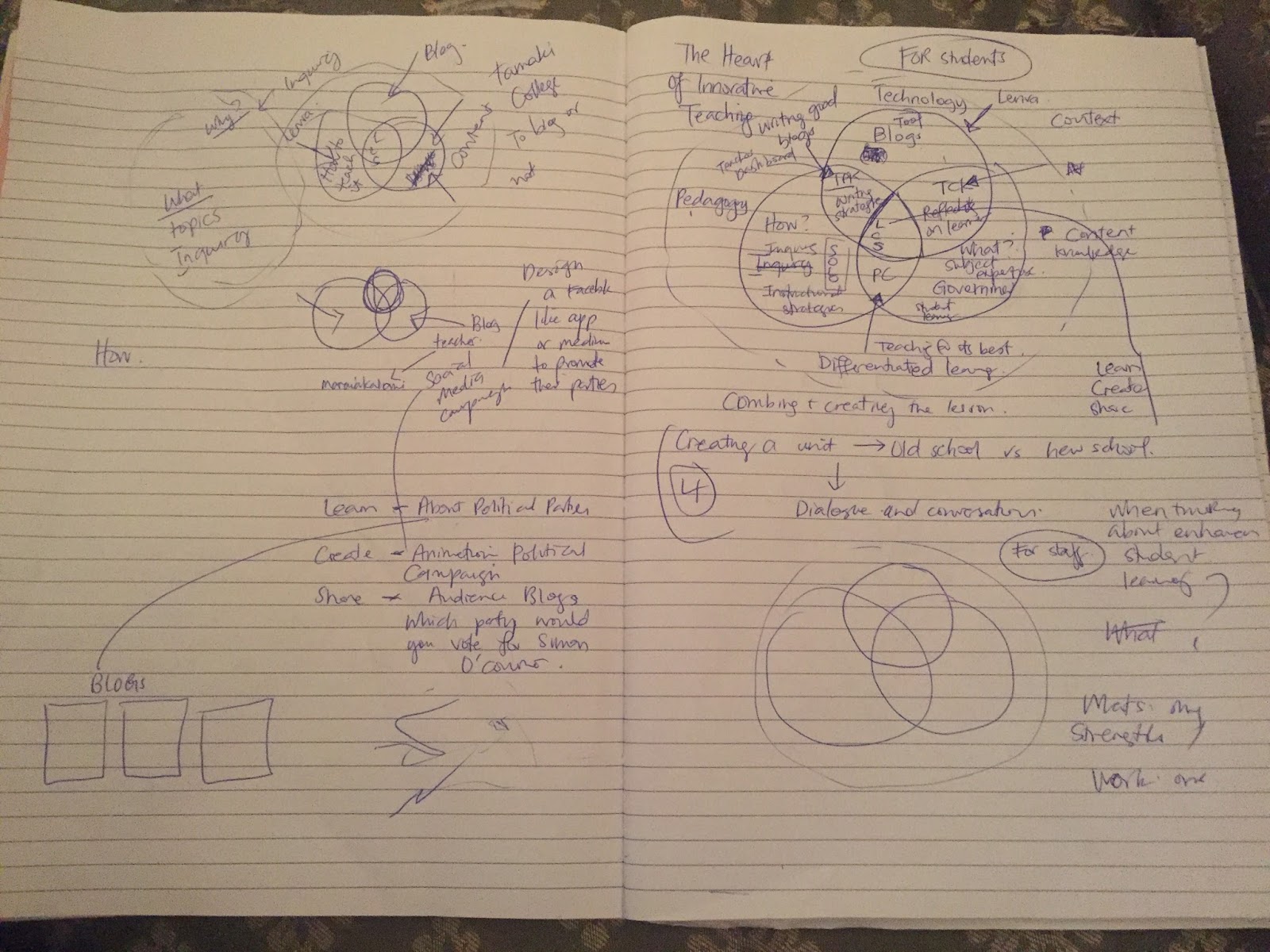
    Now that I have discovered which framework  suits my MIT Spark inquiry, the challenge is 'what does it look like in context?'.  As mentioned in a previous post, my scribing on paper has helped me formulate an idea that could be 'innovative' (let's see what my bosses say lol)!  I have attempted to apply a TPACK framework to a teaching and learning context that I am familiar with - social studies at Tamaki College.

    I started with the PK (Pedagogical knowledge) and the CK (Content knowledge) circles because I felt confident with the them.  As a teacher, my PK are the practices and methods that I use for teaching and learning.  It's me knowing how students learn and using strategies that would suit their learning needs.  My CK is everything I know about my subject area alongside knowing what students need to know to achieve success.  When you combine the two, you get the PCK (Pedagogical Content Knowledge) is basically knowing how to teach the content effectively(and be able to assess it and report on it).

    At this stage, I have made the PK and CK circles bigger then the TK (Technological Knowledge) because I am not an expert in the area of blogging as the technological tool.  The TK is where I need to know how to use the tool effectively to achieve effective outcomes.  The TPK (Technological Pedagogical Knowledge) is where "an understanding of how teaching and learning can change when particular technologies are used in a particular way" (Koehler & Mishra, 2009).  It is like understanding the need to use digital feedback for example in your teaching and planning because it is good practice.  

    The TCK (Technological Content Knowledge) could be about using the technology to enhance the learning of my subject and teachers being aware of opportunities to utilise mediums other than the ones they are used to.

    Lastly is the 'sweet spot' or the TPACK (Technological Pedagogical Content Knowledge) which is where all of the 3 knowledge areas meet.  Koehler & Mishra (2009) study of TPACK defines the framework as follows:

    TPACK is the basis of effective teaching with technology, requiring an understanding of the representation of concepts using technologies; pedagogical techniques that use technologies in constructive ways to teach content; knowledge of what makes concepts difficult or easy to learn and how technology can help redress some of the problems that students face; knowledge of students’ prior knowledge and theories of epistemology; and knowledge of how technologies can be used to build on existing knowledge to develop new epistemologies or strengthen old ones” (Koehler & Mishra, 2009).

    On my diagram, I have highlighted in yellow examples of how I would apply TPACK in my teaching and learning area of social studies with the content based around a year 9 study that my students are currently completing on 'Our Government'.  

    The parts in yellow show an example of applying a social studies context

    I have also put around my TPACK wonderings and questions that I want to apply/research further because I can see how initiatives that we currently have at our school could fit into the framework.

    My innovation lies in the use of our Manaiakalani model of Learn, Create, Share at the centre of TPACK to enhance student learning - how can we get it right at the core of TPACK with what we know works??  I have drafted an example of a possible assessment using TPACK, which I know could do with defining and developing further!

    I am really happy with my TPACK framework take 1 model because it has helped me get back on track with my MIT inquiry!  I look forward to sharing more information on my TPACK journey as I investigate further how to make sure we hit that sweet spot right!

    (My scribbles are an important part of the planning process hence why I have chosen to show them here).


    Saturday, 24 June 2017

    Using a writing strategy with my year 9 Sos class

    After reading examples of writing (like blogs and summary paragraphs) from my year 9 social studies class during their first unit on 'sustainability', I felt many of them lacked structure and did not allow me to understand where the gaps were in their learning.

    For my inquiry into how to improve the writing of our year 9 boys, I wanted to trial a writing strategy that I had learnt from Robyn Anderson at Panmure Bridge.  This strategy would hopefully allow students to formulate a more structured summary from their learning.

    The context that we had been learning about was the impact and effects of globalisation in the small country of Tokelau.  Students had been looking at the push and pull theories of migration and needed to describe reasons why Tokelauans had moved to New Zealand and the issues they'd had with moving.  I found a reading which I felt students could cope with and asked the question:


    What was life like for the Tokelauans?


    From this reading, students had to choose the 20 most important words that they felt they learnt from the reading, then 6 of the most important words from that list of 20.  Then they needed to use the 6 words in a summary. I structured the template similar to one the that Robyn had used in her teaching.


    Once I shared the document, a few interesting things happened.

    I found a number of students struggled with the reading itself.  They complained that it was too much, that it was too hard and the black background was distracting.  I told them to break the reading up by chunking it, and reading one paragraph at a time.  I asked them to find 2 or 3 important words from each paragraph and to remember to stick to the questions.

    One or two students found 10 words and struggled to find 20, another wanted to go straight to the 6 most important words, and another wanted to write the summary straight away.  I reminded the class that it was important for me to see how they found the words that they did and how it would help them write their summary.

    All in all, students worked really well on developing their summaries using the key words that they'd found in the readings.  Rather then me just telling them which were the important words, they were able to show what they thought was important and could justify these words to me.   I could direct the students who'd missed the mark or missed answering the questions, because I could see the gap in their thinking.

    Most of the students took their time to produce their summaries, which I found interesting.  When I asked them how they felt about the writing the summary this way, most said they enjoyed being able to take their time to complete the summary because they didn't have to write the summary straight away as they'd had in the past.  They were able to see the connections between what was important to write and how they wrote it and found the value in doing it this way.

    Whilst the majority of students who completed the exercise wrote their summaries on a document, one or two students shared their learning on the blogs.  In the future, I am hoping to use this strategy more often particularly at the end of the unit and I would like to see students working in groups whereby they need to debate and deliberate over which words are important.  I would also like to see students who are capable of extending themselves, to write more comprehensive summaries to show their learning.

    Leopote's blog summary


    Saturday, 17 June 2017

    Making connections across our schools to share strategies that work

    Part of the struggle that my students have is engaging in the texts that they are reading.  Too often what we give them to read is irrelevant or too hard or boring (a comment made by a year 9 student in my class just last week).  I was frustrated in trying to think of ways to address this issue and although we have a wealth of strategies that could use, I wasn't sure where to start or which strategies would work.  Then I read a blogpost by Robyn Anderson at Panmure Bridge, one of the primary schools in our Manaiakalani cluster and enjoyed reading about the learning that was happening in her classroom.

    In her blog, Robyn shared a lesson that worked with her class who were looking at a text and trying to figure out the author's message.  She shared how surprised she was when students used strategies and scaffolds that they'd learnt before to breakdown the text and transfer this skill across to a text without even being told to.

    Robyn's blogpost resonated with me.  How awesome would it be that when students are faced with a task, they search in their toolkit of knowledge to choose a strategy that they think would suit the task.  And they do it collaboratively.  And without being told!

    I really wanted to know more!  I met with Robyn and she shared the frameworks and guided teaching and learnings that she used with her class. They were simple, clear and collaborative.  Two of the ideas that Robyn shared were based on Aaron Wilson's 'Five ideas for helping students develop a basic understanding of the text' which were used to help students engage with a text.


    Robyn has invited me to see this learning in action which I can't wait to see. Now that I have heard first hand how an experienced teacher had implemented guided reading strategies in her programme and the way students were able to use them to guide their learning, I am hopeful that I can develop some of these strategies in our junior school, in an effort to engage our students more when it comes to reading.

    Friday, 12 May 2017

    Making new habits - when teachers blog in a department meeting

    One of the key achievement challenges that we have in our cohort is how to raise the writing levels of our students, particularly our boys.  At our department meetings, we are limited on the amount time we get to spend on figuring out ways to engage and motivate our students to write. Quite a bit of time is spent on admin, which is no doubt important, but alas once we get to talk about strategies and relevant activities that we could use in the classroom, the fatigue of a long meeting has set in.  Nevertheless, I needed to use the short time I had at the end of our meeting to tackle a few things that I wanted them to understand - blogging is important and relevant for teaching as inquiry and we need to use and develop more structured writing frames in the classroom.

    Aaron Wilson from Woolf Fisher says that one of the ways to get students to write is to ensure that they are writing for a purpose.  The purpose for the writing activity that I got my team to do was essentially for their teaching as inquiry but also to understand how important it is to guide our students through writing. We also expect our students to blog and yet it has not been a main focus for many of our staff.  Only one of my team members regularly blogs and I felt it important to allow my team to blog in an safe and comfortable environment.

    As with our kids, I didn't want my team to be stuck on how to start or what to write about.  I shared a structure around getting them to discuss a problem or a challenge that they'd had in their class, a strategy they used to address the challenge and a short reflection on what worked etc.  I also showed them examples of blogs using the template, my own one and Renee's who is one of our newer members on the team. I asked her to talk us through her blog to show how she formulated it and what she wrote.  She shared the fact that it did take her awhile to getting blogging, but understood the important purpose of doing so for her own professional growth.  In allowing her to share her experience, my team could feel that they could do it too.   I shared the template on a document and asked them to complete the task in 5 minutes.

    I observed how members in my team prepared to write.  Aaron Wilson shared an insightful point about metacognitive writing strategies, and understanding how people prepare to write as being just as important as the writing itself.  One of my team stared at the ceiling for a bit, another wrote notes on bits of paper and brainstormed ideas, and another grimaced at the screen, adding and deleting words and checking the examples I provided before starting with 2 minutes left.  

    After 5 minutes, I told everyone to finish off their sentences.  A comment was made about knowing how the kids felt when they're forced to write in a short amount of time and the team agreed that they needed a bit more time to do a good job for the blog.  I gave them til the next day.  What I did find interesting is how engaged my team were when they knew it had a purpose and with the limited time we had to do the activity, I found that I could achieve more by putting a few things together - blogging, writing framework and teaching as inquiry all rolled into one.  

    When I checked their blogs the next day, 4 out of the 5 had blogged.  The next step is to get the teachers to use the same strategy in the classroom with the kids.


    Friday, 17 March 2017

    To blog or not to blog - that is the question!

    One of the biggest tools of the Manaiakalani model of 'Learn, Create, Share' was the sharing of students learnings through blogging, something the primary schools in our cluster have taught their students to use.  At Tamaki, blogging was being used by some staff with their classes but we still needed to use this better as it inconsistent and under-utilised in our school.

    For our year 9 sustainability unit, I wanted to develop the use of blogging in our school to ease the transitions from primary to secondary and thought that if we enforced blogging as an expectation at in social studies at least it could be filtered across school into other curriculum areas.  I was happy to trial the setting up of the blogs and implementing it into our units. I decided to create class blogs whereby the teacher would post ideas that kids were learning or activities or questions that the class could relate to, in order to ensure that learning was visible to an audience like our parents and other students across the school.

    Firstly we needed to ensure that our kids had blogs and although it was a little bit of a logistics barrier at first, eventually the majority of the students were up and running using their blog addresses from their primary schools.  One of the reasons why it was important to keep their primary school addresses was because we could see a shift in their writing and we progress in their thinking.  The tracking of their learning journey from years 0 (for many of them) to where they were now would help us know how much of an impact each of the stages of their lives had on them  - imagine looking at your blogs in 20 years time and remembering all the wonderful memories you made at school!

    Secondly, I had to familiarise myself with blogger.  I have to admit, I had rarely used it for student work let alone as a means of communicating with the students.  The idea of my thoughts on teaching and thinkings as public to the world scared me a bit but I had to try!.  Thanks to Karen Ferguson's 'how to' site, I learnt that you could have lots of blogs and be administrators to all of them and not worry about being perfect in what I said.  I learnt that you needed to be factual.  I also looked at some of the primary schools class blogs.  I then created a site for each of the year 9 classes and shared them with their social studies teachers.

    Thirdly, I had to see where my department were at with blogging and if they felt comfortable to give feedback.  I gave them some examples of class blogs and feedback, and assured them that with practice and collaboration between us as a department, we would be able to see how well (or not so well) class blogs worked.  I could sense a bit of apprehension on their part and explained that it would be a start of a relationship with the students that could be developed and as a department, we would support each other on the journey.

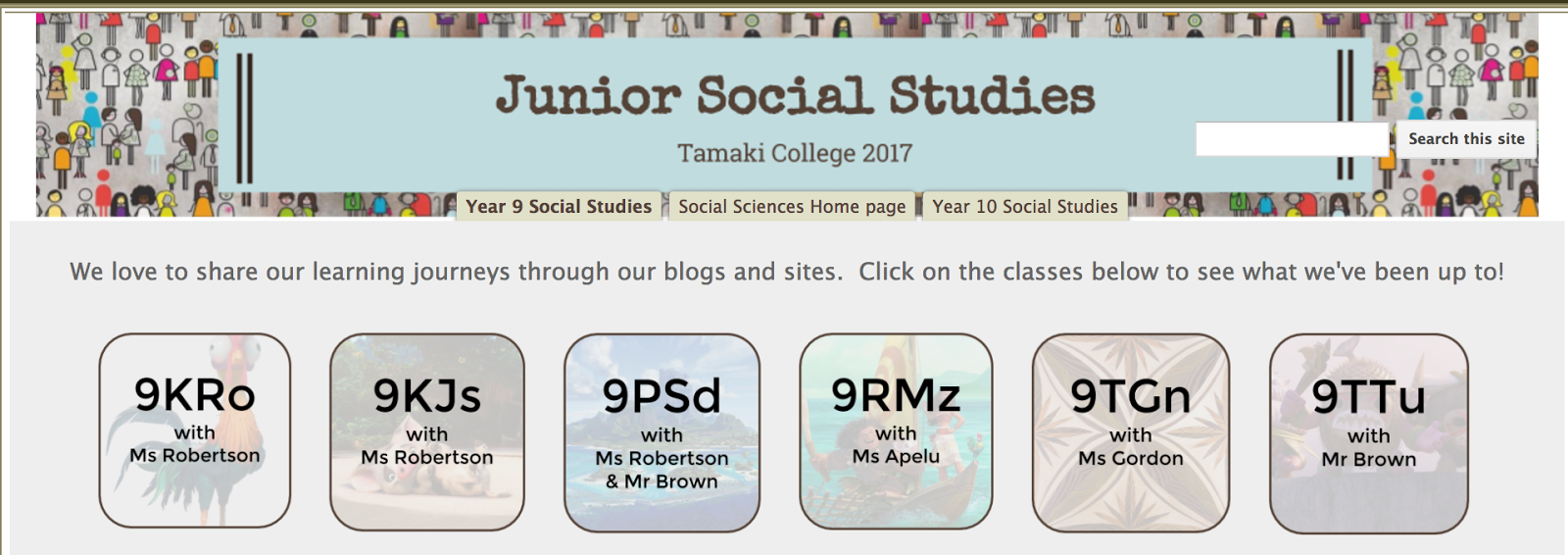
    Here is the link to our class blogs and site.  

    Our class blogs on the social studies site. 

    Sunday, 1 January 2017

    Teaching as Inquiry 2017


    “Recognising and spreading sophisticated pedagogical practice across our community so that students learn in better and more powerful ways...”

    The Manaiakalani Community of Learning is working together on this task using the expertise existing in of our community of learning.


    In 2017 for my inquiry I have selected the following CoL achievement challenge 
    #2. Lift the achievement for boys' writing years 1 - 10

    The teaching as inquiry framework I will be using in 2017 has been specifically co-constructed for Manaiakalani schools using our familiar Learn Create Share structure.
    The elements in this framework share close similarities with other models New Zealand teachers use.


    I will be labelling my posts as I update my inquiry throughout the year to make the content easy to access.

    Labels:
    LEvidence, LScan, LTrend, LHypothesise, LResearch, LReflect,
     CPlan, CTry, CInnovate, CImplement, CReflect,
    SPublish, SCoteach, SModel, SGuide, SFback, SReflect

    Label Key:


    LEvidence
    Learn - Gather Evidence
    CPlan
    Create - Make a plan
    SPublish
    Share - Publish
    LScan
    Learn - Scan
    CTry
    Create - Try new things
    SCoteach
    Share - Co-teach
    LTrend
    Learn - Identify Trends
    CInnovate
    Create - Innovate
    SModel
    Share - Model
    LHypothesise
    Learn - Hypothesise
    CImplement
    Create - Implement
    SGuide
    Share - Guide
    LResearch
    Learn - Research
    CReflect
    Create - Reflect
    SFback
    Share - Feedback
    LReflect
    Learn - Reflect


    SReflect
    Share - Reflect


    COL Inquiry #6C: Academic Reading "Teaching to the North East"

    From the Secondary Teacher Literacy Handbook page 33:  Bishop (2019) stated that to improve Māori achievement, teachers need to  create an e...