Showing posts with label Akomanga Kaihanga. Show all posts

Monday, 24 August 2020

Making the learning rewindable for my year 9's

This lockdown has given me the chance to really look at how I am presenting my teaching and learning to an global online audience.  During lockdown, there are students who will come to class religiously, there are others who will pop in from time to time and then there are others that I would not see until we are physically back at school.  The importance of providing rewindable lessons for both those on and offline is imperative.

For my year 9's, I decided to first work on my teaching site. We are studying the Pacific at the moment and I created a simple front page with each lesson provided on the right. 
I decided that I wanted to have a really basic template which had LEARN, CREATE, SHARE and NEXT STEPS as a format for each lesson.  This would be a generic teaching site for all year 9's.

Next I needed to create a more specific rewindable learning site for my class with recorded lessons taken during online lessons.  Here, I would have short edited video's that students can review and reflect on related to my teaching site as well as examples of student work.  I would hope that kids who can't come to class would use these links in their own time to catch up on their learning. 
Reflection:
I like to press the record button when I have a hangout or an online lesson.  Not because I enjoy the sound of my own voice but because I know that many of my students will miss out some important learning and it would take the hassle out of having to repeat myself again in class.  I like the fact that usually in an online class there is an audience and they can tell me if they don't understand something or need help with any of the learning.  I will try to continue to create my lessons this way even when we are out of lockdown 3 and will check with my year 9 class online whether any of them have utilised my sites.

Saturday, 22 August 2020

Connecting with Whanau in an online google hangout

One of our challenges from lockdown one was that we didn’t get a chance to connect with whanau as much as we wanted to.  This time round, we were more prepared for what to expect and wanted to connect with our whanau and families as soon as we could to see how they were doing and to share how their child's learning would continue online.  We choose the Akomanga Kaihanga class to enable this to happen and invited whanau to a google hangout earlier this week.  

We called our hui the 'Whanau Talanoa' with the main purpose to connect and hear from our kids, staff and families how lockdown learning has been for them.  Our facilitator was our DP Russell Dunn and our support staff were Whaea Kata, Karen Ferguson, Karl Bailey, Jannie Van Hees, Jay Malholtra and myself.  We had different areas to cover all linked to keeping our students and families informed about online teaching and learning.  

After Russell welcomed our attendees, one of our students Saia, led us in a karakia.  I then thanked families for their participation and feedback from our Showcase evening held recently.  I shared some of the blogposts from the students that talked about their learnings.


Russell then shared how important it was to for our students to make connections with their learning, review what they had learnt and to keep in touch through email all whilst taking care of their wellbeing.  Whaea Kata then shared that in her Health class, students were learning about gratitude.


Danielle, Siaosi and Cherry-Anne from the class then shared what they had learnt.

The classes graphics teacher Karen, then shared what the class had been up to with regard to creating a graphic novel.  She shared how students can access their learning site and where to find the resources they needed to complete their tasks set.


To give whanau a heads up as to what to expect for the rest of the year, I shared a simplified version of the year plan.  This then led into a short talanoa where parents had the opportunity to share their thoughts and feelings before our closing karakia.
Reflection:
It was really lovely to engage with our whanau and parents.  It felt we were invited into their homes for a cup of tea and there was no stress or expectation to engage.  As a staff team, it was exciting to be connected with our students and their families online and to be able to share how learning happened in an online classroom.  During the talanoa, families shared their challenges and rewards and were thankful for the opportunity to connect.  This hui has definitely been a highlight of my lockdown to date and I look forward to connecting with our whanau more in the future.


Wednesday, 19 August 2020

Using MIRO to connect my year 9's to each other

We are learning about our community and as part of this, I wanted to try a mapping activity where students could point out where they lived and create a short blurb about their household.

I tried to figure out if we could insert an interactive map into MIRO that could be zoomed in and out but I couldn’t figure it out.  So I took multiple screen shots of our local area around school, and put them together in a MIRO like a jigsaw.  I then locked it in so it couldn’t be moved.  Although it took awhile to put together, I enjoyed the challenge.  


While we were on the MIRO, I encouraged the students to try and use the video chat but they didn’t appear to want which was fine.  I found zooming in and out of the MIRO awesome because zooming in allowed the students to find their street, even their house and zooming out let us see how far kids lived away from school and how near and far they were away from each other. I enjoyed seeing the kids working in MIRO in real time as their names were the cursor so I could direct them to go to the school grounds etc which was cool.  I will definitely be sharing this activity with my department and my other classes (below is a short video of me showing them what to do in the MIRO).

The completed MIRO


Monday, 17 August 2020

Back to lockdown learning with 9KMe Akomanga Kaihanga class

This morning I had my first online lesson with my year 9KMe class and I had 10 students join me.  I was worried that not many kids would connect and I was pleasantly surprised when they did.

I did not want to create any new learning for my kids as I know from the first lockdown, many kids weren't able to get online.  Our main focus was to connect, check-in and tidy up any work we started last week.  We agreed that we only needed to catch-up for the first half of a double period.

We started with a karakia and for our do now, we moved into a fun socrative quiz where I played the 'Eye of the Tiger' to hype up the kids and expose them to some classic old school music (check out the short clip below).  Then we went into our lesson (I have purposefully recorded the lesson this way for those who didn't make it to class).


After the socrative, I sent out a check-in survey to my kids inviting to share their thoughts about the lockdown.  Here are the results.


From the results, there are a answers that I'd expected and others which surprised me.  In our next class, we may discuss the answers further.


Sunday, 26 July 2020

The Akomanga Kaihanga 9KMe Lab Showcase for Whanau

Over the last two terms, the year 9 Akomanga Kaihanga class had been working on their projects in a hope to raise awareness and social exposure to an issue they have been researching.  They were led through their projects by their mentor Karl Bailey who used design-based methods to engage the class in their learning alongside their subject teachers who worked collaboratively to support the students.  The projects came to fruition on Thursday 23rd July with our first ever Lab Showcase for whanau and stakeholders that was held in our school auditorium.

Planning and preparation:
It took us 4 full days of planning for the class to prepare to present which enabled the teams and the projects to finally come together.  Each group would have an area assigned to them and needed to have the following things ready:
  • A poster:  This was to be put onto an A2 size poster, made in digital copy drawing.  It needed to show of the groups projects, from the progression from the idea, to actions, to reflections.  This was to be the focal point of each groups presentations.
  • A takeaway pamphlet:  This may be a short blurb about their projects or a smaller version of their posters.
  • A video:  This would be a short 2 minute documentary type video to support their presentations.
  • A presentation table:  This could include props, the pamphlets and any other items that would suit the theme of their projects.

During their preparations, their subject teachers would join them for extra subject during their timetabled classes.  I was fortunate enough to have Jannie and Karl as our go to people whilst students were busy getting ready.

Showcase day:
After our karakia, the afternoon started with Nicky and Kirsty from the Ministry sharing their thoughts and our DP Russell Dunn explaining the purpose of our showcase.  Parents were then invited to have some food before moving around to listen to the groups presentations.  For 40 minutes, our students led their whanau through their projects, facilitating discussions and inviting feedback.  At the end of the time, we gathered once more to thank everyone for coming, before heading home for the evening.  


I enjoyed meeting many of the parents and hearing from them about what they saw.  Observing the kids presenting to their whanau was really rewarding and I had wished we had thought to do this sooner.  We had some awesome feedback from parents and whanau, all of which we will collate and put forward to the planning team of the Akomanga Kaihanga class. Check out the highlights video below!

Below are some blogposts from students about their presentations.  

Monday, 4 May 2020

Online Teaching and Learning #5: Week 4, Term 2: 9AK Project Based Group work online

Today I wanted to get my year 9's into their project groups.  I wanted them to try and remember some of the capabilities they'd learnt when they were fully engaged in the groups during term one.  I knew it would be a challenge as it would mean having 5 different hangouts for the 5 different groups and I could see that trying to get to each group could be hard. 

Preparation:
I created a google hangout for each group on my calendar.  I just put a two-hour block in it just to keep it consistent even though they would not be on for the entire time.

I then shared a 'Project Groups checklist' that had each of the hangout links on them.  

I knew it would be messy to send the kids individual calendar links and for me, it would be easy to pop into each group when the hangouts were next to each other.    

Each student had editing rights and their task was to go into their group hangouts, collaborate and discuss the questions and come up with a common answer that they'd all agreed on.  As soon as I'd sent out the document, I joined each of the hangouts but kept my mike off until I asked the group a question.  I began the lesson in the main group giving the instructions class.

Group Hangouts:
This is what my computer screen looked like with my main google hangout open plus 5 smaller group hangouts.  There was one hangout with 3 students in it and the other four hangouts had 4 students in each.  

Four of the five groups used the chat feature and one group, Island Skittles, discussed their tasks out loud.  I went into their hangout and asked them if I could record their discussions to help me understand how they collaborated. 

My Observations:
One of the things that I noticed is that if a group was involved in discussions where they're mikes were on, it would interrupt another group if I was visiting their hangout and I wanted to verbally check in on them and I needed to turn my mike on as well.  So I have figure that one out. 

Another thing I noticed is when I did pop into a hangout, students were chatting like they were talking to each face to face.  Team Poly had students with their camera's on and they seemed to be enjoying the interactions in the smaller groups.

Student voice:  
I gave the students 20 minutes in their group hangouts before asking them to return back to the main group.  I then asked them for chat feedback on whether they liked being in the smaller groups and most said yes.  I sent them a short survey with just 2 questions on it to gage whether being in the smaller groups was a good way to work and why.

80% of students said they found it was a good way to work and when asked why, some of their responses were as follows:
Reflections:
I definitely want to have the students work in their groups and perhaps think about presenting to each other what they’d learnt.  On our next lesson, I will explain to the students the results of their survey and have them think about how we can utilise the fact that they enjoy the smaller hangout groups better.  

Friday, 14 February 2020

Focus Inquiry #1: My Focus for 2020

Welcome back to another year of my inquiry.  It has been such a busy term already and as a teacher, I often wonder where the time has gone and have I done enough to support my learners!.

The purpose of this post is to share my learnings about my inquiry so far.  This year, I knew that I wanted to continue to focus on a group or class in Year 9.  Although I enjoy teaching my senior classes, my heart has always been in helping the junior school.  To me, that's when we can set them up for life! This year, we have finally got a year 9 project based learning class off the ground and when Russell our Deputy Principal asked staff who would be interested in teaching them, I jumped at the chance.  

Background:  The class is called Akomanga Kaihanga, a name gifted by Whaea Georgie from Ruapotaka Marae.  It means 'a class of builders and inventors'.   Below is a blurb from the classes perspective.
At the end of 2019, the decision was made to invite students to join who came from a range of backgrounds and abilities.  They submitted an application form and 30 students were invited to join.  Earlier this year we held a powhiri for families in our school marae which gave us the opportunity to share the initiative with parents and for them to ask any questions.  It was a huge success!  This connection with our families provided a good base to kick off the Akomanga Kaihanga initiative.  That same week, the students had a 2 day Noho Marae where they worked closely with Karl Bailey, the project leader and community activator to get to know each other and become familiar with the kaupapa of the course.   This was done three days before the rest of the school started!

Akomanga Kaihanga 9KMe
Our planning group are a team of educators who are made up of myself, Russell our D.P of Curriculum, Jay our HOD Science, Whaea Kata our TIC Health and Christine our year 9 Maths teacher.  The project manager is Karl Bailey who also works with for ADHB. We met a number of times at the end of 2019 and to decide how the timetable would look.  The goal was to ensure that students had enough time to work on projects but at the same not miss on essential learning needed as a year 9 student.  It was decided that they would have 6x 50 minute periods a week (essentially their Social Studies time plus 2 extra periods) to work on their projects.  There was also allocated half day, whole day and workshop type programmes spread throughout the year.

The first week was spent with the students getting to know each other as well as us as their teachers.  For second week the students jumped straight into their projects.

The Challenges:  My observations of how students and staff connected, has led me to understand that there are challenges around collaboration.  These challenges are what will drive my inquiry.
  • The Staff Planning Group:  As a planning group, we worked through issues around timetable and allocating time for project based learning although we are still at the early stage of 'real' collaboration.  In the past I have supported and led integrated projects at our school namely the Junior olympic study in 2016 and the year Sustainability unit in 2018).  What I have learnt from these integrated projects was that teachers didn't really understand what real collaboration was.  I actually didn't really understand it either - I still don't.  So my wonderings are around whether we can come to a shared understanding of what collaboration or integration is and how can we support each other better.
  • The Student Project teams:  As students are working in their groups, I have noticed that the dynamics within the groups sometime are not reflective of real collaboration.  The assumption is that we think that they just know how to collaborate.  The reality is it's a learning process, one that I think needs to be explicitly taught.  I notice that in some groups, there are dominant members and in others a lack of engagement and Talanoa.  
So for now, my inquiry will ask:  Does project based collaborative ways of learning in a Talanoa environment make the difference in the learning journey of our kids? 

As an aside, I want see if we as educators can have a shared understanding of what collaboration and integration is and whether this understanding will impact on the achievement successes of our learners.

Thursday, 13 February 2020

9AK #2: Learning conversation and interviewing skills

As part of their projects, groups were given the challenge to find 3 people who they could share their aims and intentions of their projects with.  When they were first given this challenge a week ago, about two thirds of the class took it which was positive to see.  Sadly, the ones who did not engage with the task were the quiet and shy ones of the groups.  I wondered if they knew how to approach people and ask them questions.  I assumed when we put the challenge out, that students could just 'do it'.  I decided to put together a short presentation giving students clues as to how to introduce themselves to a new person and how to continue a conversation going.

Lesson:
I reminded the class of the challenge from the previous week.  I talked to the class about the importance of knowing the skills as it may not come natural to some students.
I modelled an example of good conversation skills with Karl and another student in the front of the class.  I got them to practice in pairs then some groups had the opportunity to practice with real people.
I then wanted students to write down how would draft an email as it was another way to communicate with people.  These instructions were written on the board.
Outcome:
Quite positive overall.  I observed 2 to 3 students in some groups still not fully participating and approached them quietly to see how they were.  I could tell that they found it difficult not because they didn't know what to do, but were afraid of not knowing what to say back to other people.  I need to think about strategies that will not be too overwhelming for the shy students but would hopefully support them better in approaching others when they need to.  On reflection, I feel I need to be more clear and definitive in what skills I want the kids to learn when it comes to interviewing.  I think I need to look specifically at the Talanoa as a tool that be more scaffolding and supportive of the kids and their learning.

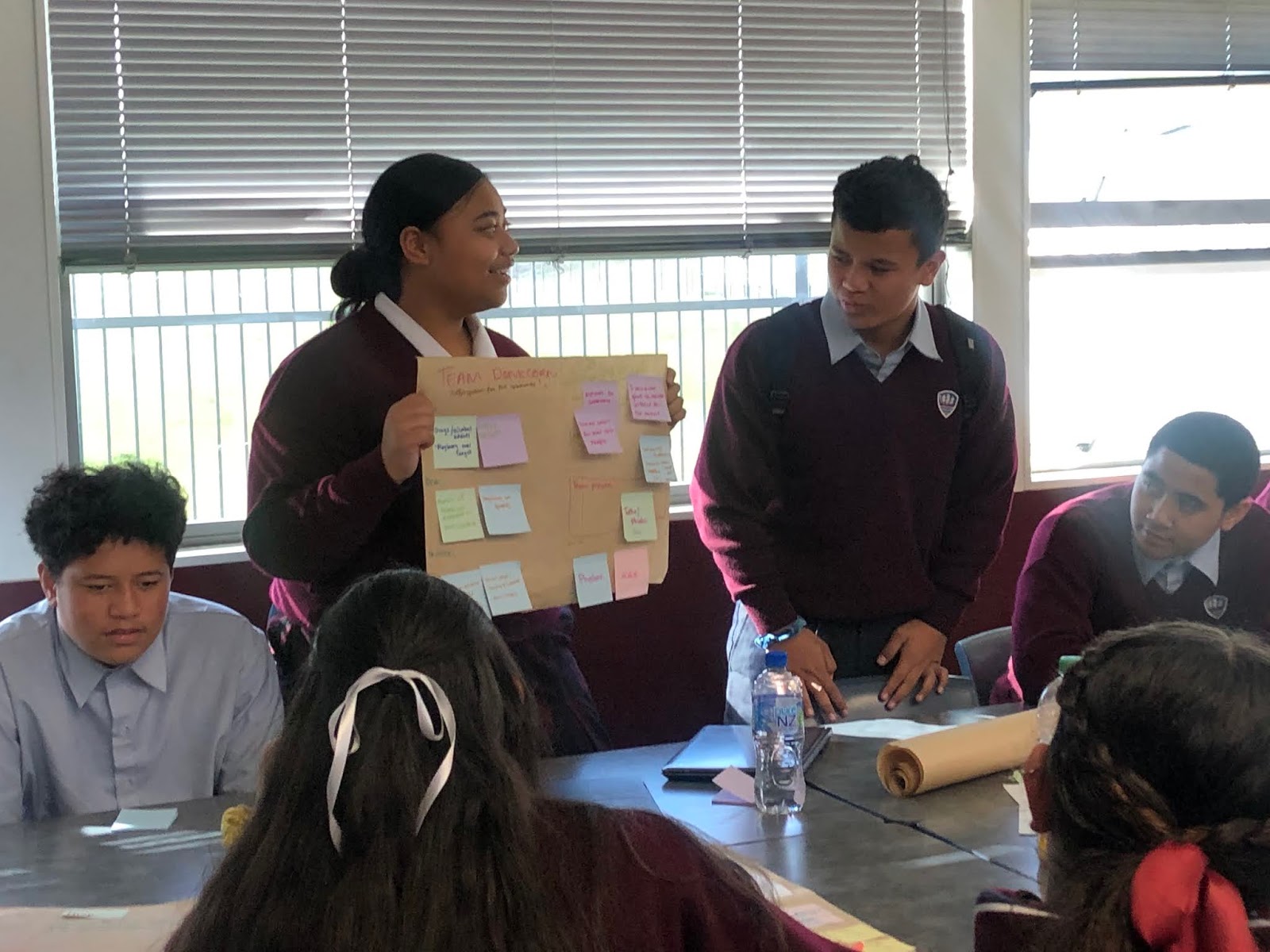
The photo shows a few students in team DonkCorn presenting their project brainstorm.


COL Inquiry #6C: Academic Reading "Teaching to the North East"

From the Secondary Teacher Literacy Handbook page 33:  Bishop (2019) stated that to improve Māori achievement, teachers need to  create an e...