Showing posts with label Writing PLD. Show all posts

Thursday, 15 November 2018

Reflecting on my Classroom inquiry into raising the achievement of boys' writing in my level 2 Social Studies class

In February this year, I shared a blog post about my classroom inquiry and the fact that 8 of the 9 students who'd joined my class had not taken social studies in year 11.

"When asked why they took my class, 2 replied because it was the only option in the line they liked, 3 said because they wanted to try it out, and rest weren't sure why they'd taken my subject.  Only 1 student had said it was part of his career pathway" (February, 2019)

Over the year, I have used engaging contexts and activities to motivate my students with their learning and to think critically about the social issues that they were learning about - the Tamaki Regeneration Company, the 40 Hour famine, Marriage amendment laws and Israel and Palestine (for the external). Having limited knowledge about what social studies is all about, I was hoping that their interest will grow if I exposed them to different learning environments.  

I also used a variety of effective writing strategies to get them used to academic writing and to improve their confidence in writing.  A workshop by Joseph Driesson on Improving boys' literacy skills helped kick off a drive to research effective practices.  This was followed by a PLD opportunity with 'Write that Essay' taken by members of staff, who have shared effective strategies that we had trialled throughout the year.  A focus on 'Language in Abundance' has allowed my students to use the 'Talanoa' to encourage my kids to make meaning of their learning through verbal and oral discussions.  This has probably been the most effective strategy because my kids love to talk.

To measure whether my inquiry has made an impact in their achievement, I have looked at:
  • Credits gained in their assessments
  • Credits gained at merit/excellence level
  • Literacy credits gained at the of the year
  • Student voice surveys
(Note:  These results are based on 8 remaining boys in the class)


Credits gained in their assessments, at merit/excellence level and in literacy.

My Reflection:  I am pleased about the results overall as there has been a shift from 6 boys achieving credits in the first assessment to all 8 in the term 3 one.  As shown by the table, there have been successes in the number of merits and excellences gained by the boys, but not a significant shift.   This shows me that more work is needed to shift the achieved students to a merit or excellence grade.  

Student voice surveys

I conducted a comprehensive student voice survey at the end of the term for my kids to sum up their experiences in the class for the year.  
  • Engaging Contexts

I asked the kids to rate the topics on a scale from 1 - 5, 1 being the least interesting, 5 being the most interesting.  I then asked them to write why they put this grade on the scale. 


  • Effective writing strategies

I asked the kids to tell me whether they thought their writing had improved and 100% of them said that it had and they then identified which strategies may have helped the most. 


My reflection:  I can see the link between engagement and achievement in that the students that did not rate the first unit we did on the marriage laws highly - they then did not achieve as well as they could have.  As we got to the next two units, there were lots of different activities and engaging tasks that I feel impacted positively on their learning and therefore led to good achievement in their assessment results.  The more engaging a context is and the more a student can identify what helps them to write, the more they will invest in their learning and achieve better results.  When asked whether they will take social studies again next year, 100% of them answered and told me they were bringing their other friends!  I look forward to taking up the challenge again next year!

Next Steps:  I want to continue to focus on raising the achievement of boys' writing because I feel is the biggest issue that needs to be addressed for our learners.  I have enjoyed learning about the different ways that writing could be improved and find it rewarding to see the success of our boys when they write a great power sentence for example or they overcome the challenge of starting a paragraph.  For my next inquiry, I want to explore the power of the 'Talanoa' further and sit down with Dr Jannie Van Hees to plan to develop our kids as informed conversationists, which I am excited about. 


Tuesday, 13 November 2018

A summary of my BIG inquiry: Raising the achievement of boys' writing by implementing engaging contexts and effective writing strategies.

When I started my big inquiry this year, I had a desire to continue the work and research that I'd begun last year as an in-school COL teacher and my key focus then was 'How to raise the achievement of our boys' in their writing'.  When I think back to my WHY, I was driven by the desire to take on this challenge because I was disillusioned with our poor results in writing, especially for the year 9 boys.  At our cluster wide meeting in February, Woolf Fisher shared these results and I couldn't stand it anymore - my goal was to change those results! I felt motivated to figure out what was going on and find ways to solve the challenge.

My Big Picture plan

I started with a big picture plan and I was guided by two questions:

1.  How can I help/support/guide the most number of people to make the most impact in addressing this issue?
2.  What do I need to do/fix/start within our school that would support the implementation of effective writing?

From this plan, I focused on a number of areas that I wanted to engage with and implement as part of my 'Big picture plan' and throughout this year, I have developed these programmes with the support of our school and Manaiakalani, who have allowed me the time to get these initiatives up and running.

I want to share with you my reflections on a few of the things that I felt were the most successful.  I have tried to write briefly what I did and what the outcomes were below.

The Students 
  • Designing engaging contexts
As part of designing engaging contexts for students in their learning, I helped to develop and implement the Rise Above: Parakuihi and Hauora cross curricula unit for a year 10 class.  This involved working alongside Jacquie Bay and Alvina Pau'uvale of the Liggins institute, as well as Rose Hipkins of NZCER to develop professional development opportunities for the teachers of the unit.  I also facilitated staff PLD and supported teachers in my department with designing lessons.  As the unit is currently being taught this term, we will be reviewing the programme with all of the team involved at the end of the year.  The initial feedback from teachers is that the students are engaged in their learning and can see the benefits in this type of integration.  This has been a good learning opportunity for me to see how to develop a programme such as this, with a number of key stakeholders involved from the start.  My hope is that the learnings from this unit could support a bigger programme next year.

    10RMz are learning about healthy eating.
  • Knowing the value of Asttle 
The TKI e-asttle 'Assessment for Learning' site describes ways to communicate the value of knowing about asttle to educators and explains the importance of sitting down with students to inform them of where they are at with their results and how to set goals to raise their achievement.  I recently wrote two blog posts about a writing plan that I'd developed to support our juniors in their recent exams (Year 9 post and a year 10 post).  Both blog posts gained some positive comments from educators in and around our outreach clusters, to schools such as Hornby Primary and I was excited to hear that their leadership team were going to try aspects of the my writing plan in their school.
Top tips for kids writing
  • My Classroom Inquiry
This year I taught a group of year 12 boys who had never taken social studies before and most of them were there by default.  I utilised some of my learnings from my last inquiry and PLD from Dr Jannie Van Hees to focus on supporting their writing through engaging contexts and the use of effective strategies.  For each of the 4 contexts taught, I tried to get us out of the classroom, invite guest speakers in, use lots of different writing techniques, debates, role plays and student initiated learning to engage and motivate the students to write.  Our focus on 'Language in abundance' and the Talanoa has given the kids another avenue to share their understanding of knowledge and make meaning from their contexts.  Overall, students have enjoyed their learning journey and have made some positive gains in their achievement.
A few of my year 12's on our recent visit to the 'Are we there yet' exhibition.
The Teachers
  • Our Social Science Department literacy goals
One of our department goals is to try and move junior students up at least one asttle score above their entry level in writing.  My team have a range of strengths and experiences in teaching literacy and a focus of most of our department meetings has been to share any writing strategies that we'd used to allow us to have a bank of strategies to draw from and to see which have been the most effective.  We also enlisted the help of Marc Milford, our literacy expert to guide us through identifying language aspects to support our learners.  Each teacher choose writing as a focus in their own inquiries and I was able to support them as a HOD and a COL teacher to guide them in their teaching and learning pedagogy.
The bestest department ever- Social Sciences team

  • Our Write that Essay (W.T.E) team
During the term 2 holidays, I found a PLD that was being run by Dr Ian Hunter, the developer of the programme 'Write that Essay'.  A number of staff from different curriculum areas attended the PLD and on their return, I invited them to share their key takeouts.  We agreed on a number of strategies that we would use and over the year we have applied, modified and shared these strategies with our students.  We will be meeting again before the end of the year, to see how it went in the classroom and reflect on what we could implement school wide next year.
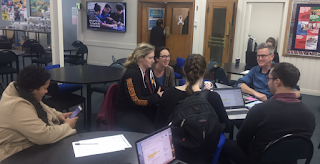
Our W.T.E team in action

  • PLD opportunities for our teachers
The Learn, Create, Share model is a model that we at the college are purposefully implementing school wide next year and to prepare us better for this, we have been supporting Lenva Shearing on the Manaiakalani team, with staff PLD over the year.  Putting a name to something we are already doing is making the learning explicit and connects us more to our Manaiakalani kaupapa.  As COL teachers, we have also been supporting staff from other curriculum areas on their inquiries which has been positive.
Lenva in her element - sharing her knowledge at the Tamaki College Staff PLD

  • Connecting with our Primary school teachers
One of the real benefits of being an across school COL teacher was that I got to meet with some really hard-working practitioners who generously gave me their time to share their knowledge.  At Glenbrae Primary, Elfrida Raj invited me to a number of their PLD sessions to see how they were incorporating writing in their PLD as a school wide goal and I was excited to be part of the planning with my insights into what we have found was needed at the college.  At Point England Primary, Rob Wiseman shared his writing strategies and units that we could link up with to connect common contexts.  At Tamaki Primary, Heather Collins discussed ways that we could be 'seen' and be actively involved more at their school and Prem Rankolowan invited me to meet some of our potential year 9 students who will be coming to the college next year and next week, Robyn Anderson from Panmure Bridge will be bringing some of her talented students to teach some of our kids how to use google drawing better.  These examples of the openness of staff in our cluster to share their practice, supports the theory that if we can build a relationship based on trust and respect, we can move towards being united in our teaching and learning journeys, whilst still embracing our uniqueness.  I look forward to working more proactively with our primary teachers in the future. 
A writing wall at Glenbrae.
  • Connecting with teachers across the globe
Earlier this year, I had the privilege of meeting Wayne Poncia, the Chief Product Officer of Hapara who invited us to be part of a Global Colab project involving students from Tamaki College, Canada and the States collaborating on solving a global issue.  As part of the planning team, we have met online several times and have designed a programme that will use workspace for  teaching and learning.  This project kicks off in term 1 of 2019, and we are really excited to be part of it.
Wayne Poncia on the right, who has kindly blocked me out:)

My personal learnings

There is no guidebook or instruction manual on how to be an effective across school COL teacher.  I think back to where I've come from and yes, I have done some good things and started some cool initiatives but at the end of the day, will it help our kids improve their writing?  It's hard to say at the moment, as you can't put your finger on just one thing that might work but I hope that part of my plan has helped start a movement. 

There were days when I wasn't sure that I was doing the right thing or working hard enough and I felt like giving up.  But I had to remember to keep my eyes on the prize - helping our kids.  At the end of this journey of inquiry, I have recognised a determination in me that has grown out of what drives us teachers to work as hard as we do.  It had given me purpose and reaffirmed that our kids are at the centre of all we do.

Kia kaha, kia toa, kia manawanui.


Tuesday, 2 October 2018

The 'Writing Plan' for our Junior school.

In November, our juniors will be sitting their second round of the asttle writing tests for this year, a test that will gage where our students are at with their writing.  I really wanted to make sure our kids knew it was coming and for them to understand how important it is.  My thinking was that if we are consistently talking to our senior students about the importance of achieving credits and NCEA, we need to be delivering the same message to our junior school with regards to their writing.  I met with Marc Milford, our literacy expert and we devised a plan to meet with all of the year 9's and year 10's during the last week of term 3.  I knew it would be a huge undertaking but it was a necessary one.

Preparing for the meetings
I created a 'Writing Plan' and Marc and I set about preparing the following resources for each student:
  • A copy of their February Asttle test paper 
  • A print out their Individual learning pathways from the Asttle website
  • A goal setting template called 'The Big Picture'
  • Exemplars of what a level 5/6 writing example looked like
  • A simplified breakdown of each of the elements that the test is marked on
Individual learning pathways
I then created a spreadsheet for each tutor class and we grouped them according to their writing results.  Below is a graph that shows where the majority of our year 9's were at according to their curriculum levels.

Results for the year 9's from their February asttle writing test.
Meeting with our students 
We met with 71 year 9 students over the week (10 or so had low attendance issues).  For the students at level 2, we met with them individually and for the others, we met with them in groups of no more then 3.  The meetings took longer then we anticipated, on average between 25 - 30 minutes each.  For the year 10's, I took my social studies class through the writing plans as a class, which I found was effective for them.  Unfortunately, we couldn't get to all the 10's, so will focus on them week one of term four.

We started by meeting with the students whose score was at levels 2 individually because we thought it best to spend some time discussing with them where they were at and to encourage them to think about ways they could improve their writing.  We wanted to hear what they had to say.

I began the discussion by talking about the 'Big Picture' .  For the 'Where am I AT?' box, we discussed their February asttle result and we talked through what each element meant on the asttle test.  They then wrote down their strengths and work on's from their individual learning pathway.

I also wanted to hear their thoughts on how they felt about writing and then we talked through the different ways in all their subject areas that has helped them improve their writing during the year.

As I led the discussions with each student, Marc read over their February test paper.  He addressed specifically what students had written.  He then discussed with them the things that they did well on and helped them identity their work ons specific to their paper.
I discuss with students their plans whilst Marc looks over their February test.
 Marc shared some of the tips below with our kids during the meetings:
  • Make sure to write an explanation not a narrative or story.
  • When explaining, try to convince your audience that what you are were saying is a fact
  • Keep it formal, no slang
  • Write a plan then use the plan - a third is planning, a third is writing and a third is editing.
  • Always write what you will talk about in the intro 
  • Use a topic sentence to start off each paragraph
  • Keep referring back to the topic of the essay
  • Don't write in first person, try to write in third
  • Imagine the person who is reading your explanation knows nothing about your topic
  • Use a variety of perspectives
Marc shares a highlighted exemplar
After sharing these tips, Marc then showed students what a level 6 exemplar looked like, highlighting the 7 elements that the markers will be looking for.  We then asked the students if there are any questions and I reminded them that there would be an opportunity for them to blog over the holidays as a way to keep their writing 'going'.  The last part of the meeting looked at setting some future goals in their writing that they could focus on.  I took a photo of their big picture pages as a way to keep track of who we'd talk to and to remind them of the goals at the end of the year.

Reflections
We knew these meetings were important but actually having them one on one with the kids was really positive.  Initially, most of the students asked if they were in trouble, but once we started, they were quite receptive to hearing about their writing.

Here are some of the responses from the students we'd met with:

"Ms, I was really dumb back then.  Can I sit the test now?"

"Can we do this with our maths?"

"If we fail this, does it mean we stay back a year?"

"I can see why it's good to plan before you write"

Our Level 2A student wrote his 'Big Picture' plan.
One particular student who was a level 2A, admitted that when it came to writing, he found it hard to start and gave up.  When Marc asked him to think of a special place in the community, he said he didn't know one because he just stayed home.  A number of other students said the same thing.  Marc and I discussed this later and found that the task of asking kids to write about a special place in the community assumed that they actually got out in the community and found somewhere 'special' that they could talk about when the reality was, they couldn't answer the question because they lacked the life experiences needed to help them.

Overall, we found sitting down with the students really beneficial, not just for the students but for us in understanding ways to support our kids more.  The kids were engaged and receptive to the thought of focusing on their writing and understood the importance of looking at where they were in February.  They seemed to understand that across all of their subject areas explanation writing is a key component of their learning and that with a few simple consistent tools and strategies, they can take an active role in improving their writing.

Next steps
For the future, I have a few ideas to support what we've started.
  • Over these holidays, our department has discussed the need to prepare our juniors through a current events context, focussed on developing their written responses.  I will design a unit to support this for our juniors.
  • Next term, I want to speak to tutor classes and a year level assembly about preparing mentally for testing.  After reading their thoughts about writing, I can see some patterns as to how they feel about it. 
  • Once the asttle results for November are available,  I want to identify the kids who are still well below their level or who may have made the least shift and develop an appropriate programme to meet their learning needs.  This will be shared with their jumpstart teachers for 2019.
  • Meet with the HOD's of core subjects and discuss a writing plan that addresses explanation writing across our subject areas.  
  • Early next year, a few days after students have their marks recorded on the asttle website (most likely in March), me and Marc will sit down with each student and set some writing goals.  I will share these with subject teachers who can support their students with their writing. 
I hope that we could continue this writing journey alongside our kids and with better planning, I am thinking about how to involve our parents and their families further in the future.  Small steps but definitely worth it!


Wednesday, 15 August 2018

Writing effective sentences using images and post its.

For my senior students to prepare for their exams, I have had to reteach and remind them to plan and structure their essays to support the writing process.  I have found in the past, that the boys especially, struggle to start a paragraph let alone write a whole essay, so my focus was to look at how to write a good effective starting sentence.

After 2 weeks of solid content on the conflict with Israel and Palestine, I went through the 'How to write effective essays in Social Studies' lesson again with the emphasis on 5 ways to start a sentence.  I printed off and laminated each slide and made the 5 sentence starter ones bigger.

"How to write an effective essay" on the wall

5 sentence types in A3

To provoke their thoughts around our context, I gave out photos with provoking images on them.  I asked them to choose an effective sentence type to create, based on what was happening in the photos. By giving them a different point of discussion to start with, I hoped it would help provide the class, especially the visual learners, a way to connect their writing to their learning.  I then encouraged them to write the sentences on post it notes, to stick to the A3 sheets on the wall.


I made mini cards with the meanings to give out if needed.

Reflections:
The skill of using different visual mediums as a source of writing is probably a skill that needs further development and use in my classroom.  Some of the students found value in the images where as others, it proved harder for them to summarise in a power sentence, what the image showed.  For the more capable students, they were able to transfer the knowledge of what was behind the image (which we had been learning about) and use that knowledge alongside the photo to provide some good power sentences.  The post it notes helped students to share their sentences and would allow them to refer to a variety for the future, if they struggled to start a paragraph.  The actual physical nature of moving and putting their post-its on the wall was something that the boys liked to do, whereas the girls needed prompting to get up-they were quite happy to show me their sentences at their seats.

Post it notes help students share their sentences

Next steps:  I can see that the students engaged in writing power sentences the most which was interesting.  Now I hope to support them in writing power paragraphs, which will be my next goal.


Friday, 10 August 2018

Using SOLO hexagons and Power Sentences

Teaching Israel and Palestine in the past has been a bit of a challenge as some kids find it hard to relate to the context.   Add the fact that learning dates and key historical facts can sometimes put my kids to sleep, I needed to find a strategy that would involve them sharing their knowledge in a way that would help them map the links for writing and verbalise what they've learnt.  Here are the steps I took for the lesson.

Step ONE:  SOLO HEXAGONS.

Using the online SOLO hexagon generator, I put in all the key words, concepts, details etc that we had learnt in 2 weeks.  I wanted the kids to use SOLO hexagons to connect what they have learnt and to verbalise the connections first to the peers and then to me.

Observation:

When I pointed out to them that being able cluster and compare concepts and facts in groups shows that they are working at merit level and describing the impacts of different links on others was an excellence, students began to recognise the relevance of the exercise.


Tough guys like to hold flowers while they are completing their hexagons

Step TWO: POWER SENTENCES.

I focused on one of the sentence types that our W.T.E (Write that Essay) crew suggested we try out to help our kids start a sentence, the power sentence.  This is a sentence that has to have a punch with only 12 words or less.  I gave examples on the board and as a class we wrote one together first.  I then shared a document where by I wanted students to write 5 paragraphs and each one had to have a power sentence.   I wanted them to use the SOLO hexagon activity to guide what to write in the paragraphs.


Observation:

I realised the expectation was a bit much to get them to write 5 paragraphs and it wasn't enough to just share a doc.  I noticed the girls in the class happily opened the doc and got on with it, but the boys couldn't be bothered.  So I adjusted the lesson to get kids to share it on the whiteboard so that we as a class could judge the best one and I would award a prize to the best one.  It was then that the boys got fully involved and I took the opportunity to video it below.


Overall REFLECTION:

It was the first time that I had actually observed some of my kids handwriting something - I never knew we had so many left handers!.   In saying that, the boys were especially engaged in the competitiveness of the activity and weren't shy to put up their answers.  This was encouraging as I want the kids to feel they can challenge each other to show what they know without being shy about it.

Next time: 
I realised that the girls are quiet and I need to make sure they feel included and have a voice in the classroom.  I see that the boys have grown in confidence and are not shy to answer and verbalise by making meaning from what they've learnt but I do not want the girls to feel that they get all of the attention.  My next steps are to ensure that they are provided a platform to voice their ideas more, whether it be out in front of the class or more 1 on 1.  I will definitely be sharing this lesson with my department and will use it with my year 13's.

Wednesday, 1 August 2018

'Write that Essay' at T.C

Across our school, effective writing is one of the challenges that we are trying to address in our individual subject areas.   In my search for answers, I was excited to find a PLD being offered during the 2nd week of the holidays, around the 'Write that Essay' programme.  This is an academic writing programme that I had heard so many positive things about.  A group of staff from our school from a range of different curriculum areas, recently attended the professional development workshop and on their return, I organised a meeting to collect key takeouts and ideas moving forward. 

The W.T.E team sharing key takeouts

It was the first meeting for the group since the workshop and their discussions were positive and they had shared how they'd learnt so much from it.  They reflected on key takeouts and decided on a number of goal.  One of the goals was to focus on improving sentence structures with the help of a guide suggesting '12 ways to write a sentence', which the group has agreed, will be a good place to start.   These strategy's are ones that I had seen before and will adapt to use with my seniors.

A few of the strategies we will be trying out
In the discussion, the team agreed to try some of the strategies in their classrooms, reflect on them and come back together near the end of the term, to figure out how to share the strategies and reflections with the rest of the staff.  I've decided my job will be to support and monitor how they are going on the way, so that they can feel empowered in sharing the great things they are doing to support our learners with their writing.


Wednesday, 9 May 2018

A professional development opportunity at Glenbrae Primary.

Professional Learning Meeting - Ministry Facilitator for Supporting Writing Mary Wootton

In my role as an across school COL's teacher, I am always looking for opportunities to meet with my colleagues in our primary schools to see how we can support each other in our inquiries.  Recently I was invited by Elfrida Raj, DP at Glenbrae Primary School to attend one of their staff PLD sessions held in their staffroom.  One of the key areas of focus for Glenbrae, is raising the achievement of their learners in writing.

Glenbrae Primary is focussing on Writing.
The senior leadership team has enlisted the help of Mary Wootton, who is the Ministry Facilitator for Supporting Writing to drive and lead professional development for teachers.  Staff have engaged in learning observations, collected diagnostic and formative data and collaborated over strategies that work.

The particular session I attended focussed on peer and teacher feedback and how effective feedback can support a child's writing.  Mary Wooton asked staff to think strengths, surprises and challenges with regards to how students' provided peer feedback and it was interesting to hear how brutally honest students were on each others work!.

Mary Wooton's PLD reflecting on Feedback.
One of the activities we did as a group, was to look at the best and not-so-best examples of feedback provided on a students piece of writing by the teacher.  We had to put in order which feedback was the most productive for the child and offered deeper levels of support.
Teachers collaborating to decide which feedback could be the most effective.
I found this exercise really useful in seeing the levels of feedback that children received and how important it was to ensure that feedback was also feed forward.  I found the meeting beneficial and valuable in my efforts to find a way of improving writing across our cluster.  I have attached my meeting notes and the parts I've highlighted in blue, are ones I want to focus on.  Thank you Elfrida, Lesley and the team at Glenbrae Primary for being so welcoming!

(Here is Elfrida's blog posts which give more insight into the Glenbrae Primary writing journey)

Thursday, 1 March 2018

Year 9 and 10 E-asttle testing for Term 1

This week, our year 9 and 10 students have been completing their easttle tests in reading, writing and maths.  We have found that in the past, our students have not taken their tests seriously which has seriously affected many of their results.  To try and address this, we have identified ways to manage the process better.

One of them is to ensure that students know the importance of these tests.  In year level assemblies, Mr Dunn, our Deputy Principal of Curriculum, has reminded them on the purpose of the tests and how they should try their hardest so that we can support them in their learning.  Their Deans reinforce this through encouraging students to use our schools R.I.S.E values when sitting the tests.  The purpose of doing this is so that students can see these tests are not separate from their teaching and learning in classroom, which in past has created a barrier for students.

The staff have also been reminded about the importance of preparing our students mentally, for the tests.  In our staff briefing, Mr Dunn has talked about making sure our teachers encourage our students to bring the right equipment to the test and have the right attitude.  The thinking was that the more our kids hear about the tests in the classroom, the more they can connect the fact that these tests influence how teachers the teach to their learning.


On testing day, the environment for which our students have been sitting the tests is mirrored on external examination conditions.  This has worked in our favour to ensure that students know the seriousness of these tests and can prepare themselves better for when they are in year 11 and doing NCEA exams.  Subject teachers are active monitors of students in the exam environment and have supported Marc, our easttle adminstrator, in ensuring that the students are settled and working to their best.


Once the tests have been marked and moderated, the next step in the process is, as a teacher, to understand what the results say and develop a plan collectively to support students in their learning.  As an across school COL teacher,  I want to support teachers in this process, because I see the need in valuing these tests, which on a whole, will speak to where our learners and at.  And it is up to us, to get them to where they need to be.

COL Inquiry #6C: Academic Reading "Teaching to the North East"

From the Secondary Teacher Literacy Handbook page 33:  Bishop (2019) stated that to improve Māori achievement, teachers need to  create an e...