Saturday, 19 August 2017

The Summer Learning Effect at the college level.


The Summer Learning Effect(SLE) encourages students to practice their reading and writing skills in the summer school holidays.  The data presented recently from Aaron Wilson and his team showed the summer drop off in results for boys well below the norm. A three time point analysis showed boys who'd been tested term one 2016, term 4 2016 and again term 1 of this year falling well below the norm.  I wondered why the data showed such alarming statistics particularly for our boys.


During the SLE, the majority of students who signed up and participated were from the primary schools, which was fantastic.  We originally had 5 students partake, but ended up having 2-3 students regularly blogging which in the scope of things is a bit sad.  I wondered why this was and remembered at the end of last year 2016, we had one introduction to the programme and then sent the kids off on their merry way.  In hindsight, I wish we as staff had understood the importance of the programme and had given it more time and value.

Over the summer our girl Quasia blogged regularly!

This year, my aim to use the time in November after the seniors leave, to get students hyped up to blog over the summer holidays.  I realise that we as a school needed to make more of an effort to emphasis the importance of students reading and writing over the holidays and I wondered how to motivate students to be engaged, especially our boys.  At our recent school leaders PLG,  Aaron Wilson alluded to a study that discussed what motivated youth to read and write outside of school.  The Complex World of Adolescent Literacy: Myths, Motivations and Mysteries' found that youth like to read and write about things they can identify with.

They like to read books about people like them, and not only in terms of race, ethnicity, age, class, or gender (although these features are important). They also like to identify with characters who are resilient through struggles, people who are working through relationships, people trying to figure out who they are. They want to read books and write texts that offer them social capital in the form of information, ideas for self-improvement, models for identities, or ways to maintain existing relationships and build new ones ( Moie, Overby, Tysvaer and Morris, 2008).

This resonated with me because during our sustainability study in term 1, I found that some of my year 9's liked to talk about the issues that affected them in our community because they were living the reality.  There were a group of boys in my year 9 class that really engaged with their inquiries and this showed when they presented their projects at the Te Taiao o Tamaki showcase earlier this year.  

What I would like to do is to plan a unit in social studies for the end of the year, that could incorporate these aspects in the hope and model how learning could happen during the summer holidays.  This way, students could be motivated to read and write more and be better prepared for the on-coming year.  

Moje, E., Overby, M., Tysvaer, N., & Morris, K. (2008).  The Complex World of Adolescent Literacy:  Myths, Motivations and Mysteries.  Harvard Education Review, 78(1), 107-154.  Retrieved from https://www.ncbi.nlm.nih.gov/pmc/articles/pmid/19756223/

Tuesday, 15 August 2017

Connected learners share - the writing challenge exemplified!


In our recent school leaders PLG, Aaron Wilson shared feedback that he and Selena Meikljohn-Whiu had collated, which looked at comparing e-asttle results in term 1, 2016 to term 1, 2017.   Although all aspects of his presentation were important, the focus of my COLs inquiry is lifting the achievement in writing for boys particularly in year 9 which I will discuss in my blog.  What I found is that writing is THE biggest challenge across all schools in our cluster.

Some of the evidence from the report show for writing overall:


  • Strong evidence of acceleration in Years 3 and 4 but less than norm gains in Years 2, 9 and 10
  • Despite acceleration overall, writing achievement remains a significant achievement challenge with levels on average more than two years below norm
  • Addressing the summer learning effect could be instrumental in increasing acceleration in writing
  • Gender: Marked gender difference with boys’ writing 13 terms (-125) behind norm vs girls 6 terms (-63 pts) behind norm


Our boys are well below the norm for e-asTTle writing.

When faced with the data, the challenge to me seems daunting and frankly overwhelming - how do I move students who are 13 terms behind the norm? The reality of the importance of my inquiry has caused me to shift my thinking from just finding the right strategies for the learners in my own classroom to how we could create systems school wide, that put writing at the forefront of our goals.

Aaron posed some questions for each of our schools to discuss and provoked us to think about how we could use the data to influence actions in our school and across the cluster. Each school shared their reflections for reading, writing and maths. Marc Milford our student achievement co-ordinator and Sheila Singh our HOD of Maths presented the implications of using the data for our school to the leaders. They were able to show how we are trying to address these challenges with initiatives like a focus on grammatical writing and accelerated reader programmes that will hopefully support our learners.

From this session I realised the significance of addressing our writing achievement challenge, especially for our boys, and on reflection, I know my inquiry needs to be more purposeful and driven in finding ways to tackle the challenge.  This means I will need to look at ways of developing writing strategies that could work across the department and across the school in a more strategic way, to cause a greater shift in our achievement data.

Tuesday, 8 August 2017

PLD blogging at Tamaki College

Today we had an awesome session on blogging presented by Lenva Shearing.  It was really refreshing to see and hear how important blogging is for our staff and the students at our school as I can see it as a powerful teaching and learning tool.

As we followed the presentation, Lenva led us 'back to the future'. We were reminded of our links to the cluster and how everything is visible, which is a driver for the learn, create and share model (the presentation can be found here).

I liked understanding how blogging is rewindable and you can revisit a child's learning over time and see their journey as a progression of skills and ideas.

Here are my key takeouts from the session that I found could be useful for now and in the future:
  • Let's get an online newsletter for students, staff and parents which could link back to a students' blogs
  • Get onto the Tamaki College facebook page and promote our blogs
  • In the classroom, get a group of students to become a 'committee' of bloggers who are assigned a week each, find the best piece of work and post it on the class site.  They can also get badges on their personal blogs which they appreciate.
  • DLO's (Digital learning objects) are common phrases for our primary schools but not so common at the college.  My understanding of it is that it takes learning to another level to show what students have learnt eg a slideshow, movie, sisomo (a new word that I'd learnt meaning sight, sound and motion), screen castify or vlog.
  • The Kawa of care is important to go over from time to time.
  • At our parent teacher interviews, we could show examples of student learning through class blogs and individual blogs.  We could share with parents links to sites etc for them to see.
  • For ease of finding a subject that students are writing about, they should put the title of the subject first, then the title of their blog eg. "Social studies:  My wonderings about our government".
  • Why not start commenting on kids blogs at year 8 before they come college? It's a good idea to track a student and understand how they write and what they enjoy - a way to get to know the learner.
  • Everyone who blogs wants to get a comment and they love it.  A good structure is to use 'positive, thoughtful and helpful'.
A good way to give quality blogs.

One of my colleagues from the spark MIT team Kelsey, shared what her students had created to make it appeal to kids in their year group.  I loved the idea of kids being empowered to recreate something that will be meaningful to them and not just a boring poster the teacher designed.  The infographics are called 'How to comment like a boss' which is a pretty awesome title!


After the PLD, my colleague Hinerau and I thanked Lenva for her really informative presentation on blogging.  As hard as it is sometimes to shift practice and pedagogy, when it's purpose is clear, it's value is essentially bigger then ourselves - bring it on blogging!!.  

Me, Lenva, Kelsey and Hinerau after the awesome blogging presentation!


Monday, 7 August 2017

What will the end result be? Refocusing my Spark M.I.T

Today at our SPARK M.I.T day, we were asked 'in a perfect world, what will the vision look like in 6 months time?  What will the end result be with our inquiries?'.  When I was asked this question, I totally thought I knew what to say. When it came to my turn, I had decided that my focus would be on getting the teachers and systems in place and that all will be wonderful in the world - but noooo, I was totally on the wrong track!  Where were the learners in all of this??


I needed to check what my original inquiry was:  how could my year 9 social studies students be engaged in their learning to improve literacy outcomes through the use of blogs?  I decided to write down some learning objectives.

By the end of the year, year 9 social studies students will be engaged in their learning to improve literacy outcomes.

Students will be able to:
  • Engage in blogging consistently and effectively
  • Provide constructive feedback to their peers on their blogs
  • Recognise, use and choose effective writing frames to improve their blog writing.
I am glad that we had the session to refocus because I knew I had strayed away from the focus and made my picture too wide and too big!  I know I have done a lot with regards to trying things out, and with the focus back on the kids rather than the teachers, I am able to free myself up to give them more of my time and energy.

Our spark buddies joined us for lunch and I was really happy to share my inquiry updates with my buddy Raven who is an awesome listener.  He gave me some really good ideas about how in his job, he deals with hundreds of calls and complaints a day, and that they are working on an automated service that picks up key words and concepts to prepare relevant answers - could we have an automated way of commenting or replying to comment for the future of blogging?  I enjoyed catching up with Raven who may come out to a visit to my year 9 class to talk about what he gets up to at spark.

For the remainder of our day, we focussed on preparing for presenting our inquiries at the Manaiakalani Hui on the 25th of August and again at ULearn in the October holidays.  Although this is a bit of a scary experience to prep for, my colleagues and I excited at the opportunity to share our inquiry journeys.  

Friday, 28 July 2017

The Heart of Innovative Teaching - Unpacking the 'TPACK'

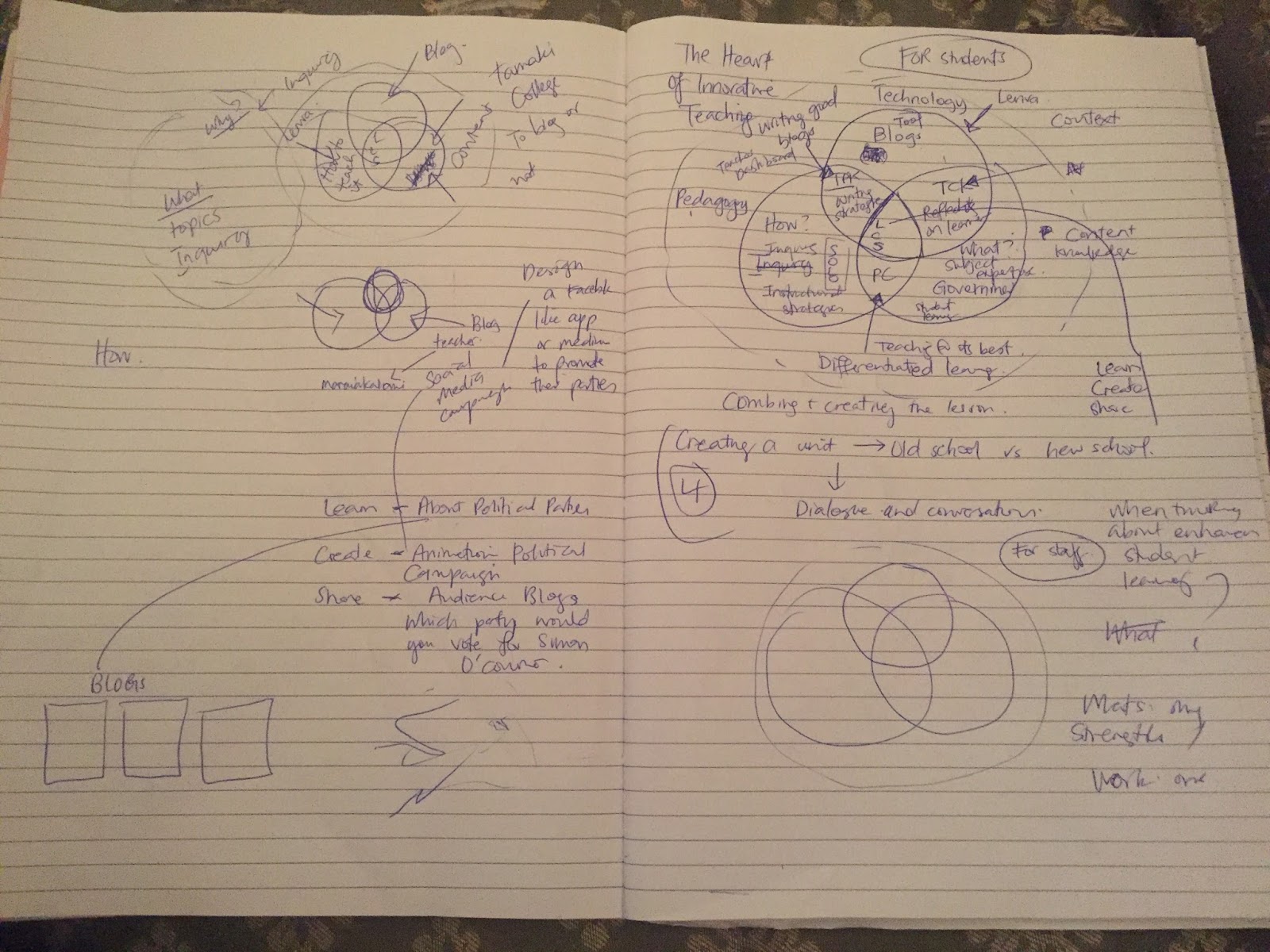
Now that I have discovered which framework  suits my MIT Spark inquiry, the challenge is 'what does it look like in context?'.  As mentioned in a previous post, my scribing on paper has helped me formulate an idea that could be 'innovative' (let's see what my bosses say lol)!  I have attempted to apply a TPACK framework to a teaching and learning context that I am familiar with - social studies at Tamaki College.

I started with the PK (Pedagogical knowledge) and the CK (Content knowledge) circles because I felt confident with the them.  As a teacher, my PK are the practices and methods that I use for teaching and learning.  It's me knowing how students learn and using strategies that would suit their learning needs.  My CK is everything I know about my subject area alongside knowing what students need to know to achieve success.  When you combine the two, you get the PCK (Pedagogical Content Knowledge) is basically knowing how to teach the content effectively(and be able to assess it and report on it).

At this stage, I have made the PK and CK circles bigger then the TK (Technological Knowledge) because I am not an expert in the area of blogging as the technological tool.  The TK is where I need to know how to use the tool effectively to achieve effective outcomes.  The TPK (Technological Pedagogical Knowledge) is where "an understanding of how teaching and learning can change when particular technologies are used in a particular way" (Koehler & Mishra, 2009).  It is like understanding the need to use digital feedback for example in your teaching and planning because it is good practice.  

The TCK (Technological Content Knowledge) could be about using the technology to enhance the learning of my subject and teachers being aware of opportunities to utilise mediums other than the ones they are used to.

Lastly is the 'sweet spot' or the TPACK (Technological Pedagogical Content Knowledge) which is where all of the 3 knowledge areas meet.  Koehler & Mishra (2009) study of TPACK defines the framework as follows:

TPACK is the basis of effective teaching with technology, requiring an understanding of the representation of concepts using technologies; pedagogical techniques that use technologies in constructive ways to teach content; knowledge of what makes concepts difficult or easy to learn and how technology can help redress some of the problems that students face; knowledge of students’ prior knowledge and theories of epistemology; and knowledge of how technologies can be used to build on existing knowledge to develop new epistemologies or strengthen old ones” (Koehler & Mishra, 2009).

On my diagram, I have highlighted in yellow examples of how I would apply TPACK in my teaching and learning area of social studies with the content based around a year 9 study that my students are currently completing on 'Our Government'.  

The parts in yellow show an example of applying a social studies context

I have also put around my TPACK wonderings and questions that I want to apply/research further because I can see how initiatives that we currently have at our school could fit into the framework.

My innovation lies in the use of our Manaiakalani model of Learn, Create, Share at the centre of TPACK to enhance student learning - how can we get it right at the core of TPACK with what we know works??  I have drafted an example of a possible assessment using TPACK, which I know could do with defining and developing further!

I am really happy with my TPACK framework take 1 model because it has helped me get back on track with my MIT inquiry!  I look forward to sharing more information on my TPACK journey as I investigate further how to make sure we hit that sweet spot right!

(My scribbles are an important part of the planning process hence why I have chosen to show them here).


Friday, 21 July 2017

A visit to Panmure Bridge School

After trialling a writing strategy with my year 9 social studies class, I still needed to explore whether I was applying the strategy correctly and how students could use a writing strategy within their learning independently.  During the last week of term 2, one of my COLs colleagues Robyn Anderson invited me to see her LS2 class in action.  I was really excited at the chance!

The context that the students had been working on was on the 'Tamaki Wrap'.  I observed students move into groups to identify and summarise the main points of their learning and as they did so, they shared their 'learning talk' so I could hear what they thinking and doing.

Firstly students wrote down freely the key ideas that they had learnt previously (they would normally do this online, but because it was easier for me to see the bigger picture and roam around to see each of the groups, it was done on big realms of A3 paper which I appreciated).  Once the students wrote their own key points on the shared paper, they discussed the need to identify any similarities and differences in ideas by looking at each others notes.

Students sorting out similarities and differences of ideas.
Once they had sorted which were the key ideas and points, they created a summary of these ideas which was collaborative and succinct.  I found the discussions that the students had when creating these summaries invaluable in the fact that they needed to work together to achieve a common goal, something that I have yet to see with my year 9's.

I found observing how this writing strategy was used effectively in a classroom like Robyn's important in not just how students used the strategy, but the importance of a creating a learning environment whereby student agency is key.  What I saw was a collaborative learning environment between students and an established shared trust between the teacher and the students towards achieving common goals.  One of my key takeaways from this observation is that setting the culture of learning is important so that students believe that is the norm.

Students are able to articulate their learning.
Another key takeout for me is that the learning environment is explicit and 'in your face'.  On every wall space, there were words and phrases that reminded students of how to learn and what learning looks like.  Writing frameworks are spelled out in big writing, examples of sentence structures are provided, how to write a paragraph or what the writing process looks like is everywhere!  I know that by seeing it everywhere, students would benefit from it and it becomes their mantra!  The idea that the skill of learning is 'repetitive' and the more you see it, the more you know, the more you'd use it - I know this is what is missing on my classroom walls that's for sure!

'How' to learn is everywhere!
Students define what a learning conversation is which shows they own their learning!

Students add their examples on a learning matrix

Making connections in their learning.
Moving forward, I know that I want to use some of the ideas that I'd learnt from visiting Robyn and her lovely students to implement in my classroom practice because I see the wider benefits of students owning their learning more.  This makes me think more widely and deeply about the implications in my pedagogy and I will be reflecting more in finding out how this looks for my year 9 class.

(Robyn reflects on my visit)

Wednesday, 19 July 2017

Blogging resources for teachers

One of the challenges that I have come across was that very few teachers at my school blogged.  I wanted to encourage more teachers to start so I thought I would find some interesting sites and readings that discussed how teachers and educators just like them, have dealt with blogging, in a hope that it would allow for a clearer understanding of how important it is, regardless of what subject they taught.

I like the image that is shared on this site.  It has all the components that we dream of providing our students when it comes to their learning.  Fryer analyses 6 different blogging domains that staff could find use dependant on their context and highlights the features of each of the domains that could be useful in a classroom.  


This is a really helpful guide which describes the processes involved in composing blogs in the classroom, the process of writing regular posts that are published online and a step by step guide on the ins and outs of blogging for an educator.


This write up discusses Micheal Drennan's observation of a classroom whose main teaching and learning is centred around using blogs to enrich their learning experiences.  He says that students realise how high the bar of public domain writing is and raise the challenge levels themselves.  What he found was that student blogging was 'powerful, stimulating and enriching'. 

4.  Blogging in the 21st century classroom (Michelle Lampinen) 

This blog is from a teacher who struggled to get her students to write effectively.  She introduced blogging to her junior class and found that they were motivated to write when they had an authentic audience.  She felt their writing had made a marked improvement and surveyed her students to find out their thoughts on blogging.  What I like about this blog is that she also shares the trials and honest thoughts of students who didn't enjoy blogging which has allowed for more reflection and a need to look at other means to help them write better.  One aspect that Michelle did reflect on was something that I have learnt from research that explores the notion of an integrated curriculum - that we should 'encourage students to blog about topics from other classes as it helps them to see connections among subjects and realise that writing is a worthwhile skill in any field'.  

When connecting these readings, I found that they have shared common experiences around the importance of blogging within the classroom context, teachers need to allow students the opportunity to blog and that blogging allows for the transfer of skills across a students learning journey, both in and outside of the classroom.  

COL Inquiry #6C: Academic Reading "Teaching to the North East"

From the Secondary Teacher Literacy Handbook page 33:  Bishop (2019) stated that to improve Māori achievement, teachers need to  create an e...