Thursday, 8 February 2018

Learning 'Language' at our first COL meeting


The kaupapa of our Manaiakalani COL team focuses on “Recognising and spreading sophisticated pedagogical practice across our community so that students learn in better and more powerful ways...”.

As an Across Schools COL teacher this year,  I have the opportunity to 'recognise' and 'spread' pedagogical practice not just within my own school, but across the cluster.  I am looking forward to the challenge and acknowledge that it is a big role to undertake.

At our first COL meeting, we discussed our big idea for the year 'Language in Abundance' and we were fortunate enough to hear from Dr Jannie van Hees.  Dr van Hees is an expert in 'Language' and has studied why talking matters related to 5 - 6 year olds at school.  We were given an example of how a child would feel, if they were told instructions on how to make a kite.  Through each of the stages, I thought a lot about assumptions and when I am teaching students, do they really understand the language and the words that I am using?  And how do I know this?

An example of this was earlier in the day with my year 12 class, and we were talking about different perspectives on Waitangi Day.  I found a short Mike Hosking clip and when I played it, it became clear to me that students didn't understand what he was saying.  When it was finished,  I asked the class 'do you think he is for or against Waitangi day', and straight away a student said 'Ms, he used some big flash words aye?  I feel dumb'.  I felt so disheartened and sad when I heard this because I assumed that our kids could gage his perspective from what he was saying.  This was not my kids fault, but definitely my lack of knowing the learner and assuming that in year 12, they would have 'language' to make meaning from what they'd heard.

Next time I use a clip by Mike, I need to lots of time to teach and expose kids to the 'flash words.'

One of the phrases that resonated with me, was Dr van Hees saying we needed to have 'an abundance of language that was drippingly available'.  She went on to describe significant ways to share language with our kids.  I remembered my visit to Panmure Bridge and seeing on every inch of their walls, language that flowed from every ebb - it definitely inspired me to want share this way of exposing our kids to language across our school - to be honest, at the moment my walls are bare.

What 'Language in Abundance' could look like - Panmure Bridge

Dr van Hees went on to describe that the contexts for sharing this language was right here on our doorstep, in our community and all around our kids.  I understand the value of this and saw it in action when our year 9's took on the integrated unit around 'Sustainability' in our community - our kids were so engaged and motivated because they could connect in some way to the theme.

Contexts are all around us.

I left the COL meeting feeling like I had learnt much about the value  of understanding how important language is for our kids to making meaning of their world.  It is clear that 'knowing language' is the key to whether our kids are able to achieve or not. One of my challenges as an across schools COL teacher is recognise how we currently use 'language' across our cluster, why we use it this way, and to develop collaborative and successful strategies to use the 'language in abundance' values so as to complement and support our teacher's practices and pedagogies.

Saturday, 3 February 2018

When the Context drives the Learning...looking at the 'Big Picture'.

Over the past few years, I have been working with Jacquie Bay from the Liggins Institute to develop and implement a context embedded curriculum for our year 9's.  A recent study published by Jacquie and the team, trialled a context embedded science based curriculum within a number of different schools, including our own.  "Adolescents as agents of healthful change through scientific literacy development: A school-university partnership program in New Zealand" found that when students learnt about what they were eating, they made changes in their attitudes towards food habits. This in
turn had the potential to 'improve long-term health outcomes for adolescents'(1).

'Non-communicable diseases (NCDs) are the leading cause of preventable ill health, related disability and premature death in the world today(2)'.   Part of the Liggins kaupapa is to support schools like ours, to educate our young people on this epidermic, through a context embedded curriculum.  To support this theory, one of our own ex-students is leading research which relates to the our kids and their community.  Alvina Pau'uvale, Dux and head girl of 2011, is completing a Masters degree looking at the 'Health-related Attitudes, Perceptions and Practices of Young people' at Tamaki College and compares them with students at Tonga High School.  Last year, Alvina conducted a survey with our year 9's and collated data from a number of focus groups to find out that:
  • Students generally had poor food consumption 
  • Those who have the poorest diet scores were those who though that what they ate doesn’t matter very much to them
  • Their preferences were influenced by cost, taste, their current mood, access, availability and advertising.
Alvina presents the data to our staff


I could relate to some of the findings when thinking about my senior students.  For most of 2017, our school was kindly donated bread from Countdown.  Every second day, I would gather a whole heap in my arms and trudge down to my classroom to an eager group of seniors who had neither eaten breakfast nor brought any food to eat for the day.  At the back of my room would be milo, coffee and hot water for them to have with their bread.  This routine came about after two weeks of kids telling me how hungry they were when they came to class.  We know that kids can't learn if they are hungry.  I could see that the seniors in my classes were accustomed to the habit of not bothering to bring food to eat because to them, being hungry and not being able to learn was something they could not link together.

The logical step from knowing what our kids think about food is to figure out how we can use the research and data, to shift their mindset and bring about change.  In 2015, Tereora College in the Cook Islands led an integrated unit across it's year 9 cohort that looked at developing a healthy attitude to food, diet and wellbeing.  The Ministries of Health and Education supported research developed by Liggins and utilised data gathered from students and their families at the school.  Within the school,  the Social Studies, P.E/Health and Science departments created a unit and robust resources, that used real examples from their communities and found that students were making conscious informed choices about food, that extended out into their homes.

Students at Tereora sharing the resources that were created for them, about them.

On a personal level, my interests in the project haven't just stemed from knowing that our kids weren't eating healthy.  I myself have been bought up in a world that has revolved around eating whatever we could afford, whether it was good for you or not.  Now I can see my own children battling with their own struggles with food, and it is really disheartening.
If we can get it right, the resources that we can develop for our kids will allow for the use of real data collected by real people that our kids can relate to, to address the real issues that they are facing now and in the future.   For our kids, if we make the context real and meaningful for them, they can potentially change the health and wellbeing of their generation and the next generation that will follow.


Saturday, 27 January 2018

The Inquiry continues...2018

A wise woman once said to me "Insanity is doing the same thing over and over again and expecting different results" (little did I know Albert Einstein had said the same thing and look where it got him!).


My inquiry for 2017 looked at addressing our 'Achievement Challenge number 4: Raising the achievement of boys writing and specifically using effective & engaging strategies to lift the achievement of boys’ writing. As I reflect on my inquiry in 2017, I felt I had learnt a lot about my capabilities as a COLs teacher and realised that  I only knew what I knew because I was comfortable and felt safe in the knowing of it.  I knew how to motivate my class to write by offering exciting things to learn, but when it came to outputs and actually writing for achievement, sadly their results were well below my expectations.

This year, I want to continue addressing this challenge, because I felt I didn't do enough, nor did I challenge myself to do the best that I could've for the students.   I want to dive into the 'unknown' and expose 'the unsaid'.  I want to look at the least obvious and find ways to address goals that I didn't know could work - needless to say it may take me out of my comfort zone, but I'm willing to try.  One of my key goals is to develop consistency, across the my department area, the school and the cluster.  What this looks like?  I don't know, but I'm willing to get in there and find out!

Thursday, 7 December 2017

Starting our 'Summer Smart Learning Journey'

Over the past week, we have been promoting an initiative that we've called the 'Summer Smart Learning Journey' with our year 9 and 10 students.  Research has shown that when students leave school for the holidays, on their return from their holidays, most face a 'slump' in their results when tested on their reading and writing.

In 2015, Woolf Fisher started a 'Summer Learning Journey' (SLJ) which involved students in years 4 to 8 from our Manaiakalani cluster who took part in a programme which involved them blogging throughout their holidays.  When tested at the beginning of the next school year, they tested higher then students who didn't take part in the learning journey.

At the end of 2016, Rachel Williamson came to our school and talked to our year 9 cohort about taking part in the journey.  Although students appeared enthusiastic at the meeting, only about 3 students regularly took part in the SLJ and they were rewarded for their efforts at the end of the summer holidays.

This year, part of my inquiry has focussed on shifting achievement in writing for boys and rather then rely purely on their easttle end of year results for 2017 as a measure of shift, I wanted to see if I motivated students more to be engaged with the SLJ in their holidays.

I thought of a few ways to address this.  My thinking was that if students didn't blog at home, was there a place that they could access to help them to 'blog'?  I thought of the Glen Innes library, and set about surveying my year 9's to see whether they would go there in their holidays - it was a uninamous 'NO'! When I queried why, they said 'there are too many ratties there' (I found out ratties meant hoodlums or street thugs, some of which have attended our school!).  This was sad to hear and I realised students wouldn't go anywhere near the G.I library.

I visited the library and met with Genevieve and she confirmed that there were issues around safety outside the library and they were finding ways of addressing these.  I let her know what our kids thought and offered any kind of support and although she seemed keen to work with us, I have not heard from her since the meeting.

My next step was to put a proposal to our principal to see if it was possible to open the library during the school holidays for any students who were interested in coming in to complete their blogs or who wanted to read and issue out books.  I wanted to work alongside Mele Suipi Latu, who was our Accelerated Reader co-ordinator, to see if we could combine the two activities to allow students the opportunity to access their learning at school during the holidays.  We came up with a timetable that would see us at school at once a week over the holidays to open the library for a few hours for our students.  Our principal saw as a good idea, and with her support, I set about an intensive promotion campaign.

I enlisted the help of one of my year 9 students Leopote to design the promotion flyer, I designed a simple website with facts and information on it and I encouraged tutor teachers and subject teachers to promote the SLJ i n their classrooms.


I met with Rachel Williamson and Hazel Fowler, another member of the team and they shared the fact that part of the reason why many students had not joined the SLJ in the past was that they may have been discouraged by the registration process.  So we made a plan to promote the SLJ in a year level assembly, then go to each class after that, to encourage and support students to register.  This worked really well as it allowed us to see what the main issues with when students tried to register and we were able to answer any questions they had before and after registration.  Last but not least, we sent one of the flyers out with all of the students' school reports to encourage parents to support the initiative.  I hope that all of this work behind the scenes, could encourage our kids to take part in the SLJ.


Monday, 27 November 2017

Reflecting on my year as a SPARK Innovative teacher

This year, I have had the privilege of being part of the SPARK Manaiakalani Innovative Teacher programme that has allowed me the opportunity to inquire into an aspect of teaching and learning to create better outcomes for my learners.  I started the year with a goal to basically change the world but in reality, the changes haven't panned out the way that I'd expected.

There were 3 areas of my inquiry:
  • Better student engagement
  • Implementing effective writing strategies
  • Making 'blogging normal' for students and staff
I guess with student engagement, it's hard to put a definite measure on it.  My kids looked happy and said they loved being in my class but does it come down to what and how they were learning, or was it because I am a chilled, cool teacher??  My thoughts are then deeper, it's about how we approach teaching and pedagogy.

I wanted to create an integrated cross-curricula unit for our year 9's to help them be engaged because I thought that that is what they were used to and it would help their transitions to college be a lot better - done, although I was really surprised in how my assumptions were challenged.  In a recent survey I did, students said they loved being in a new environment and meeting new people so maybe it wasn't about continuing what they knew from primary but helping them adjust to the new environment.

I wanted to connect better with our primary schools and find out what writing frames worked for them - yes, to some degree this has started.  I learnt that to really get this right, it's about making solid and collaborative relationships work.  It's not all about the frameworks, it's about the connections and networking.

I wanted to work with the teachers in my department to get them to blog so that they could understand the thinking behind it - started but not achieved.  I needed to allow them to feel safe and comfortable with where they were at and 'close the gap' slowly but surely.

Yes, some practice has changed but have they been effective?  When I think about what has worked and what hasn't, my main objective was to help the staff in my department take on the monitoring of blogging for the kids in front of them.  This started with a whizz and bang, then all of these (many self imposed) barriers shot to the forefront, and we as a team didn't achieve the mark.  I think my lack of clear direction and purpose for having them blog as well didn't help.  I figure it was partly because I saw the big picture, but my getting there wasn't clear.


What next?
Next year, our school is undertaking the cluster wide shared approach relating to teacher inquiries whereby all staff will have to blog about their inquiries.  Blogging itself has been an issue for many of our staff for so many different reasons, and with the new approach kicking in at the start of the year, my hope is that my team will feel empowered to blog.  My hunch is that if they are comfortable with blogging, they will see the value and need for it for our kids.  I hope to encourage our staff to blog more through modelling the blogging progress, something I struggled with at the beginning, but have found got easier the more I blogged.  The reflective nature of blogging for me as a teacher, has allowed to critically think about my pedagogy and the redefine my practice.

There were 3 areas of my inquiry:
  • Better student engagement
    • Getting the students to decide the topics
  • Implementing effective writing strategies
    • Classroom visits.
  • Making 'blogging normal' for students and staff
    • Holiday blogging
    • School wide blogging
Next year, I hope to continue looking at fine tuning these areas of my inquiry and have found be part of the SPARK innovative team an invaluable experience.

Thursday, 16 November 2017

Reviewing our school goal number 4

At our annual middle leaders planning day, our first session was a review of our school goals for 2017.  Part of my inquiry this year has been focussed on implementing school goal number 4:

To work across departments in Year 9 on an integrated unit of work with a community focus or context.
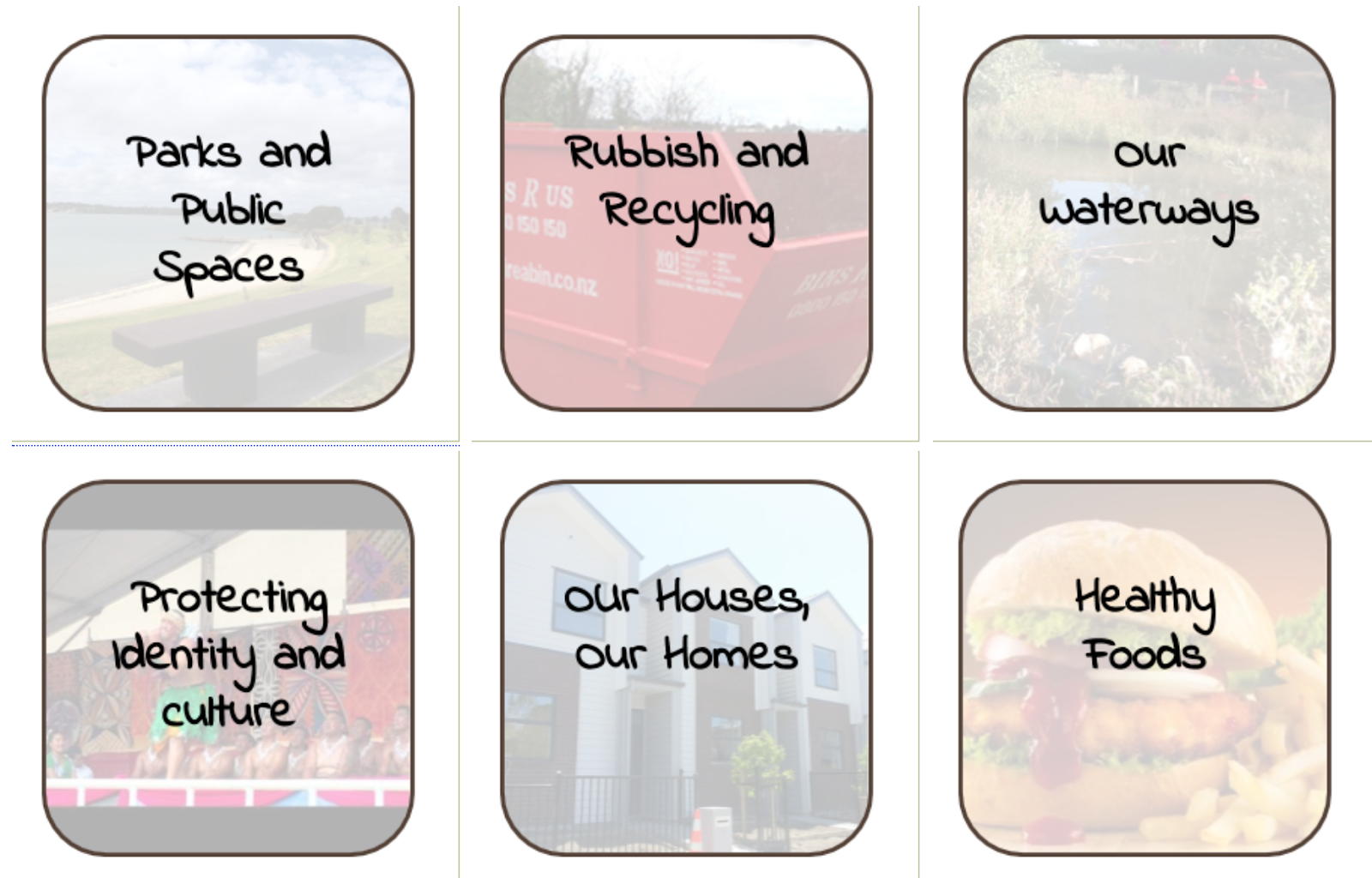
At the end of 2016, we decided to implement links to the 4 To remind staff about the lead up to the unit, I discussed the staff PLD around what that would like and decided on our term 1 unit to focus on 'Sustainability'. As a staff we developed 6 areas of focus, each designed to give students a choice as to which issue they wanted to focus on.

From there, department were shared a document to show how they could support the teaching and learning of the topic as followed: English
From there, an initial plan for the Middle Leaders was designed whereby HOD's were assigned to support a class on their blogs. A draft Unit plan and a student site were developed and this was taught to the year 9's in term 1.

Below is a swat analysis review of the unit:
  • Process of integration during the unit (Teaching and Learning)
    • Strengths:  
      • Social Studies driven meant consistency in approach.  Weekly meetings with year 9 teachers.
      • All year 9 Students were talking sustainability
      • ‘Just in time teaching’ happened eg. The River Talks and 9RMz’s trip to Ruapotaka (contexts outside of school where Science and Sos teachers expected to come)
      • Student blogs
      • High engagement for staff involved (Gene, Karen etc)
    • Weaknesses:
      • Not all staff/departments on board.
      • HODs not able to check on classes.
      • Project Templates not used because of difficulty in applying them in social studies context.  Staff not comfortable using them.
      • Structure not totally clear
    • Opportunities
      • Fewer departments involved means more structure
      • More student agency
      • More learnings from this year
    • Threats
      • Loss of interest or enthusiasm from staff
      • Lack of time


  • End product from integration:  Te Taiao O Tamaki presentations.  
    • Strengths:
      • Positive feedback from the community
      • High student engagement for students who presented and students who visited
      • Developed better relationships with students
    • Weaknesses:
      • Wish we could’ve taken more presentations
      • Lots of Dot’s time taken on own
    • Opportunities
      • Have our own school presentations for all projects
    • Threats:
      • Limiting it to the best kids
Key Learnings:  Kids loved it.
MOVING FORWARD:
We want to develop and looking at a model that will work for us:
  • Howick College innovation stream - one class where students apply to be in it.  Involves 4 core subjects.
  • Fusion at Oxford Area school -all year 9’s and 10’s.  Involves Maths, Technology and Social Sciences.  Project based.
  • A partnership with the Liggins Institute from Auckland University is helping to lead a collaborative narrative/transformative learning approach developed  in the Cook Islands.  Ready made resources (Unit plan)


Wednesday, 15 November 2017

The Impact of my COL's inquiry, 2017

My COL's inquiry this year has focussed on:
Using effective & engaging strategies to lift the achievement of boys’ writing.

My learners this year have been the boys in my year 9 social studies class.

My aims were:
  • To increase engagement and motivation for writing
    • "I want to write because I like to write"
  • To improve and shift achievement in writing
    • "I want to write because I know how to write"

The ways I have addressed my aims are evident in the presentation below:


For the remainder of this blog, I will explore the current outcomes of my inquiry.

1. What happened for the learners and how did I make this happen?

There are 9 boys in my year 9 social studies who I have tracked throughout the year.  They began the year with the class and have been members right until the end of the year.

With regards to engagement, I found that for the majority of the boys, have responded positively to the integrated cross-curricular teaching and learning programme that I organised in our sustainability unit at the beginning of the year.  Our 'Sustainability day' helped to ease with transitions for year 9 students to our school and it was a day that brought juniors, seniors and staff together to show support for our year 9's and helped them feel part of the Tamaki family.

As part of the integrated unit, students took on relevant environmental projects that saw them working with all of their teachers on a project that interested them.  For the boys in my class, they really enjoyed getting their hands dirty and working on fixing up our 'un-loved' Rain Garden.  They were able to talk about the process in their writing because they felt connected to the project.  This came to fruition at our Te Taiao o Tamaki cluster-wider presentations at Te Oro, where students shared they're presentations.


Within the classroom I wanted to see if students could write about what they'd experienced during the integrated unit.  To help them with their writing, I found writing strategies that they were familiar to them from our local primary schools .  After visiting a number of schools, I want to trial the 'Summary Strategy' which I saw being used effectively on a visit to Robyn Anderson's year 8 classroom.

Many students recognised the strategy, and I found that the more they used it, the more they became more confident in using it to improve their writing.  I then combined this with SOLO taxonomy, to help students with the language of NCEA in a hope to also prepare them for senior school.  My students found SOLO helpful in understanding where they were at and how to get to the next stage.

To support their writing, students were also encouraged to share their learning through regular blog posts.

2.  What evidence do I have for this?

Here are some snapshots of evidence.

Engagement and motivation for writing

Blog posts:  A number of boys in the class have expressed their engagement through blogposts.

A blog by a Year 9 student

Teacher observations of students' comments:
Due to our jumpstart programme starting, the year 9 class has now moved to year 10, which meant I would no longer be their social studies teacher.  For our last lesson, I asked the students to write a reflection on the year and the boys that were present, wanted to verbalise how much they'd enjoyed being part of the class.  Student 8 and student 10 described how much they've learnt and how they felt like a family.  It was quite emotional and seeing how far the students had coming from being quiet, scared and nervous at the beginning of the year to the confident and engaged students that they are today, made me feel proud.

Our last class together!

Improvement and a shift in achievement in writing:

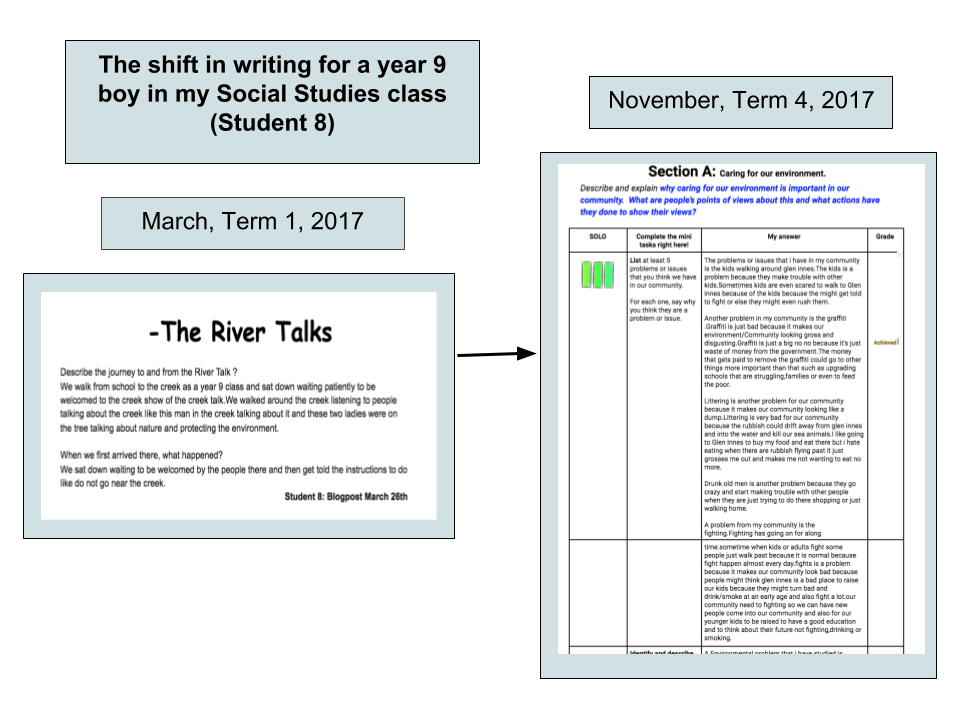
Examples of writing: From term 1 to term 4.
All of the students in the class have made positive shifts in their writing.  The majority of the boys are able to describe and explain key points as they understand the need to ensure they fully explain what they need to describe. They are able to use structures and strategies learnt to improve their writing.  Below is an example of a students' writing from term 1 to term 4.
Student voice surveys:
I surveyed the students in my class and asked them if they felt they're writing has improved and 7 out 9 boys said yes and when asked why, 3 of them replied:
Because I was able to explain more about the point
Yes because writing help me understand all the difficult words I've never understood in primary. Because it helped me with my vocabulary. Because it helped me write more, by explaining and giving examples from the texts.
Because I was low in writing but when I came here I improved

Comparison of Mid-term exam results to the End of year exam results: The 'Sustainability/Environment' essay.

In the mid-term exams, students were given an essay question about 'Sustainability and Caring for the Environment'.  Only 4 of the 9 boys passed, with 3 Excellences and 1 Achieved.  For the end of year exam, students completed the same essay and this time all 9 boys passed, with 4 Excellences, 4 Merits and 1 Achieved grades.  This is an excellent result!

Evidence that is still to come:
I am currently waiting (with eager anticipation) on the recent asttle writing results that students have completed, to see if there has been a shift in their writing according to our national standards.

3. What's next?


There are a few things that I am working towards implementing to continue my inquiry and rather than go into detail, I will list the ideas below (and talk more about them in future blog posts!):

  • Use the writing strategies across the whole of year 9 in 2018.
  • Work with the other departments in our school to develop and implement a collaborative context embedded curriculum.
  • Work closely with more primary schools to develop a structured transfer of writing strategies from years 7 and 8 to year 9.
  • Set up the 'Summer Blogging Challenge' at the college to encourage students to blog over the holidays.

I just want to take this opportunity to thank our COL's leader Russell Burt, the Manaiakalani Innovative team and the other COL's teachers for allowing me to be part of the Inquiry Journey.  Kia Kaha, Kia Toa.

COL Inquiry #6C: Academic Reading "Teaching to the North East"

From the Secondary Teacher Literacy Handbook page 33:  Bishop (2019) stated that to improve Māori achievement, teachers need to  create an e...