Friday, 13 April 2018

A visit from our Canadian friends

Today we had a visit from Wayne Poncia, who is the Chief Product Officer at Hapara, and a group of teachers from Canada who were interested in connecting with our school to develop a Global science action project.  In 2010, Hapara started right here in our Manaiakalani cluster and so we felt excited about developing a relationship that was innovative and collaborative.

We talked about the initial stages of collaborating on a project that essentially would see our students connecting to solve real world 'wicked' problems with groups of students from schools in Canada, the U.S and other countries.  We brainstormed what this could looked like and put together a few ideas that we would go away and work on.  We then took our visitors around the school and they saw how engaged our students were in their learning using teacher dashboard and workspace.  Many of our teachers use Hapara workspace as their teaching and learning tool.  At the end of the visit, our guests left feeling positive and looking forward to connecting and collaborating more with our students in the future.

Hinerau Anderson shows our visitors how she uses dashboard


Saturday, 24 March 2018

My theory of 'Action'

My theory of Action

At our recent COL teacher meeting we learnt about identifying our Theories of Action and we discussed a 'causal chain'.

A causal chain is when a cause leads to an effect and that effect becomes the cause of another effect

A leads to B. B leads to C. C leads to D.

Any intervention you design will (consciously or not) be based on a causal chain you have in mind - this is my theory of action.


Thursday, 22 March 2018

Stepping outside the classroom - real life learning in our wonderful Community.

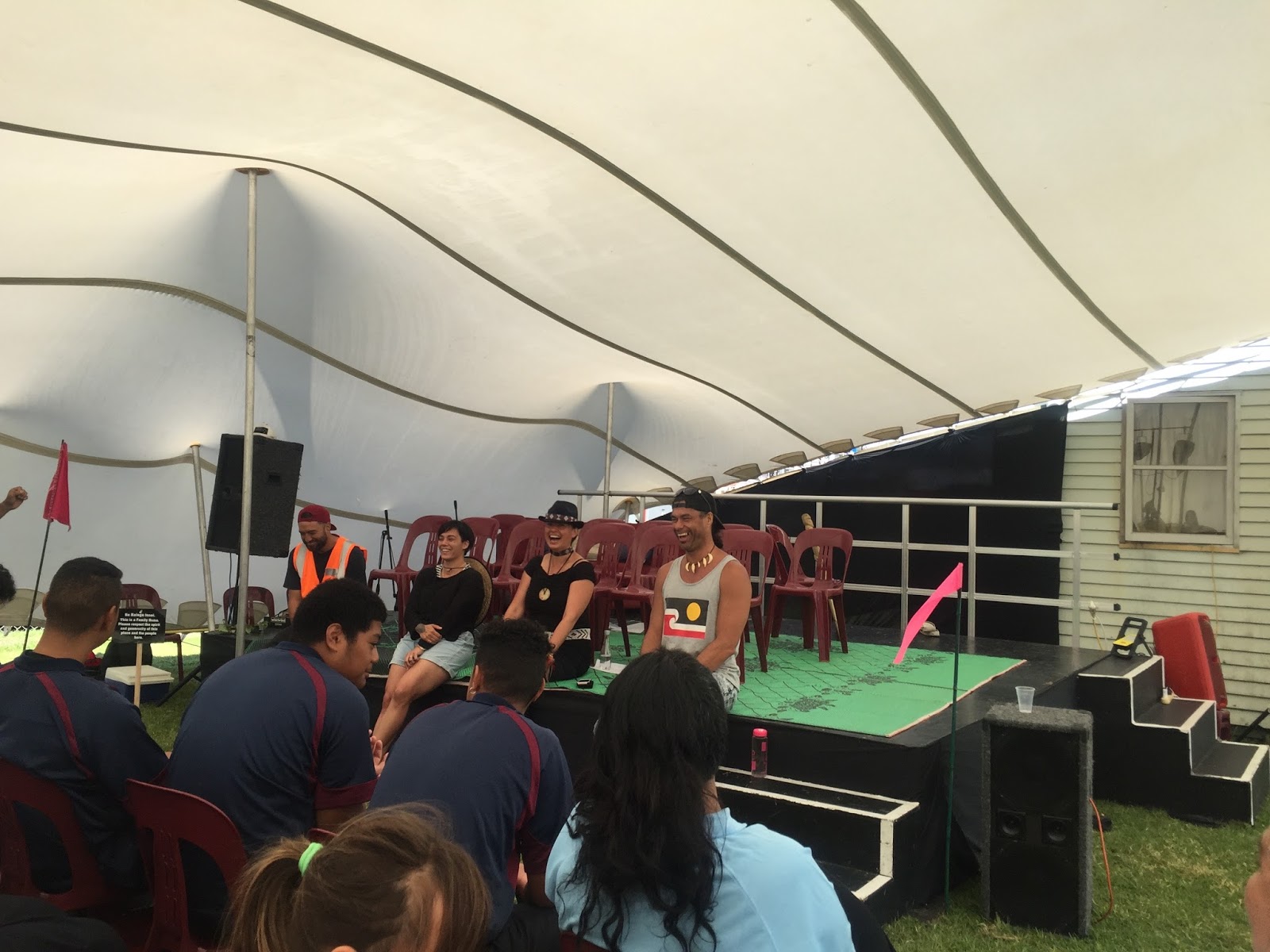
Today our level 2 Sos class took part in the 'Home Fires' workshops as part of their assessment 'Conduct a reflective Social Inquiry 91280' into the TRC and the housing issues happening in our area.  One of the criteria requires our students to 'describe people’s points of view, values and perspectives and to consider the ways in which people make decisions and participate in social action related to the focus of the inquiry'.  The social actions that our kids have been studying in class and have happened in our community, have been wide and varied.  We watched numerous videos, read articles about protesting and listened to guest speakers (thank you DJ, Renee, Brenton and Phoenix Lemalu) about their perspectives on the issue.  But these types of learnings were still in the confines of my classroom and after a while, my kids were becoming disengaged and off-task because the context for their 'language of learning' was limited to my class.

Today they were challenged to step out of the classroom and see what the issue meant to another group of people it had affected.  Tamati Patuwai is part of a group called Madave who are a local community group and have shared their journey of the changes that are going on around them.  They invited our kids to a non-violent, artistic, peaceful expression of actions as they are a group of people whose houses are one of the few remaining on Fenchurch - the development is unbelievable!.  Every day the families in the little houses that remain, wake up at 6am to the sounds of drills, trucks moving concrete or generators buzzing furiously all the way til 10pm.  I can't imagine what that would be like!.

The group welcomed our kids onto their whenua (property) with a powhiri.  I sensed our kids feeling nervous and apprehensive for the day.  But those feelings soon disappeared as the day went on.  They were feeling like one of the whanau.  Our kids had a choice of one of 4 workshops:  Poetry, Graffiti, Dance and Photography.  Each group had the same question - what does a 'Home' mean to you?  Seeing the kids step out of their comfort zones and not be shy about sharing what they've learnt in such a short time, showed me the value in taking these 'last minute' opportunities when they come.
The respected Kaiako for the each group.

I was worried about taking these students out of their other classes to this field trip because I know how hard it was when half of your kids are taken out out of your class especially during an assessment.  Believe you me,  I know how frustrating it can be.  But as I look for ways to engage my kids better, if as a teacher you are willing to take the risk and in your hearts of hearts know that the value & learning in it is bigger then the walls of our classroom, sometimes you just gotta take that chance.

I saw our kids respectfully treat Tamati and his sister Ngaraiti's home like it was their own.  I saw how involved they became in their groups learning and engage in their learning like I've never seen before.  And I saw how they stood up proud of who they were and who they represented.  Three of them said they didn't want to leave, and when we got back to school, two of them told me that they would be going back for the evening session.

When I ask myself 'was it worth all the grief that comes with being last minute?' I say 'hell yeah - just ask the kids!'
Ms Gordon and the little fulla 


A beatiful Tui painted on the side of the house


The photography group is brainstorming

The poetry/haiku group getting their poems ready.

Photographers out and about

Teariki starts the graffiti groups story

Vei asked Ms Gordon if she could take a photo of her art work

The words become real.

Lawrence learning his dance poses


The completed graffiti 'wall'

The Graffiti group sharing what they have learnt

The photographers sharing what they have learnt

Go Tupou!

Lawrence and the dance team in action.


Chasity, Evelyn and Latisha being expressive in their dance

You were amazing dance team!

Our poets Kaho, Zeke and Neva sharing their poems.

Antonio has the last word.

Tuesday, 20 March 2018

Learning from our 'future' students

Sometimes our students become our best teachers.

With the hectic schedules we have as teachers, I have found checking out students' blogs from our primary schools really useful in understanding what they are learning and how they are learning it.

I decided to start with the year 8's because I am interested in seeing what strategies they know and which ones we could adapt, particularly around writing.

Andrew in Room 2 at Point England Primary, shared his presentation about 'Explanation writing' and used a framework that explored how to use 'Structure' and 'Features' in their writing.


Here are a few others that give awesome reflections about their learning, that I hope to utilise:


As our students complete their asttle tests over the next few days, I will look at how to utilise the strategies from these posts to inform our practice.  I've also looked at comparing how we tackle explanation writing across departments.   Using Andrew's model, I've put on a drawing what departments use.  From this, I hope find a common 'Tamaki' approach to explanation writing as our kids often move from class to class hearing a different version of the same thing.


Monday, 19 March 2018

Finding better ways to connect with our Whānau

There are very few times that I may actually meet the parents of the children I teach - on the rugby field, at a fiafia night or at parent teacher interviews twice a year. I know that there needs to be more of a connection between school and home and I have been wondering how to do this better with the time constraints we have at school. My hypothesise is that if we bridge the gap between school and home better, our kids could achieve better.

A good friend of mine is an intermediate school teacher at a decile one school. She texted me to ask me if I knew the translation of the question 'What are the aspirations for your child?' in Samoan. I called my mother who translated the saying over the phone. Because Samoan is not my first language, it took me awhile to get the intonations right and I had to repeat it back to my mum until she was happy with my pronunciations. I called my friend back and carefully shared the saying. I asked her why she wanted to know and she shared that her school was having a 'Connections' night where they meet with the parents of their students and in their native languages, would ask parents 'What were the aspirations for your child? And why do you have these aspirations?". Our discussion led to me thinking about the value in understanding the thoughts of our parents and if we knew what their hopes and dreams were for their children, we could all be on the same waka rowing towards success.

A recent report by the Education Review Office (2014) looked at how well 256 schools worked with parents and whänau to respond to students at risk of underachievement. The report shared examples of where parents and whänau accelerated and supported progress and improved achievement. In their findings, they identified two ways that schools had responded to the 'risk of underachievement' - by supporting future underachievement and by supporting those not achieving as well as their peers to accelerate progress (pg 16, ERO, 2014). It was interesting to note where schools focused on 'preventing future underachievement', examples focussed on whole cohorts, such as all of Years 1 to 3 students or a large group, whereas the examples of accelerations involved smaller groups of up to 10 students and in many secondary schools, the example involved only one or two students. As a COL teacher I can relate to using examples of the smaller groups because our inquiries have allowed us to focus on our own practices and shared these inquiries across our cluster.

The report goes on to outline a number of relevant and interesting examples of ways to connect with families and one of the key words that stood out to me was persistence. Part of the reason why we as teachers and educators may not involve our families as much as we should, could be a lack of persistence and not understanding the value in making these connections. I believe we need to be persistent in our approach to getting our parents and families involved in their child's learning.

One of my next steps is to create opportunities for our families to engage in learning and understanding ways to help their child learn. On Tuesday 27th March, our students and their families are invited to attend PowerUp, an initiative that is run to support students from the community with their learning. I met with DJ, the co-ordinator and expressed my interest in running workshops with our parents around reading and writing alongside PowerUp. We have been developing a plan that will include parents brainstorming their hopes for their children, identifying their strengths and engaging in meaningful discussions in the hope that they will feel confident and empowered enough to engage in learning discussions with their children. So when our families are asked "Po'o lea ni ou fa'amoemoenga mo lou alo?" (What are the aspirations for your child) we can work together, with purpose and persistently to make those hopes and dreams a reality.

Sunday, 18 March 2018

Understanding the Asttle marking process

One of my reasons for taking up the writing aspect was that my kids had problems writing.  But what areas in particular did our kids find hard?  And how do we know what the best writing looks like.  As someone who has not much experience with marking asttle,  Marc Milford, our student literacy expert provided the opportunity for staff to meet together and moderate student asttle papers to help us understand the process better.

We sat down together and went through a number of scripts and I was amazed at how thorough the process was when it came to understanding each of the areas of language that a learner needed to achieve.  There are 7 areas in marking rubic that contribute to an overall grade and each requires knowledge of how to identify them.  Each paper needed to be moderated 3 times was a way to ensure that each mark was awarded fairly.  After going through a number of papers, I felt more confident in how to approach the marking and clearer on what I wanted to address within my department.  From this session, my hope is to identify the students who share gaps within specific areas of the rubic and create differentiated writing strategies to support them.  This would require ensuring my teachers know what to look for and how to teach it. 

Moderating student asttle tests.
Me and Marc working hard to get it done!


Friday, 16 March 2018

Reading about Language

I have been doing a bit of background reading from our COL's sessions to help me understand what 'Language in Abundance' could look like at our school and in my classroom and how we could value the theories shared by Dr Jannie van Hees on making 'language' a key focus for us.


In the 'Education Aotearoa', an article the Dr van Hees had written looked at 'Conversational Classrooms', the discussion looks at how when 5 year olds arrive at school, who have noticeable gaps in their language.  When thinking about my own classrooms, my year 12 and 13 students at this stage should be able to articulate and tell me what their thoughts are around their learning - but find it difficult.  When it comes to critical thinking or high order thinking, I am the one who is often discussing concepts and at times, they are present but not contributing. I wonder if it is because I assume they should know the language or are they're other reasons.


I am interested in finding strategies to address this. Dr van Hees describes difference making in two schools - an all girls Catholic secondary school and it's feeder primary school.  What she noticed was they shared an:
  • unswerving belief in the capabilities of students
  • high student expectations
  • fine tuned, scaffolded learning support
  • high calibre teaching staff and leaders
  • strong home-school partnerships
  • high levels of student self-belief
  • and a focus on ‘what really matters’ – the essence of enablement educationally.'
When I read this, I wonder which of these do we as a school have and how did these schools get to these stages?


The article goes on to say that the teacher dominated classrooms where the teacher asks questions and the kids put their hands up lacks the depth required to allow kids to think critically.


"Seldom occurring will be the dynamic cut and trust of ideas exchange – what we might hear in families where balanced sharing of ideas and thinking is the ‘bread and butter’ of meaning-making relationships and learning".  

When I am thinking about my seniors, I know it is about stepping away from dominating in front of the classroom and listening to the language of my learners better. In my classroom, I have control and can apply the strategies suggested by Dr van Hees but in my role as a COLs, I want to think about how I can approach and work with the culture of our school to develop the change that can help other learners achieve success.

COL Inquiry #6C: Academic Reading "Teaching to the North East"

From the Secondary Teacher Literacy Handbook page 33:  Bishop (2019) stated that to improve Māori achievement, teachers need to  create an e...