Saturday, 15 April 2017

Te Taiao o Tamaki at Te Oro - A quick review

One of the huge motivators behind our sustainability unit was the opportunity to showcase our learning as part of the Te Taiao o te Tamaki Manaiakalani cluster wide environmental themed focus. This was held on Wednesday 12th April, during the last week of term at Te Oro and attracted students, parents and members of community to our displays.

We wanted to show all of our kids work but we were limited in space and time.  The year 9 teachers of sos had looked at the best projects in their classes and selected the students who had put in a lot of effort and showed understanding in what was needed in the assessment criteria (to be discussed later), then emailed me their names.  Over the last two weeks, I had worked with them to help them prepare for their presentations.  There were 6 chosen to put on display at Te Oro. The projects were based on:
  • The housing crisis in Glen Innes
  • Our school rain garden
  • Healthy foods and gardens
  • Our parks and public spaces
  • Measuring pollution in the Omaru river 
  • Sustaining our culture and identity
Our schools display was in a busy area which had lots of foot traffic.   Our kids had put up our displays the day before and practiced presenting as we knew there would be lots of people interested in what their projects and what they'd discovered.  

Leopote showing students his display on our schools rain garden.
Although the weather was crazy, it did not deter our kids from presenting well and doing a remarkable job at explaining what they researched and why.  All of the schools in the cluster had created outstanding projects and I feel we connected at another level which was inspiring!
Our principal listens intently to Pareata's explanation of the Rain Garden.

Our Samoan group performed for the first time in Te Oro - they sounded magical and for most of our year 9's it was their first time seeing students from their own school in such a highly disciplined forum.  At the end of the performance, I addressed the year 9's and connected the ideas of belonging and value to how the students who performed in the Samoan group felt.  I reminded them of when they planted their seeds and how it relates to sustainability and praised them on their behaviour and efforts during the term before they were allowed to go. 

To be honest, I did feel exhausted at the end of the day but mainly relieved that our kids had journeyed through the sustainability unit and theme and come out the other end and survived - wait, did I mean the kids or me!?! Let me rephrase that - I felt that we needed to do something different with regards to an integrated cross curricula programme, whereby kids could work on a project and call on their teachers to help them.  Although our theme was conceptually future focussed and grounded in the aspect of sustainability, our students needed to see the value in protecting and safeguarding their environment around them and to feel like they belonged to it and it belonged to them.  In that way they could be empowered to safeguard and protect it.  I wondered and hoped they' learnt something on the integrated journey.

Jolise proudly displays her research on the housing crisis in our area.


Friday, 17 March 2017

To blog or not to blog - that is the question!

One of the biggest tools of the Manaiakalani model of 'Learn, Create, Share' was the sharing of students learnings through blogging, something the primary schools in our cluster have taught their students to use.  At Tamaki, blogging was being used by some staff with their classes but we still needed to use this better as it inconsistent and under-utilised in our school.

For our year 9 sustainability unit, I wanted to develop the use of blogging in our school to ease the transitions from primary to secondary and thought that if we enforced blogging as an expectation at in social studies at least it could be filtered across school into other curriculum areas.  I was happy to trial the setting up of the blogs and implementing it into our units. I decided to create class blogs whereby the teacher would post ideas that kids were learning or activities or questions that the class could relate to, in order to ensure that learning was visible to an audience like our parents and other students across the school.

Firstly we needed to ensure that our kids had blogs and although it was a little bit of a logistics barrier at first, eventually the majority of the students were up and running using their blog addresses from their primary schools.  One of the reasons why it was important to keep their primary school addresses was because we could see a shift in their writing and we progress in their thinking.  The tracking of their learning journey from years 0 (for many of them) to where they were now would help us know how much of an impact each of the stages of their lives had on them  - imagine looking at your blogs in 20 years time and remembering all the wonderful memories you made at school!

Secondly, I had to familiarise myself with blogger.  I have to admit, I had rarely used it for student work let alone as a means of communicating with the students.  The idea of my thoughts on teaching and thinkings as public to the world scared me a bit but I had to try!.  Thanks to Karen Ferguson's 'how to' site, I learnt that you could have lots of blogs and be administrators to all of them and not worry about being perfect in what I said.  I learnt that you needed to be factual.  I also looked at some of the primary schools class blogs.  I then created a site for each of the year 9 classes and shared them with their social studies teachers.

Thirdly, I had to see where my department were at with blogging and if they felt comfortable to give feedback.  I gave them some examples of class blogs and feedback, and assured them that with practice and collaboration between us as a department, we would be able to see how well (or not so well) class blogs worked.  I could sense a bit of apprehension on their part and explained that it would be a start of a relationship with the students that could be developed and as a department, we would support each other on the journey.

Here is the link to our class blogs and site.  

Our class blogs on the social studies site. 

Friday, 3 March 2017

“Ko au te awa, ko te awa ko au - our visit to the River Talks

The theme for our year 9's was sustainability which we as a school, we had identified a number of different areas in the community that were issues.  One of the issues raised was how to protect and sustain our waterways.  The Omaru Creek runs through Glen Innes and is polluted.

Mad Ave productions invited our students this week to attend 'The River Talks'.  The production was run over two days which allows us to take some of the classes to the production over the two days, without disrupting subject teachers timetables which I was conscious of, even though it had been planned from last year. 

On our first day, we took 3 year 9 classes and although we were only able to see half of the production, they gained some insight into why and how the river became polluted.  They were told how 100 years ago, the river was a means of collecting food for families and kids like them, could swim safely in the river.

We were lucky enough to be joined by the other schools in the cluster.

On the second day, we took the remaining 3 year 9 classes and were able to see the entire production from beginning to end.  The students enjoyed seeing lots of different points of view about the river and one of the exhibits showed how water was collected and diluted but showed an excess amount of pollution and poison which surprised many of our kids.  A number of students wanted to know if they could choose the river as their topic for their sustainability projects!  All in all, the days were valuable in showing real life issues to relate to what they were learning about.

A few of our students holding up signs - future social activists maybe?


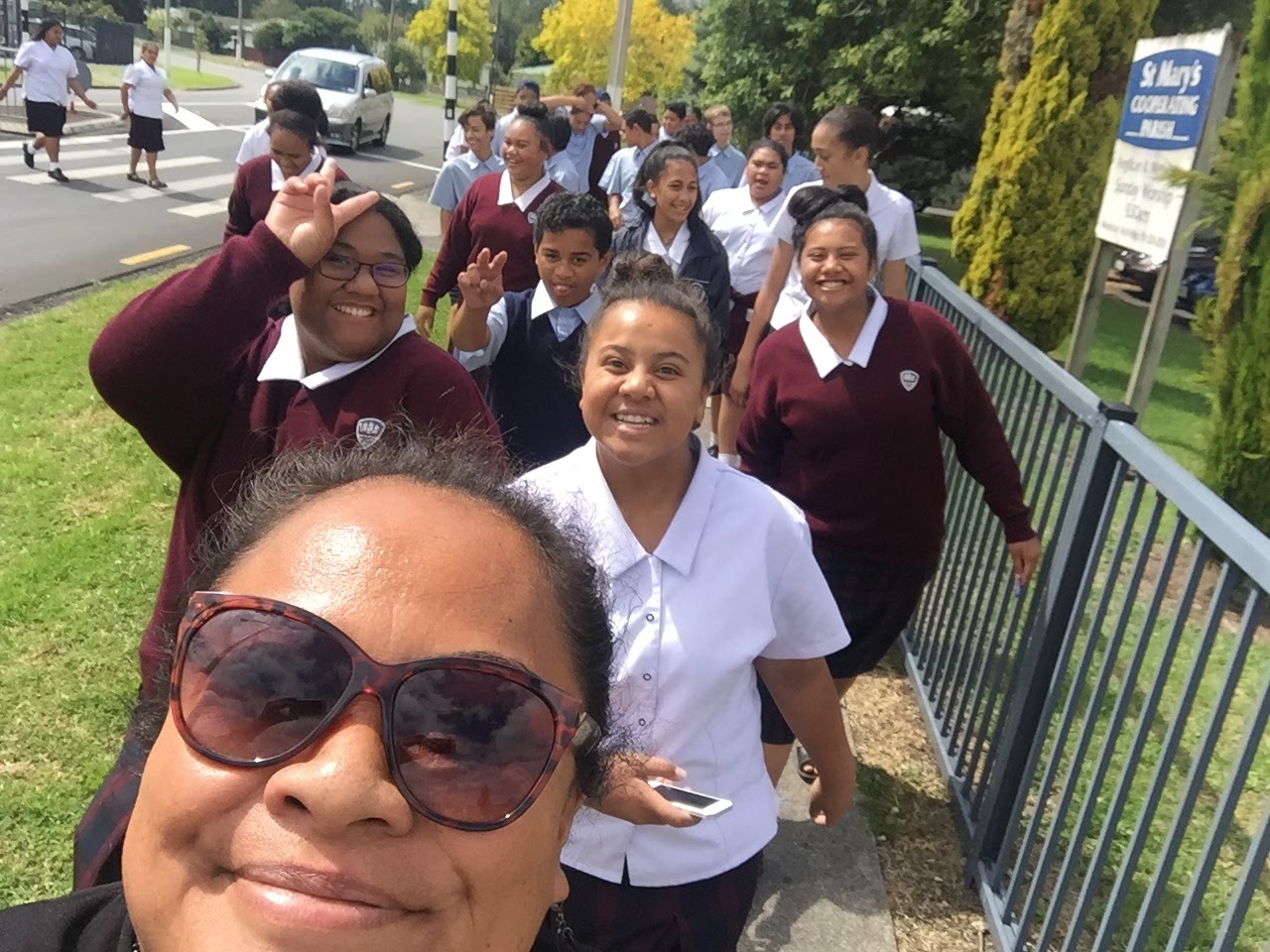
Always time for a selfie!


The kids were a little freaked out by this scene!


Our kids looking over the tunnel entrance where polluted water travels down from the businesses in St Johns to Glen Innes.

Looking for the theory behind an integrated curriculum

“It’s not about doing something differently, it about doing something really different…” (James Beane, 1998)


Integrated teaching didn't just happen over night.  Theorists have studied the effectiveness and the ins and outs of developing an integrated program - my problem was finding out which theorists were 'right' and which could support the why and how an integrated curriculum was needed particularly at a school like ours, where an established single silo curriculum already existed.


I wanted to research theories of integrated teaching and learning in New Zealand, to see what was happening out there and I came across two schools whose models of integration that appealed to me because of it's straightforward and logical approaches:
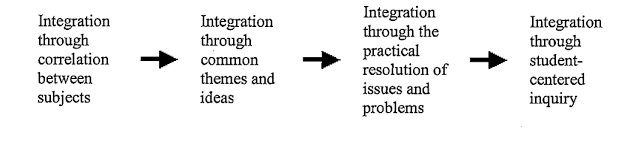
Both referred to the studies of James Beane whose research developed an interdisciplinary pedagogical approach and identified that curriculum integration occured when students experienced and understood connections. The concept of curriculum integration offered by James Beane (1998) involves four major aspects:

  • The integration of experiences uses both past and new experiences to help students understand and solve new problems.
  • Social integration is based on personal and social issues that can be identified in, and developed from, the students’ world. Social integration assists students to apply new ideas and understandings to their daily lives and to the lives of others.
  • The integration of knowledge involves being aware of the ‘big picture’ of learning. When knowledge and skills are connected, rather than fragmented, students begin to see situations as real to themselves and the world they live in.
  • Integration as a curriculum design occurs when students and teachers explore, gather, process, refine and present information about topics they wish to investigate without being constrained to a specific learning area

These four aspects all develop a sense of student centered teaching and learning, where students take ownership of their learning, rather than the teacher leading the learning.  


As an aside, the St Cuthbert's approach to integrated teaching and learning acknowledges the idea of 'problem based learning' as an approach that students could take towards learning, an approach adapted by Brown and Nolan (1989)


This approach acknowledges the complexity of real-life issues today’s students are grappling with, and has built-in flexibility that enables students to apply one or all these types of integration on their learning journey.


Teachers and schools fear that an integrated programme will mean disciplines disappear but Beane argues that the disciplines of knowledge are more likely to find legitimacy than they have now in the curriculum.  I have been interested in finding out more about how to emphasis this to our teachers and have evidence to show that an integrated curriculum could be an effective way to engage our students.


I wanted to find out if Beane's approach was a common one in other schools or whether there were other approaches schools used instead.


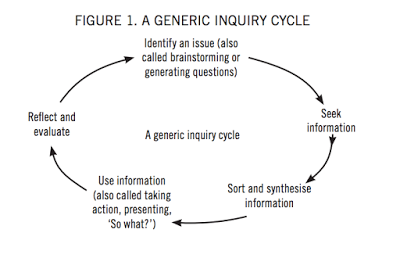
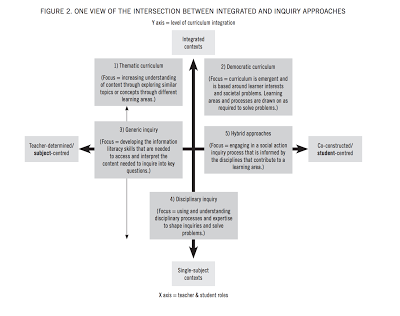
Sally Boyd and Rose Hipkins (2012)  NZCER study of 'Student inquiry and curriculum integration' found that schools were using a wide range of different approaches to inquiry and integrated-inquiry.  They found that most schools used a common generic student inquiry cycle, where learning was viewed as a process with different stages or steps that students are guided through.


It is important to understand that when students have been conducting an inquiry in their classrooms they are often using a single cell or one subject approach.  Inquiry approaches can be used to support learning within a single subject or learning area, or they can be combined with integrated approaches to the curriculum. Boyd and Rose (2012) identified 5 different approaches which have a mix of aspects that schools had chosen and/or adapted to suit their needs.


One approach which I felt suited our school was the thematic approach.  Because subject content is the starting point for planning, the thematic approach is described as subject-centred. Teachers identify the curriculum content focus and plan how connections will be made.  


On reflection, this approach seemed like the best place for us to start.  It allowed for subject teachers to relate to a theme that they could connect to and therefore base their planning around.  The downside was, it was very teacher focussed and centred.  There are other approaches which I am interested in finding out more about are provided on a diagram based around different approaches to integrated curriculums that schools have adopted outside of the traditional thematic approach.  These approaches are ones that I hope to investigate (and possibly trial) more about.  Please watch this space!


Beane, J. (1996). Curriculum integration. Designing the core of democratic education. New York and London: Teachers College Press, Columbia University. Brown, M.T. & Nolan, C.J.P. (1989).

Brown, M.T. & Nolan, C.J.P. (1989). Getting it Together: Explorations in CurriculumIntegration, Out of Class Activities and Computer Applications. Massey University, Palmerston North.


The Manaiakalani Framework of Inquiry structure


Manaiakalani Teaching as Inquiry Framework


Labels for blog posts ...


Personal Inquiry Log
Click on the link to see the document


Focusing Inquiry
Possible Actions
Learn
Focusing Inquiry
“What is important (and therefore worth spending time on) given where my students are at?”
Gather evidence
Student achievement data eg. standardised tests, OTJs, internals and externals
Anecdotal evidence eg. observations, formative assessment tasks, student voice,  parent voice, previous teachers, surveys,  learning walks and reciprocal visits
Scan
Wider perspective on learning not just aspects that are easily measured eg considering perspectives of our young people and their whānau. How engaged are they with learning? Can they describe what they are learning and why it is important?  (AfL) Links to Key Competencies
Dr Graeme Aitken: Manaiakalani Leaders PLG May 2017
Identify Trends
Looking at all the evidence, thinking hard about its “shape”. Noticing where there are cohort trends that extend out beyond the class, to the team or department, maybe even for this school across schools in the CoL
Clearly identifying the common learning challenges or problems.
Looking for and identifying strategies that are known to have the greatest impact on on this/these challenges
Hypothesise (Hunch)

Analysis and interpretation often take place in the mind of the teacher, who then uses the insights gained to shape their actions as they continue to work with their students. These theories for improvement should connect with the inquiries related to the Achievement Challenge of the Department/Team, the School and the CoL.
Research
“This involves asking questions about how well current strategies are working and whether others might be more successful. Teachers search their own and their colleagues’ past practice for strategies that may be more effective, and they also look in the research literature to see what has worked in other contexts.”

Reflect
“Inquiry into the teaching–learning relationship goes hand in hand with formative assessment, in the cyclical evaluation process that goes on moment by moment, day by day, and over the longer term.” Assessment-in-the-classroom/Teaching-as-inquiry

Teaching Inquiry
Possible Actions
Create
Teaching Inquiry “What strategies (evidence-based) are most likely to help my students learn?”


Make a plan
What can I already do and  what do I need help with?
Who are the learners? Group/class
What are the goals for my practice and student achievement?
Set up processes for capturing evidence about whether the strategies are working for my students.
Try new things
It is a constant state of action, monitoring, reflection, and adjustment - and then more action.
Failure may occur.
Feedback from learners - how will I engage them with new learning? Do they know we’re trying something new?  
Innovate
Are we capitalising on the affordances of the technology to support the Five Affordances of Learn Create Share (Engagement, Teaching Conversations, Visibility, Cognitive Challenge, Scaffolding) identified by the WFRC
Implement (Taking Action)
Just do it!

Reflect
“Inquiry into the teaching–learning relationship goes hand in hand with formative assessment, in the cyclical evaluation process that goes on moment by moment, day by day, and over the longer term.” Assessment-in-the-classroom/Teaching-as-inquiry

Learning Inquiry
Possible Actions
Share
Learning Inquiry -
“What has happened as a result of the changes in teaching, and what are the implications for future teaching? ...We need people to provide us with different perspectives and to share their ideas, knowledge, and experiences.”
Publish  
What happened as a result of the changes? Share evidence (artefacts of student learning, DLOs) and effective strategies.
Co-teach
What if my plans didn’t work? Are there different approaches?Who can help me? Peer observations, video analysis of my practice.
Model / Guide
How can my findings and experiences support my peers? How is this shared?
Feedback / Feedforward
What are my next steps? How will I sustain effective practice? Learner feedback? New goals?

Reflect
“Inquiry into the teaching–learning relationship goes hand in hand with formative assessment, in the cyclical evaluation process that goes on moment by moment, day by day, and over the longer term.” Assessment-in-the-classroom/Teaching-as-inquiry

Thanks to Anjila Dixon for starting us on this co-construction

Monday, 27 February 2017

Reviews and re-visings

This year we are trialling an integrated approach to teaching and learning for our year 9 students.  Each term there is an overarching theme link to the four future focussed principles outlined in our New Zealand curriculum:

“The curriculum encourages students to look to the future by exploring such significant future-focused issues as sustainability, citizenship, enterprise, and globalisation.”

This term we have taken on the issue of sustainability and ways we can more sustainable in the community.  In their classes, students will select a project and work in groups to come up with ideas of how to sustain an issue or problem in our community.  Issues were chosen around relevance, interest and the problems identified by staff and students.  One of the main drivers for our integrated sustainability curriculum this term was our Manaiakalani clusters focus which is on the health of our local streams and pest eradiction, one of the projects that students can select under the sustainability umbrella.  At the end of the term, students with the best projects are invited to show their learning at 'Te Taiao o Tamaki' which is a showcase of projects from around the cluster - we are really excited about this!

The social studies department has been leading the teaching and learning around sustainability and this has been an interesting challenge.  One of the challenges for our department has been trying to fit in to a already busy and defined programme something that can prepare students for their individual projects but at the same time ensuring that there is some link to other curriculum areas.  In saying that, other departments are invited to contribute to the learning rather than create a programme that will work alongside the social studies department.  This is definitely something that I feel needs to be clarified and refined better thus the reason why I have chosen this to be my teaching inquiry.

I think back to a trial integrated project we did last year on the Olympics and although we gained a lot from giving it ago, the struggles were far and wide.   We learnt a lot from that unit.

Lately I have worked closely with my department on what the teaching and learning of the sustainability projects 'look like' and I have tried to use my digital (although somewhat limited) expertise to guide them through some of the process.   One of the issues we have needed to overcome was blogging.  Creating a blog, then understanding the need for a blog (especially a teacher inquiry blog) has been one that teachers are trying to get to grips with - I've noticed that it is confronting for staff and the thought of sharing their inquiry and thoughts and reflections with the world can be daunting and terrifying!  I feel that this fear is real and we will need a more supportive approach for the teachers that digs down to the roots of the 'blogging phobia in public' issue rather than smoothing over it and expecting everyone to conform to the expectations of doing a blog and sharing it publicly.

Thinking about reasons why blog, I found this simple (very Americanised) video on blogging that makes sense to me:


There are group of HOD's at our school who don't have tutor classes but meet every Tuesday, Wednesday and Thursday's to go through different relevant aspects of our curriculum and looking at understanding how each others departments operates.  I've found that they have been really beneficial in that we are united in our vision and can support each other in the planning and implementing of relevant programmes such as the integrated unit - we are fine tuning every time we meet and move closer and closer to developing something that is the right fit for our learners and for our school.

My desire to take on the challenge of developing an integrated programme at year 9 level is linked to a PLG meeting we had in February 2016.  It was a cluster wide PLG so not only were our HOD's present but most of the leaders of teaching and learning from the primary schools in the cluster.  We were asked to contribute to a padlet and the question on the padlet was:

Write your hypothesis for what you see as a problem during the transition from Y8 to Y9. Include an example of evidence or a scenario of what this might look like.

The page instantly filled up with comments that students had told their year 8 teachers - "it's scary"..."meeting new teachers and students is hard"...

Below are some of the comments:


This resonated with me.  At first I felt like the college was being blamed and it made me angry.  How were we supposed to know this?  We've never been told?  Then it hit me...we didn't know this because we didn't ask.

After the Woolf Fisher Research presentation on the 7th February, 2016, writing was identified as a major issue and I was horrified at seeing how badly year 9 Boys did in writing.  Here are the stats:

This has become my inquiry!

Then I put myself in the students' shoes and it made total sense.  Looking back to term 1, 2016, our year 9 students really struggled to settle in to school.  I was teaching a year 9 class who I enjoyed, but battled on a daily basis just to settle them down and try and engage in their learning.  I had a feeling of helplessness, which turned into determination and finally into action - something needed to change!

When I think about our year 9's, I think about my granddaughter Satori and how she will feel when she starts school in year 9.  Will she be scared?  Will she be able to cope with such huge changes to the teaching and learning that she has been used to?  Knowing what I know now, I feel the future of education has been entrusted to us by the parents and grandparents in our community, so we need to get it right!  Watch this space!

Saturday, 25 February 2017

Updates on my inquiry

My COL's inquiry is how to plan and implement an integrated cross-curricula programme at year 9 to lift the achievement of boys’ writing.

One of our department goals this year is to collaborate, create and implement an integrated future focussed unit at year 9.  This is linked directly to our schools goal of 'working across departments in Year 9 on an integrated unit of work with a community focus or context'.  I have chosen this as my inquiry as I am really hoping to engage our year 9's in interesting and relevant contexts across curriculum areas.

Over the past year, I have been gathering evidence, engaging in professional development and attempting to put together a template for our learning environment.  We have an established 'old school junior curriculum' where departments are generally working in silos and the challenge has been to change the status quo and work more purposely across curriculum areas.  

There are many faucets to the planning and implementing of this change.  Trying to apply a cross-curriculum has been challenging particular with subject areas used to being silo's, however the dialogue between departments have helped to create conversations and a review of our teaching and learning pedagogies.

One of the key documents that I have found useful combines student inquiry with curriculum integration was Sally Boyd and Rose Hopkins study of schools who've adopted varying approaches to inquiry and integration.  They have also been part of a recent report on supporting future-oriented learning and teaching with a New Zealand perspective that looks at what 21st century teaching and learning could look like in schools.   These documents have been useful in looking at the wider implications of a systematic approach to teaching and learning.

You are here

COL Inquiry #6C: Academic Reading "Teaching to the North East"

From the Secondary Teacher Literacy Handbook page 33:  Bishop (2019) stated that to improve Māori achievement, teachers need to  create an e...