Sunday, 10 September 2017

Using SOLO to support my year 12's exam preparations

This week is senior exam week for our students and trying to get my year 12's ready for exams has been challenging at times, especially with the mixed levels of literacy in my class.  Students have to write an explanatory essay, and the context is the Israeli/Palestinian conflict.

Students were engaged with learning about the conflict but when it came to retaining some of the information and using it to write a structured essay, quite a few didn't know where to start.  

A few weeks ago, I taught some facts and issues around the conflict using the presentation below.  


The slide is quite content heavy, so I created a SOLO Hexagon activity to help them remember the key ideas and concepts.  I wanted them to connect ideas so they could show they were working to at least the relational stage of SOLO taxonomy.


At first, students were a bit hesitant to use the hexagons and had to refer to their notes.  But I persisted and every day for two weeks, I pulled out the hexagons and as I did, I expected complaints like 'why are we doing this again' and 'boringgg'.  Instead, students seemed excited when I brought out the hexagons and became confident in explaining how they were connected.  Each time they used the hexagons, I would mix try and mix up the task abit - sometimes they needed to work individually, sometimes it was a race to get it done the fastest or it was work in a mixed group with someone you'd never worked with before and be ready to explain to them what you knew.

For the less confident quieter students, I asked them to tell me the story of the conflict from their hexagons and it was nice to hear them articulate what they knew about the conflict.  It was tempting for their confident friends to jump in and try to help them out, but with a bit of guiding and patience, the quieter students were allowed their moment to speak.

Explaining to each other how ideas are related. 

After 3 weeks of hexagons, I wanted the students to firstly as a group, write down the what they'd learnt.  I wanted them to do this so they could show how they could collaboratively come up with what they thought was the best answer and then I could help them formulate and structure their paragraphs better with some formative feedback.   One of my quieter students completed the task straight away, which I thought was fantastic.


Using the hexagons has allowed my students to explain what they've learnt and gain a sense of confidence in using them to help structure their essays.   My next steps are to develop strategies which will allow for a deeper level of understanding, so that they could explore and make predictions about the future of the conflict.


Thursday, 7 September 2017

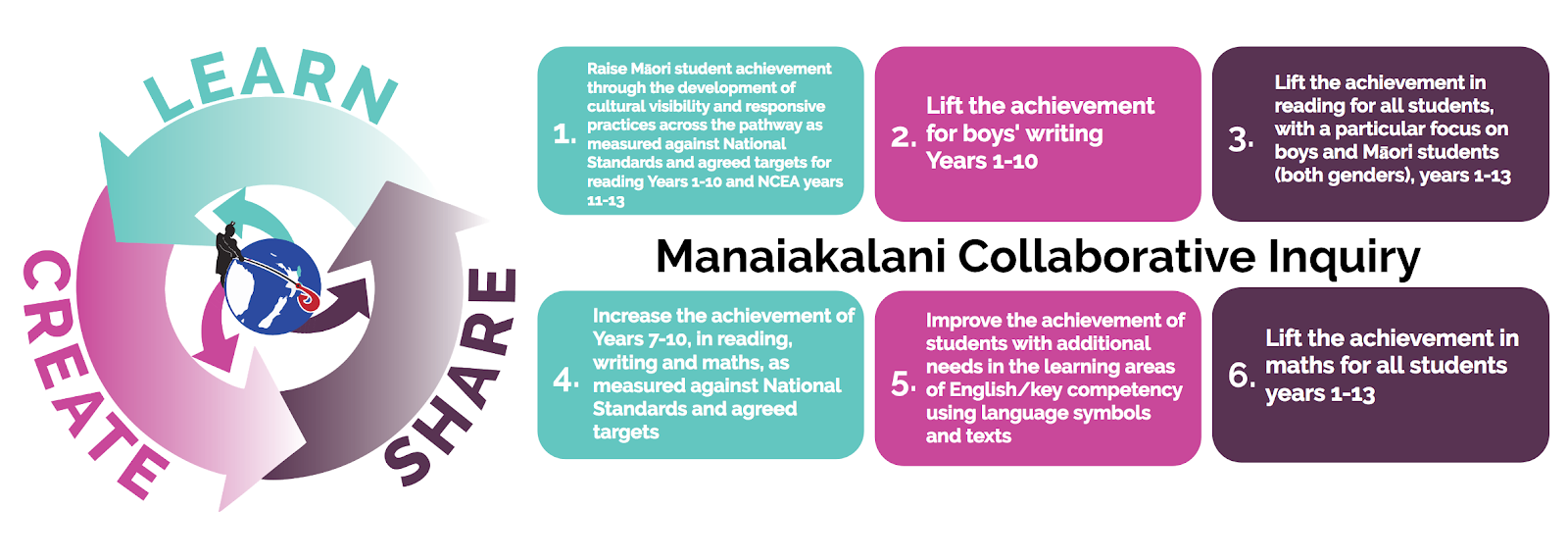
How my Inquiry fits in with our Achievement Challenges.

The Achievement Challenge that I am inquiring into relates to achievement challenge number 2, which aims to:
Lift the achievement of boys' writing in Years 1 - 10.

The students I am focussing on are the year 9 students in my social studies class, with a focus on the writing achievements of the boys.  I want to look at effective writing tools that will engage my learners and raise achievement.

My aims are:
  • To increase engagement and motivation for writing
    • "I want to write because I like to write"
  • To improve and shift achievement in writing 
    • "I want to write because I know how to write"
I had a hunch:  That transitioning from year 8 to year 9 can be pretty scary and sometimes overwhelming for our kids - lots of teachers, new students from other schools, new ways of being taught.  What can help with the transition?  What skills can they transfer over?  How can we better connect and track their writing from one year to the next?  These were the questions I had at the beginning of my inquiry.

Just recently, I completed a quick survey of my year 9 class and when asked if they liked school, 100% said yes.  When I asked them what they liked, the common answers were 'meeting new people and making new friends, having different classes and doing new subjects'.  These responses were surprising to me and I have to give our kids credit.  They've taught me that yip change can be scary but we (as teachers) need to accept that they will step up and accept it and we need to respond to what they like rather than what we think they like.  More kids voice, less teachers me thinks!!

To read more, have a look at this inquiry presentation that will show what I've been up to so far!

Friday, 1 September 2017

Year 9's writing across curriculum areas.

After our local MP Simon O'Connor visited our students, I wanted to continue the momentum by getting my year 9 social studies class to 'SLOG' (SOLO + Blog) about his visit.  I had my year 9's period 5 on Friday afternoon and I felt they needed more time to develop their blog without feeling pressured or hurried.  I asked their English teacher Ms Latu, if they could work on completing their blogs during her class (which was after mine) and she was happy to let them work on them.  She offered to help them by checking spelling, punctuation and grammar which was really helpful.

At the start of the class, I reminded my students about the importance of 'slogging' and how they would be rewarded with dojo points if they worked well.  I then shared a document with them using the familiar 'summary strategy' that they had been using over the last copy of weeks and asked them to reflect about Simon's visit.  We firstly brainstormed as a class and I was surprised about how much information students had remembered from the visit and how keen students were to give their answers.  I wrote the brainstorm on the board around the SOLO activity which implicitly showed them that we were at the multi-structural stage of SOLO.   Students then picked 20 important words related to Simon O'Connors life and from there the 8 MOST important words that they would use in a summary.  They were also given access to photos from the visit to support their writing.

The start of the brainstorm 

When the bell went students continued with their writing.  Their English teacher arrived and I left.
I went on to check the work that they'd shared with me at the end of the day, and saw that most of the students had completed their writing to a high merit/excellence standard which I was really pleased about. 


Examples of student work

What I found useful was to complete the writing reflection immediately after Simon O'Connor had visited as students could still remember and relate to him.  He was a real person in the real context of their learning about the government and they felt a connection with him and therefore felt a connection to their writing.  I had told students that if they managed to blog, I would share it with him.  

I also saw how engaged the students were knowing that two of their teachers were checking the one piece of writing and I wondered if this was what it was like in a modern learning environment where two or more teachers shared the learning space?  I would like to look into developing this kind of learning context next term and will aim at collaborating with one or two of their teachers on a topic for writing.  Overall, I think the lesson went well and students are becoming more confident and capable writers. 

Our local MP drops in for a visit

At the moment, our year 9's are learning all about our government.  There are a lot of systems and processes that they need to know to understand how it all works and sometimes our kids get disengaged and bored because it feels so far removed from their realities.  To try and get them to understand the importance of the up and coming elections, I invited our local MP Simon O'Connor to talk to some of our students about what it's like to be an MP at the moment.
Simon shares his journey with some of our year 9's

He talked about the challenges he faces in his job and his passion in helping the people in our community.  At question time, our students asked what his inspirations were, whether he played sport when he was younger and where he saw himself in 6 years time.  Simon's mother and family were his main inspirations which resonated with many of our students.  He shared that he played soccer and cricket when he was younger and that his favourite past time at the moment was fencing.  He shared a story of when he went to the doctor and showed the doctor his chest full of bruises and the doctor asked him if everything was alright at home (our kids found this hilarious!).  When asked where he saw himself in 6 years, he answered 'in the opposition' and some of kids looked at each other, wondering what he was implying.
Simon showing our kids his fencing stance

After question time, some of our students wanted to share their sustainability inquiries with Simon to show him what they thought the issues in our community were.  He expressed how pleased he was with the effort our kids had put into their inquiries and spent time listening to their thoughts on the issues.  Before he left, I explained that our kids will blog about his visit and he said he was happy to read them and leave comments.
Fusi and Lana sharing their inquiry on protecting our language
Simon marvels at Jolise's 'Our homes and houses' project
Simon is left speechless after seeing Danny's project

Overall, I think this visit was successful in connecting our kids to their learning.  They could put a real person to a photo, and hopefully believe that they too could be an MP someday.  By sharing their blogs with him, they will have an authentic audience which will validate their learning.


Sunday, 27 August 2017

SOLO + Blogging = SLOGGING!

My SPARK M.I.T inquiry is looking at using effective blogging with my year 9 social studies class.  Part of my reason for choosing blogging relates to challenges that our year 9 students face have when they start high school and the need to shift and accelerate their achievement towards the national norm. With my focus being on writing, I found one of the biggest obstacles was transitions from year 8 to year 9.  A writing tool that students have been using throughout primary school are their blogs which showcase their learnings.  They also allow me an insight into how students write.

I have looked into writing frames that were being used in the primary schools so I could understand what their teachers were using to teach writing.  In finding a connection between years 8 and 9, I am also looking at balancing what students need to know by the end of year 10.  I felt it was important to acknowledge the need to prepare students for the how to write better, in the senior school and for NCEA.  At the college we use the SOLO (Structured of Observed Learning Outcomes) taxonomy framework which we have linked carefully to the NCEA criteria of Achieved, Merit and Excellence.


Recently, I introduced the SOLO taxonomy structure to my year 9's and showed them a video of SOLO using mine craft.  I then went through each stage from pre structural to extended abstract using the concept 'Leadership' as their writing topic, to relate it back to the government unit that we were currently studying (here is a link to the document template the students used).   Whilst I was checking their writing, I continually made verbal reference back to the SOLO and showed students where their writing was on the framework and what they needed to do to move from one structure to the next.


Students then blogged about their learning which would give them an audience who could support them further with their writing.  To get kids to use the SOLO framework whilst they blogged, I came up with the term 'SLOGGING' which I thought would be a catchy phrase for them to remember (although I got weird looks when I said the term the first time!).  Some students completed their blogs, but a few spent time perfecting their paragraphs and didn't get a chance to blog.  There were some interesting and engaging responses from students about the session which I felt overall was positive.  Below is an example of one of my students' Jamaine, who used a scaffolded writing framework to completed his extended abstract answer.  

Jamaine writes using the SOLO structure

For my next actions, I will continue to ensure that every time we 'slog', I consciously use SOLO language and relate it to NCEA so that students.  I want to also see if students could time themselves and aim to process the information faster so that they could complete their blogs in the one period as some didn't get a chance to.  I would also like to work with their English teacher to see whether we could develop a plan to help with our students to develop their writing skills better.


Thursday, 24 August 2017

Unifying our inquiries - Tamaki College's COL's staff meeting

One of the key aspects of raising achievement for the young people in our cluster is through a collective focus on our Manaiakalani achievement challenges.  In the past, teaching as inquiry has often been hidden away and considered something a teacher might do as part of appraisal or teacher registration. A few teachers generally like to inquire into their practice, but in my experience there has rarely been a unifying movement that connects a great number of inquiries to central shared challenges - that was until now! (Click on the link below to find out more about our achievement challenges).

Screen Shot 2017-07-23 at 12.54.21 PM.png
Recently, we held a staff meeting where our challenges were revisited and discussed.  Our COL leader Russell Burt began the session by reminding us of our purpose and to focus on the positives of our work.  His words were pretty inspiring for many of our staff and I know it was an eye opener for both our newbies and our  'oldbies' like me.

Russell Burt our COL leader sharing our achievement challenges.

The purpose for our staff meeting was to share our COLs inquiries and show how they aligned with our achievement challenges.  Staff sat in their professional learning groups and discussed which achievement challenge they thought their inquiries could be connected to.  This discussion helped to clarify some questions people had about where and how to relate their inquiries to the challenges.  It was really interesting to hear what people were doing and I enjoyed helping our staff feel connected.  Because I'd been doing my own inquiry and working alongside other COLs this year, I felt more confident in sharing my journey.

Sharing my inquiry with our staff

Staff sharing their inquiries with each other

Big pink bowls of food always helps!

At the end of the session, we asked staff to complete a feedback form to see if our PLD was effective.  We asked three questions.  The first one was, on a scale from 1 - 4 (1 being not at all, 4 being extremely useful), did you find today's session useful?

The majority of staff found the session useful which was really positive.

The next question asked staff what their key takeouts were.  I took a screen shot of some of the answers because I noticed a pattern which I personally felt was a bit of a breakthrough.


At least one third of the staff surveyed referred to blogging and when I reflect back to a survey I had sent out at the beginning of the year, less then half the staff even had a blog.  My favourite comment was 'blogging is not scary' - to me it feels as if staff blogging is becoming normal language around the staffroom which awesome.  The last question asked staff what their next action will be with their inquiries and most wrote about refining their inquiry and getting more support from our COLs team.

Overall I think our meeting was effective in helping staff feel connected to the 'big picture. I enjoyed the session and I look forward to supporting our staff, alongside our COLs team, in the future.

Saturday, 19 August 2017

The Summer Learning Effect at the college level.


The Summer Learning Effect(SLE) encourages students to practice their reading and writing skills in the summer school holidays.  The data presented recently from Aaron Wilson and his team showed the summer drop off in results for boys well below the norm. A three time point analysis showed boys who'd been tested term one 2016, term 4 2016 and again term 1 of this year falling well below the norm.  I wondered why the data showed such alarming statistics particularly for our boys.


During the SLE, the majority of students who signed up and participated were from the primary schools, which was fantastic.  We originally had 5 students partake, but ended up having 2-3 students regularly blogging which in the scope of things is a bit sad.  I wondered why this was and remembered at the end of last year 2016, we had one introduction to the programme and then sent the kids off on their merry way.  In hindsight, I wish we as staff had understood the importance of the programme and had given it more time and value.

Over the summer our girl Quasia blogged regularly!

This year, my aim to use the time in November after the seniors leave, to get students hyped up to blog over the summer holidays.  I realise that we as a school needed to make more of an effort to emphasis the importance of students reading and writing over the holidays and I wondered how to motivate students to be engaged, especially our boys.  At our recent school leaders PLG,  Aaron Wilson alluded to a study that discussed what motivated youth to read and write outside of school.  The Complex World of Adolescent Literacy: Myths, Motivations and Mysteries' found that youth like to read and write about things they can identify with.

They like to read books about people like them, and not only in terms of race, ethnicity, age, class, or gender (although these features are important). They also like to identify with characters who are resilient through struggles, people who are working through relationships, people trying to figure out who they are. They want to read books and write texts that offer them social capital in the form of information, ideas for self-improvement, models for identities, or ways to maintain existing relationships and build new ones ( Moie, Overby, Tysvaer and Morris, 2008).

This resonated with me because during our sustainability study in term 1, I found that some of my year 9's liked to talk about the issues that affected them in our community because they were living the reality.  There were a group of boys in my year 9 class that really engaged with their inquiries and this showed when they presented their projects at the Te Taiao o Tamaki showcase earlier this year.  

What I would like to do is to plan a unit in social studies for the end of the year, that could incorporate these aspects in the hope and model how learning could happen during the summer holidays.  This way, students could be motivated to read and write more and be better prepared for the on-coming year.  

Moje, E., Overby, M., Tysvaer, N., & Morris, K. (2008).  The Complex World of Adolescent Literacy:  Myths, Motivations and Mysteries.  Harvard Education Review, 78(1), 107-154.  Retrieved from https://www.ncbi.nlm.nih.gov/pmc/articles/pmid/19756223/

COL Inquiry #6C: Academic Reading "Teaching to the North East"

From the Secondary Teacher Literacy Handbook page 33:  Bishop (2019) stated that to improve Māori achievement, teachers need to  create an e...