Tuesday, 28 January 2020

9AK #1: A class trip on day ONE!

Today the year 9AK class got the chance to visit a few different places where actions and projects were taking place that directly impacted their community.  This was essentially their first ‘real’ day at Tamaki and they went straight into a class trip!
Students were divided into 3 groups and went to the following places: 
  • Auckland City Council in downtown Auckland.
  • Tamaki Regeneration Company in Panmure
  • Ministry of Education in Mt Eden.
The purpose was to give the kids a chance to see projects being done in a wider scale and how these organisations went about planning and implementing a process.  I was blessed with taking a group to Panmure to visit the TRC’s head office.


Reflection:  The feedback from the students was positive and they enjoyed listening to the speakers.  They were shown around the office and introduced to most of the people in the office.  They were invited to ask questions and it was a good opportunity for them to practice speaking to adults in a professional organisation.  As I did not know all of the kids well, it was a good chance for me also to observe who the confident students were and those who were quieter in the group.  


Saturday, 7 December 2019

Thinking about my Inquiry for 2019 #1: The Big Summary!


When I looked back at my teaching, my concern was that students were not completing the work that I’d set them.  I noticed this when the kids found it difficult to write a quality paragraph.  

My initial evidence of this was through reading their paragraphs and looking just at the ideas that they’d covered.  I knew this wasn't vigorous and it was impressionistic rather then analytical.  On reflection,  I needed to think about what was the causality here.  In the past I had used student learning strategies that worked for some but not for all of the students so I decided that if I look at the way I was delivering learning, I could I make a difference to their capability.

I needed to collect samples and Dr Jannie suggested I put an analytical lense on it.  What I was seeing was that students were able to talk about their learning at the time which was a strength, but I also saw a lot of gaps when it came to writing.  

I asked myself 'Have I given them the tools that they need in order to become more capable writers or are they just intrinsically not able to write’.  Ah No, light bulb, they are clever people - so therefore it's about the tools.

I did an extensive quantitive process of vocabulary measuring comparing times 1 to time 2 in their paragraph writing.  After doing the analysis, it became clear is that their lack of vocabulary and their inability to expand ideas was sitting inside their writing.  They also lacked organisational skills.  From this, I wondered if I am going to teach writing or is there something deeper then that.

When I unpacked my pedagogy, I realised that because of the pressures of time and the need to get through content,  I would basically scoot over learning and only really tapped the surface.  BUT if I did deep diving and we talked our learning more, we would foreground the language which would then inform their writing. 

I decided that if I was more intentional in noticing language, that that would increase their uptake and an increase in noticing (which is one of the optimised conditions for learning).  If we, both orally and in written, deliberately put out in our mind and our eyes on how the language is working and what the language means, then they are more likely to hold it in their head and make it their repertoire.  By doing that it I believed it would make a difference to their writing.  

During the interventions, it was important for me to monitor student progress as well as reflecting on my pedagogy when teaching during my inquiry.  As challenges arose, I tried to tweak small things to see if they could help address the challenges.  It was important for me share these tweaks because it helped justify why changes were made and I could revisit whether these tweaks worked or not. 

Although the evidence shows some shift for one of my students, there are still gaps in their writing that I hope to address in my future inquiries.  

Monday, 2 December 2019

Evidence #1: A Quantitive Analysis of Student Writing

To find evidence of whether my inquiry (interventions) has shifted student writing, I discussed ways to do this with Dr Jannie.  She suggested that I carefully analysed writing samples from the beginning of the year, pre intervention, and compared it to their most recent piece of writing.

This is an analysis of writing for 3 students in 9PKr: (M1, R1 and A1 are codes for the students names).  What I did was to select 3 students who were low, middle and upper in their asttle writing and PAT results to start off with.  I then gave collected two writing samples (Time 1 and Time 2).  I then compared the following:
  • How many Notions and Ideas the student had
  • Examples of complex word groups used
  • How well ideas were expanded and detailed under text development
  • If the student was able to write in an academic style
Using the vocab profiler called ‘Lextutor’, I put in the sample writings and calculated the number of simple, compound, complex and complex compound sentences in the sample.  The vocab profiler also calculated k1 (1-1000) and k2 (1001 - 2000), which counts the most frequent English words that people should know (eg k1 is the first 1000).  AWL stands for ‘Academic Word List’.  In the last column, I counted how many sentences/phrases were topic specific.  
Lextutor
I have linked the collated results here and taken screen shots of the evidence below:
Here are the links to each students of writing:
Summary:  After an extensive quantitive process of vocab measuring comparing times 1 to time 2 in my students' paragraph writing and looking at qualitative student voice feedback,  I found that the higher the stanine of the learner, the more stand out are areas of uplift.  A1 has made significant areas of uplift too, mainly a greater density of ideas and notions, and complex word groups.  R1 and M1 did not make as much gain as I’d liked.

After doing the analysis, it has became clear it is that their lack of vocabulary and their inability to expand ideas was sitting inside their writing.  This was evident even after the interventions I had applied in slowing down the learning.  Overall they also lacked organisational skills.  

My learnings from analysing data/writing academically is that I need to do this more to understand the needs of the students more purposefully and it definitely helps direct a clearer inquiry.  Quantitive data combined with a qualitative approach gives a more realistic picture of where our kids are at and how my teaching can be guided and informed when planning my inquiry.  In my next blog, I hope to provide an overview of my inquiry process.


    Thursday, 21 November 2019

    My 'Bursts and Bubbles' Presentation

    Today, I presented alongside my fellow COL'ers my Burst and Bubbles presentations.  We were given 3 minutes to present. Here is my one:)

    Will putting the focus on language by deep diving into text, enhance year 9 understanding and comprehension of text to improve achievement in writing? 

    Have you ever taught something then asked your students ‘so what did you learn’ and they look at you like you’re speaking another language?  I get that everyday and in an ideal world, I would spend hours revisiting my teaching but in reality, I would scoot through content and hope for the best.

    The catalytic aspect of student learning my inquiry focused on this year was …..getting kids to notice language by deep diving into text and slowing down my teaching through talking the learning.
    I noticed  ……that my year 9’s were not writing good quality paragraphs, so I needed to build a rich picture of my students’ learning by collecting writing samples, asttle and PAT results, student voice etc.  

    The main patterns I found were  …… that within their writing there was a clear lack of vocabulary and an inability to expand ideas.  So then I thought, am I going to teach writing or is there something deeper then that, that I needed to address. 

    I was good at…engaging the class in discussions around contexts But I realised that my students would likely make more progress if... I allowed them the time and opportunity to deep dive into text and talk the learning without time constraints.

    So a change I made in my teaching was to  …Have ‘Talanoa days’ where we just explored contents/context through talk and I couldn’t take it for granted that kids knew words.
    I read alot of literature and called on some experts but the key biggest support I have found was working closely with Dr Jannie Van Hees.

    The easiest things for me to change was... sounding out words with more purpose and intent which required lots of talking and I like talking alot.

    The hardest things for me to change was... letting go of time pressures and the thinking that kids needed to write something everyday to show me they’ve learnt something. 

    Some changes I made along the way were… to cut down on trying to teach too much content over a unit but to focus on quality and deep diving through talking the learning so that we could foreground the language.

    Overall I would rate the changes in student learning as… happening in small doses but not consistent enough to impact a shift in achievement and I know this because when I analysed their writing and vocab, students were expanding their ideas more, but still lacked the skills to write competently.  

    The most important learning I made about deep diving into text was that... kids need optimal conditions to uptake the language.  They need time to allow for deep diving and they needed an expert with the capabilities and tools to teach to the students needs.

    The most important learning I made about inquiry was… keeping your eyes on the prize is the key.  If I don’t blog, I fall behind.  Let the kids know that you are collecting evidence to become a better teacher is being open, transparent and patient. 

    Some learnings that would be relevant to other teachers are… 
    • Always back up your hunches with evidence that proves or disproves your theories.
    • It’s o.k to have stink days and share it because it saves other people having a stink day too. 
    Next steps would be to work collaboratively across departments to give kids optimal conditions to learn language.   Learn how to be a teacher of language eg. know what a complex compound sentence is.  Prepare our year 9 teachers for the year 8’s coming through by developing richer learning environments.  

    Friday, 25 October 2019

    Intervention #3: Talking the Learning vs Writing the Learning

    How do 'Bills become laws in New Zealand: Banning Plastic Bags'.  

    The objective of this lesson was to reinforce some new terminology using our ‘slowing down the learning technique’ and to deep dive into unfamiliar text.  I hoped that students would be used to this technique and would respond to instructions faster.
    Lesson structure:
    1.  Introduce the concepts through think, pair, share.
    2.  Watch video on the P.M's decision to ban plastic bags.
    3.  Read article together through deep diving on the N.Z parliament site.
    4.  Discuss blogpost assessment to show their understanding.

    Actual lesson 
    I feel that students responded well to our first part of the lesson that focused on knowing key concepts as they've come to expect that when I say we are talking our learning today, they engage and energise their brains.

    In depth 'Albert Einstein' Reflections
    (As I write this, I am listening to John Lennon, Imagine...😳😂)
    When it comes to my teaching, the more I do slow down the learning and deep dive into text, the easier it gets.  I am sharing with kids the process of thinking about their thinking and in turn I am thinking about my teaching.  The pace and timing of my lesson is more intentional which I am becoming more comfortable with - I am not expecting much writing to show their learning, but we are talking and listening to our learning which is pretty awesome.  In saying that, my levels of tolerance for 'learning talk' has increased - I'm not really asking for quiet if I know kids want to talk more about a topic.  I feel like I'm giving them a bit more permission to inquiry into why things are they way they are rather then scooting over an issue.  The offset of this is that we aren't spending much (or enough) time on writing.  I wonder, no actually I know that this might effect their writing in Social Studies because when would I have time to teach them how to write when they are deep diving?  I think about the original intention of my inquiry, which was to enhance their writing, was one that needed more deliberate planning and scaffolding related to the specifics of the 'teaching of writing', something that I know I'm not an expert at.  I've found that to get kids to write well, they need to understand what they are writing.  Kids are showing their understanding better, but are not necessarily 'writing' better...hmm, back to the drawing board!

    Saturday, 5 October 2019

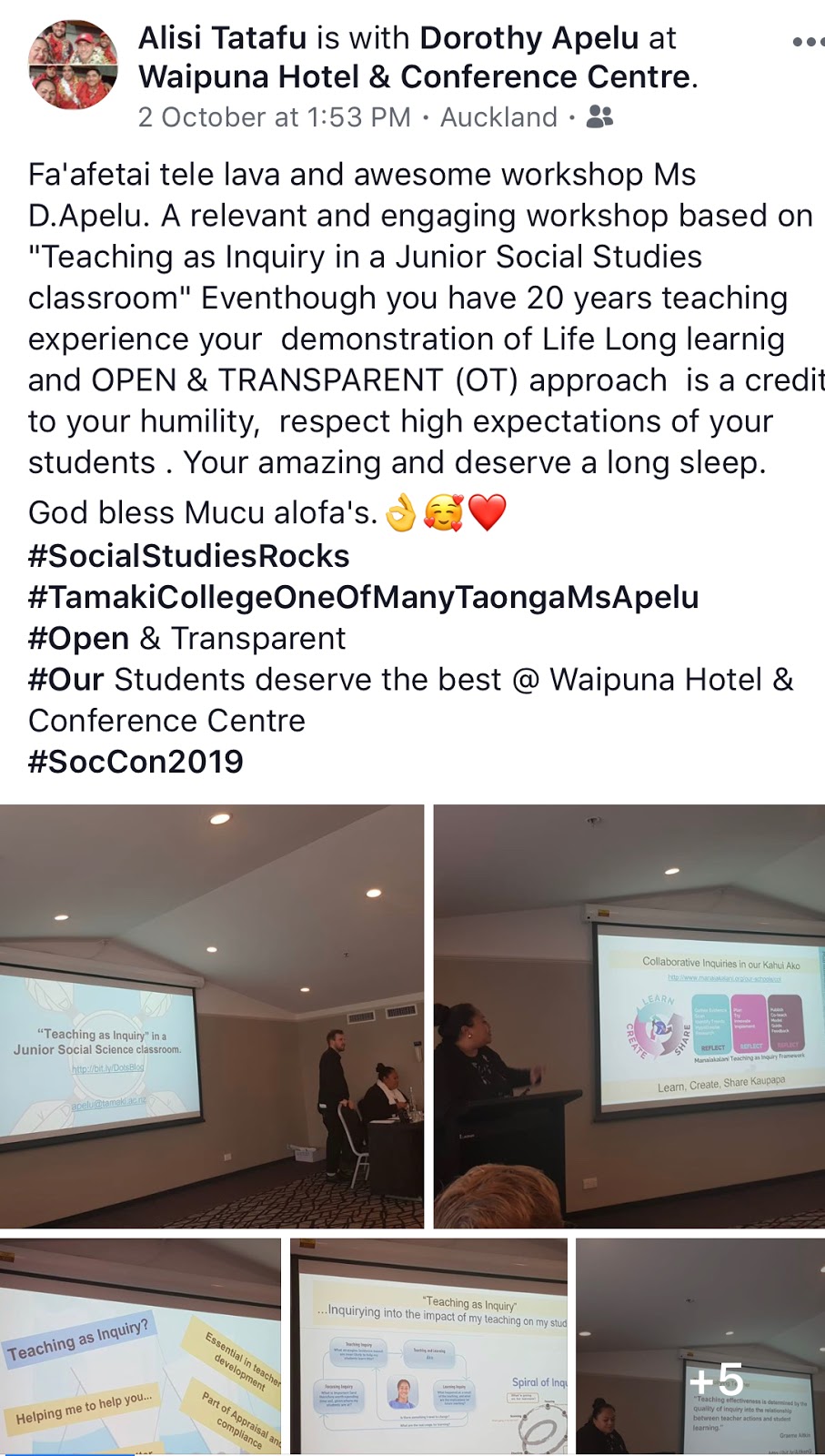
    Presenting at the New Zealand Social Sciences Conference 2019

    This week, I was invited to present at our annual Social Sciences Conference (SOCCON) which was held this year at the Waipuna Hotel and Conference Centre.  The theme of my presentation was 'Teaching as Inquiry in a Junior Social Science classroom' and it was a 30 minute brilliant burst.  I choose this theme because at conferences in the past, I have not seen or heard much about inquiry and this has been focus for me.  I wanted to share my journey in understanding the impact of my practice on my learners.
    I was nervous because it is hard to gage why people are there so I first asked them to share in groups their understanding of inquiry and what it looked like to them.  I then defined my understanding so they could see where I was at, then proceeded to share some of my findings and reflections.


    I explained the Manaiakalani kaupapa and how it had guided my inquiry to where I felt confident to describe my learnings as a teacher in the kahui ako.  I also explored the idea of being open and transparent as it supported others who may have the same challenges.  As the workshop progressed, I grew more and more at ease with the flow of the presentation and choose to have time at the end of the session for people to talk and ask questions.


    At the end of the session, a number of people came up to thank me and one particular teacher, Sarah from Naenae College in Wellington said I was doing exactly what she was doing except her focus was on reading rather then writing!  She said she was so happy to find someone else who was doing something similar and we exchanged email addresses and said we would share resources.  Another colleague of mine from Mangere College tagged me in a facebook post which was really encouraging.  I enjoyed the chance to share my journey and look forward to doing it again.


    Wednesday, 2 October 2019

    "Teaching as Inquiry" in a Junior Social Science classroom: SOCCON 2019

    Talofa Lava everyone,
    Here is my presentation for my talk today.  Please feel free to like, comment or email me at: apelu@tamaki.ac.nz!
    Malo Soifua,
    Dot

    COL Inquiry #6C: Academic Reading "Teaching to the North East"

    From the Secondary Teacher Literacy Handbook page 33:  Bishop (2019) stated that to improve Māori achievement, teachers need to  create an e...