Thursday, 16 November 2017

Reviewing our school goal number 4

At our annual middle leaders planning day, our first session was a review of our school goals for 2017.  Part of my inquiry this year has been focussed on implementing school goal number 4:

To work across departments in Year 9 on an integrated unit of work with a community focus or context.
At the end of 2016, we decided to implement links to the 4 To remind staff about the lead up to the unit, I discussed the staff PLD around what that would like and decided on our term 1 unit to focus on 'Sustainability'. As a staff we developed 6 areas of focus, each designed to give students a choice as to which issue they wanted to focus on.
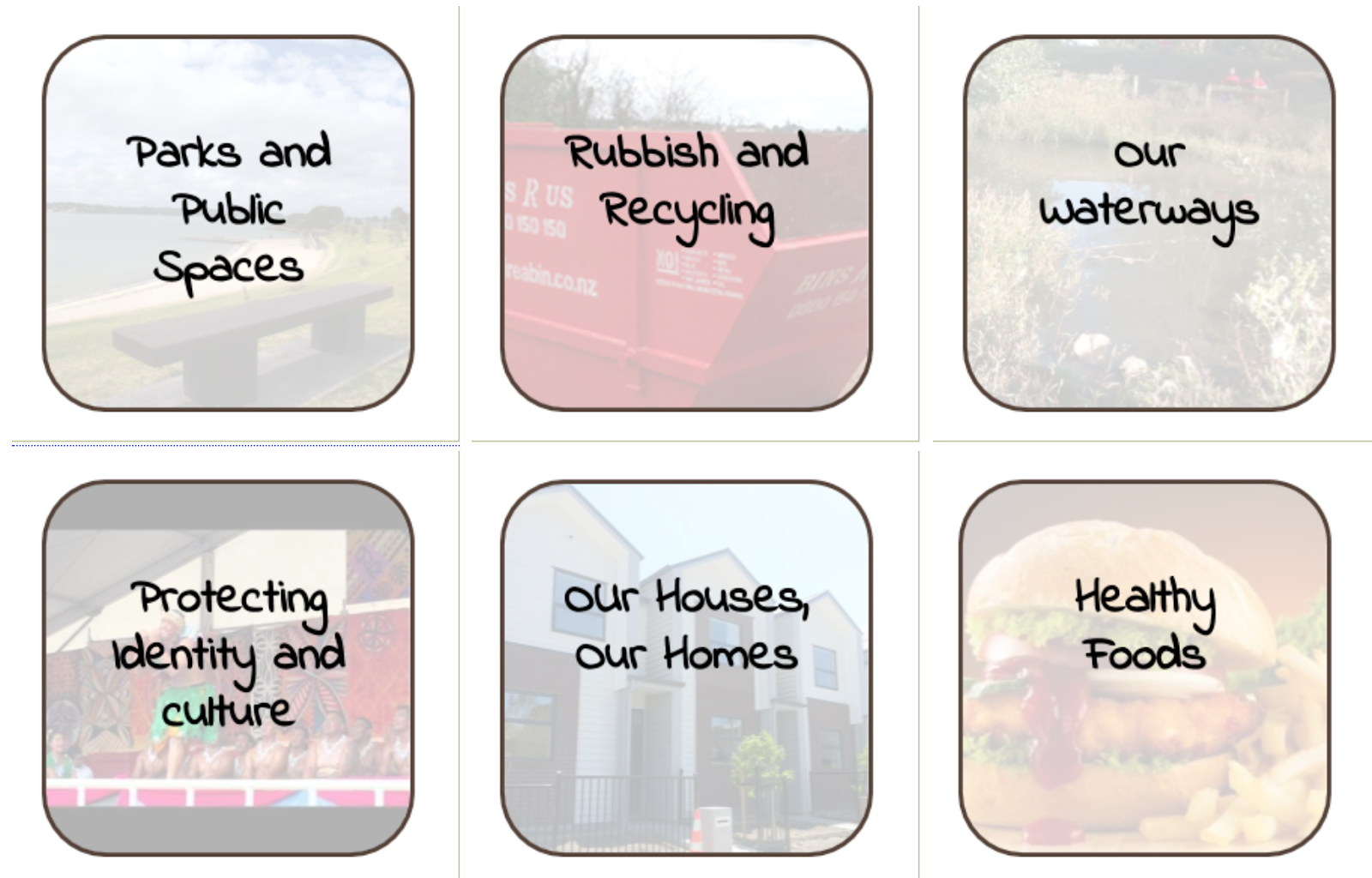
From there, department were shared a document to show how they could support the teaching and learning of the topic as followed: English
From there, an initial plan for the Middle Leaders was designed whereby HOD's were assigned to support a class on their blogs. A draft Unit plan and a student site were developed and this was taught to the year 9's in term 1.

Below is a swat analysis review of the unit:
  • Process of integration during the unit (Teaching and Learning)
    • Strengths:  
      • Social Studies driven meant consistency in approach.  Weekly meetings with year 9 teachers.
      • All year 9 Students were talking sustainability
      • ‘Just in time teaching’ happened eg. The River Talks and 9RMz’s trip to Ruapotaka (contexts outside of school where Science and Sos teachers expected to come)
      • Student blogs
      • High engagement for staff involved (Gene, Karen etc)
    • Weaknesses:
      • Not all staff/departments on board.
      • HODs not able to check on classes.
      • Project Templates not used because of difficulty in applying them in social studies context.  Staff not comfortable using them.
      • Structure not totally clear
    • Opportunities
      • Fewer departments involved means more structure
      • More student agency
      • More learnings from this year
    • Threats
      • Loss of interest or enthusiasm from staff
      • Lack of time


  • End product from integration:  Te Taiao O Tamaki presentations.  
    • Strengths:
      • Positive feedback from the community
      • High student engagement for students who presented and students who visited
      • Developed better relationships with students
    • Weaknesses:
      • Wish we could’ve taken more presentations
      • Lots of Dot’s time taken on own
    • Opportunities
      • Have our own school presentations for all projects
    • Threats:
      • Limiting it to the best kids
Key Learnings:  Kids loved it.
MOVING FORWARD:
We want to develop and looking at a model that will work for us:
  • Howick College innovation stream - one class where students apply to be in it.  Involves 4 core subjects.
  • Fusion at Oxford Area school -all year 9’s and 10’s.  Involves Maths, Technology and Social Sciences.  Project based.
  • A partnership with the Liggins Institute from Auckland University is helping to lead a collaborative narrative/transformative learning approach developed  in the Cook Islands.  Ready made resources (Unit plan)


Wednesday, 15 November 2017

The Impact of my COL's inquiry, 2017

My COL's inquiry this year has focussed on:
Using effective & engaging strategies to lift the achievement of boys’ writing.

My learners this year have been the boys in my year 9 social studies class.

My aims were:
  • To increase engagement and motivation for writing
    • "I want to write because I like to write"
  • To improve and shift achievement in writing
    • "I want to write because I know how to write"

The ways I have addressed my aims are evident in the presentation below:


For the remainder of this blog, I will explore the current outcomes of my inquiry.

1. What happened for the learners and how did I make this happen?

There are 9 boys in my year 9 social studies who I have tracked throughout the year.  They began the year with the class and have been members right until the end of the year.

With regards to engagement, I found that for the majority of the boys, have responded positively to the integrated cross-curricular teaching and learning programme that I organised in our sustainability unit at the beginning of the year.  Our 'Sustainability day' helped to ease with transitions for year 9 students to our school and it was a day that brought juniors, seniors and staff together to show support for our year 9's and helped them feel part of the Tamaki family.

As part of the integrated unit, students took on relevant environmental projects that saw them working with all of their teachers on a project that interested them.  For the boys in my class, they really enjoyed getting their hands dirty and working on fixing up our 'un-loved' Rain Garden.  They were able to talk about the process in their writing because they felt connected to the project.  This came to fruition at our Te Taiao o Tamaki cluster-wider presentations at Te Oro, where students shared they're presentations.


Within the classroom I wanted to see if students could write about what they'd experienced during the integrated unit.  To help them with their writing, I found writing strategies that they were familiar to them from our local primary schools .  After visiting a number of schools, I want to trial the 'Summary Strategy' which I saw being used effectively on a visit to Robyn Anderson's year 8 classroom.

Many students recognised the strategy, and I found that the more they used it, the more they became more confident in using it to improve their writing.  I then combined this with SOLO taxonomy, to help students with the language of NCEA in a hope to also prepare them for senior school.  My students found SOLO helpful in understanding where they were at and how to get to the next stage.

To support their writing, students were also encouraged to share their learning through regular blog posts.

2.  What evidence do I have for this?

Here are some snapshots of evidence.

Engagement and motivation for writing

Blog posts:  A number of boys in the class have expressed their engagement through blogposts.

A blog by a Year 9 student

Teacher observations of students' comments:
Due to our jumpstart programme starting, the year 9 class has now moved to year 10, which meant I would no longer be their social studies teacher.  For our last lesson, I asked the students to write a reflection on the year and the boys that were present, wanted to verbalise how much they'd enjoyed being part of the class.  Student 8 and student 10 described how much they've learnt and how they felt like a family.  It was quite emotional and seeing how far the students had coming from being quiet, scared and nervous at the beginning of the year to the confident and engaged students that they are today, made me feel proud.

Our last class together!

Improvement and a shift in achievement in writing:

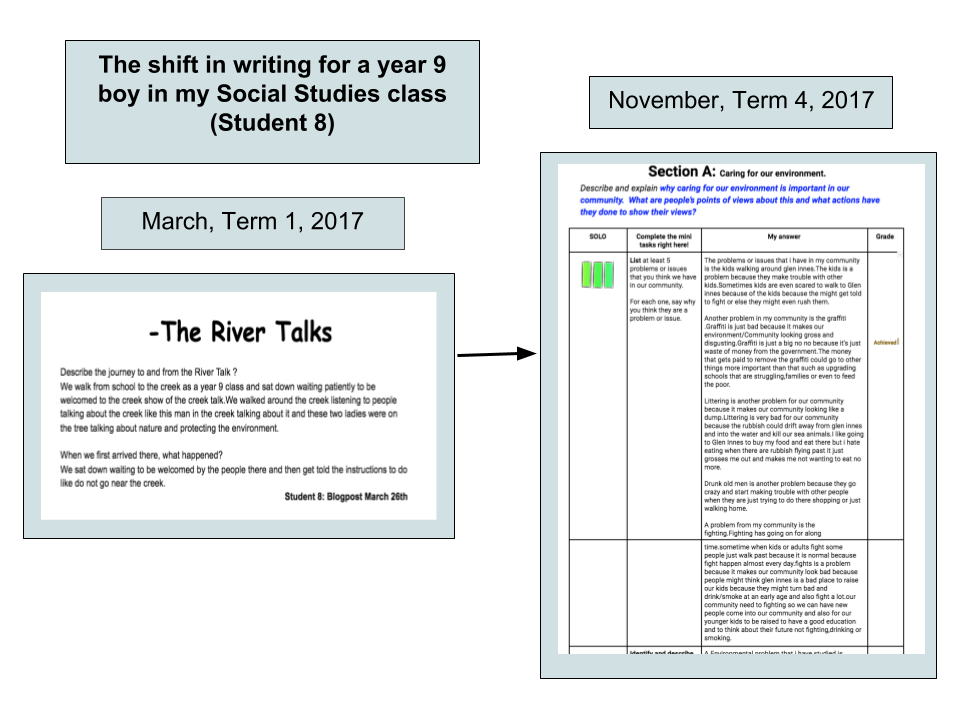
Examples of writing: From term 1 to term 4.
All of the students in the class have made positive shifts in their writing.  The majority of the boys are able to describe and explain key points as they understand the need to ensure they fully explain what they need to describe. They are able to use structures and strategies learnt to improve their writing.  Below is an example of a students' writing from term 1 to term 4.
Student voice surveys:
I surveyed the students in my class and asked them if they felt they're writing has improved and 7 out 9 boys said yes and when asked why, 3 of them replied:
Because I was able to explain more about the point
Yes because writing help me understand all the difficult words I've never understood in primary. Because it helped me with my vocabulary. Because it helped me write more, by explaining and giving examples from the texts.
Because I was low in writing but when I came here I improved

Comparison of Mid-term exam results to the End of year exam results: The 'Sustainability/Environment' essay.

In the mid-term exams, students were given an essay question about 'Sustainability and Caring for the Environment'.  Only 4 of the 9 boys passed, with 3 Excellences and 1 Achieved.  For the end of year exam, students completed the same essay and this time all 9 boys passed, with 4 Excellences, 4 Merits and 1 Achieved grades.  This is an excellent result!

Evidence that is still to come:
I am currently waiting (with eager anticipation) on the recent asttle writing results that students have completed, to see if there has been a shift in their writing according to our national standards.

3. What's next?


There are a few things that I am working towards implementing to continue my inquiry and rather than go into detail, I will list the ideas below (and talk more about them in future blog posts!):

  • Use the writing strategies across the whole of year 9 in 2018.
  • Work with the other departments in our school to develop and implement a collaborative context embedded curriculum.
  • Work closely with more primary schools to develop a structured transfer of writing strategies from years 7 and 8 to year 9.
  • Set up the 'Summer Blogging Challenge' at the college to encourage students to blog over the holidays.

I just want to take this opportunity to thank our COL's leader Russell Burt, the Manaiakalani Innovative team and the other COL's teachers for allowing me to be part of the Inquiry Journey.  Kia Kaha, Kia Toa.

Friday, 27 October 2017

Presenting at the Manaiakalani Wananga

On Thursday the 26th of October, I was privileged to attend the Manaiakalani Wananga held at Point England Primary.  The wananga was a chance for principals and school leaders from our wider outreach clusters and schools, to join our cluster to reflect on data and share ideas for the future.  During one of the sessions, I was invited to present my COL's inquiry alongside 5 of my colleagues, to show how we have been addressing our achievement challenges.  Although I was nervous to start of with, I felt happy with how the presentation went and received some good feedback afterwards.


Thursday, 26 October 2017

Well done to our Year 9 October holiday bloggers!

Over the holidays, I sent out a challenge to our year 9 students to write blog posts about different tasks that I'd set, related to topics that they had chosen.  Of the 9 tasks set, 4 students completed 4 or 5 of the tasks, with one student, Mateaki of 9RMz, completing them all!  That was a massive achievement!  At their year 9 assembly on Wednesday, I acknowledged their hard work and presented them with special prizes.  I hope that this would be an incentive to show the rest of the year 9 cohort that learning doesn't stop when their holidays start!


Wednesday, 18 October 2017

Year 9 Holiday Blogging challenge!


At the end of term 2, I wanted to test out whether year 9 students would blog during the holidays by setting up a holiday blogging challenge.  We know students may not think about school much over the two weeks holiday and I wanted to see what would happen if I gave them a challenge that would force them to.   I decided to do a few things to set this up.

1.  SURVEY THE YEAR 9 STUDENTS FOR IDEAS FOR TOPICS.

I shared with the entire year 9 cohort a short survey because I was interested in finding out who would blog during the holiday break.  Out of the 100 or so students in year 9, 28 from different tutor classes completed the survey.

I wanted to see if students would have internet access during the holidays and surprisingly, a number said they would not have access.  


Then I asked students,  if they were to blog in their holidays, to list 2 or 3 things that they would blog about.  There were lots of varied answers, but the majority said the holidays, family and other subjects that were of interest to them which helped me with the next step.  

2.  USE THE TOPICS TO DESIGN RELEVANT SOLO TASKS.

I designed a document that had lots of different topics chosen by the students.  I gave them the choice to either use the document to help them scaffold their writing or to just blog about it.  For each topic there was a document that had a scaffolded 'solo' type structure to help students with their writing for that topic.
3.  RESULTS OF THE CHALLENGE

During the first week of the holidays, I got 6 or 7 emails from really keen students signing up to do the challenge - one student stayed up until 2am on the first night to work on the tasks!  Although this was positive,  of the 28 students who completed the survey, only 5 students actually completed at least one blog.


This student shows the extended abstract SOLO image next to his writing

One of my students in the class I teach really surprised me by completing all of his documents and blog posts shared.  His e-asttle scores at the beginning of the year were at 2P, and as I read through his documents this past week to see how well he has written, I can see a huge improvement in how far he has come and I am hoping that he moves up a level (fingers crossed).

4.  NEXT STEPS:

I want to find out why so few students completed the survey or blogged over the holidays.  I will meet with the 5 students who did try, as a focus group and get their feedback into why they decided to blog.  I also want to meet with other students who didn't blog and also get their feedback.  I also want to look at how other schools assign challenges like the one I did, and get ideas as to how to promote it better as I feel that I could have prepared the students better before the holidays for the challenge.

I then want to sit down with a team of students to design a plan as to how we can get their peers to blog over the Christmas holidays.  I am really interested in this idea of blogging over Christmas because I want to start thinking about addressing another challenge we have - the summer holiday slump. 


Monday, 16 October 2017

Spark M.I.T presentations at Ulearn 2017

On the Thursday 12th October, our SPARK M.I.T team presented at the annual uLearn conference for educators in Hamilton. 

Spark M.I.T team 2017

We presented our inquiries through an ignite type session which was an interesting challenge as it made us refine our inquiries and not waste words.  When it came to my turn to present,  I was nervous at first but as I continued to speak, I felt a lot more at ease.  As I was presenting, I didn't realise that people were tweeting about what I was talking about - I've never been tweeted about before - what an honour!!


At the end of our presentations, the audience were given the opportunity to ask us questions which was positive.  Afterwards, we had time to sit down one to one with people who wanted to share their wonderings.

I had two people come and see me.  A teacher at a secondary school shared her frustrations about trying to implement an integrated junior programme at their school and asked for advice as to how to approach it.  I talked about how we started small last year, with a small group of teachers, then branched out into a wider thematic approach around the Olympics.  I let her know that we found teachers struggled with shifting from the subject silos to integration because they feared the change and needed time and P.D to allow for the shift.  I also said that support from the top is really important and finding models of how other schools are doing it helps.  I also invited her to check out my blog or to email me if she wanted to talk more about the process.  

The second person was a very charismatic Vicky Jeffares who stopped by to share her excitement about being at our session.  I loved hearing about how she was inspired by our team and I insisted that she said it on a video as proof, with which I've included below.  She was awesome and really excited to hear about what we were up to.   I invited her to come and visit our schools to find out more and she said she will bring at least 14 staff!  Talk about making connections!


Overall, working on my inquiry alongside my SPARK M.I.T team has been such a rewarding experience and presenting at uLearn was like the pinnacle.  Although we are nearing the end of our inquiries, I feel that I have grown so much along this inquiry journey.  Thank you to the SPARK team,  Lynne LeGros, my SPARK buddy Raven Garcia and Manaiakalani for your support.


Sunday, 10 September 2017

Using SOLO to support my year 12's exam preparations

This week is senior exam week for our students and trying to get my year 12's ready for exams has been challenging at times, especially with the mixed levels of literacy in my class.  Students have to write an explanatory essay, and the context is the Israeli/Palestinian conflict.

Students were engaged with learning about the conflict but when it came to retaining some of the information and using it to write a structured essay, quite a few didn't know where to start.  

A few weeks ago, I taught some facts and issues around the conflict using the presentation below.  


The slide is quite content heavy, so I created a SOLO Hexagon activity to help them remember the key ideas and concepts.  I wanted them to connect ideas so they could show they were working to at least the relational stage of SOLO taxonomy.


At first, students were a bit hesitant to use the hexagons and had to refer to their notes.  But I persisted and every day for two weeks, I pulled out the hexagons and as I did, I expected complaints like 'why are we doing this again' and 'boringgg'.  Instead, students seemed excited when I brought out the hexagons and became confident in explaining how they were connected.  Each time they used the hexagons, I would mix try and mix up the task abit - sometimes they needed to work individually, sometimes it was a race to get it done the fastest or it was work in a mixed group with someone you'd never worked with before and be ready to explain to them what you knew.

For the less confident quieter students, I asked them to tell me the story of the conflict from their hexagons and it was nice to hear them articulate what they knew about the conflict.  It was tempting for their confident friends to jump in and try to help them out, but with a bit of guiding and patience, the quieter students were allowed their moment to speak.

Explaining to each other how ideas are related. 

After 3 weeks of hexagons, I wanted the students to firstly as a group, write down the what they'd learnt.  I wanted them to do this so they could show how they could collaboratively come up with what they thought was the best answer and then I could help them formulate and structure their paragraphs better with some formative feedback.   One of my quieter students completed the task straight away, which I thought was fantastic.


Using the hexagons has allowed my students to explain what they've learnt and gain a sense of confidence in using them to help structure their essays.   My next steps are to develop strategies which will allow for a deeper level of understanding, so that they could explore and make predictions about the future of the conflict.


COL Inquiry #6C: Academic Reading "Teaching to the North East"

From the Secondary Teacher Literacy Handbook page 33:  Bishop (2019) stated that to improve Māori achievement, teachers need to  create an e...